The Flat Earth Is a Trust Problem, Not a Science Problem
Scientists keep answering flat-earthers with evidence. The evidence is right. It is not what is missing.
 John ElijahFreely accessible
Listen to this essay
15 min · AI narration
The recording is temporarily unavailable. You can continue reading below.
The physicist Brian Cox answered the flat-earther’s clever argument, granted that these people are not idiots, and stopped there.
What does a man who believes the Earth is flat have to teach the institutions that run on evidence? More than they have been willing to learn from him.
People who have the evidence on their side have a habit, and they cannot see it in themselves. When someone does not believe them, they explain again, with more evidence. This essay is about why that fails, and what it costs. The short version: the person who does not believe is not short of facts. He has decided not to trust the people handing him the facts. More facts from those people are more of what he has already turned down.
Earlier essays in this series split trust into two kinds. Assumed trust is the kind a person gives in advance, because the source is old, or official, or because he was taught to. Inferred trust is the kind he works out afterward, from what he can see of how the source behaves. [1] The argument here rests on that split, and it comes down to this. An institution whose legitimacy rests on accurate evidence cannot assume it is legitimate in anyone’s eyes because the evidence is accurate. Legitimacy is extended by the person, on the flat-earther’s terms, which are now everyone’s terms: can I see it, or do I trust the one who says he did? The institutions cannot show everyone everything with their own eyes. But they can stop assuming two things: that being right will be enough, and that contempt is free. Under assumed trust, those habits cost little, because nobody was reading them. Under inferred trust, they are the evidence the other side is reading.
Flat-earthers are the cleanest place to watch this, because nothing rides on the shape of the Earth. The same mistake, made where something does ride on it, has a bill attached. And the machines now answering everyone’s questions are about to make it universal.
The glacier
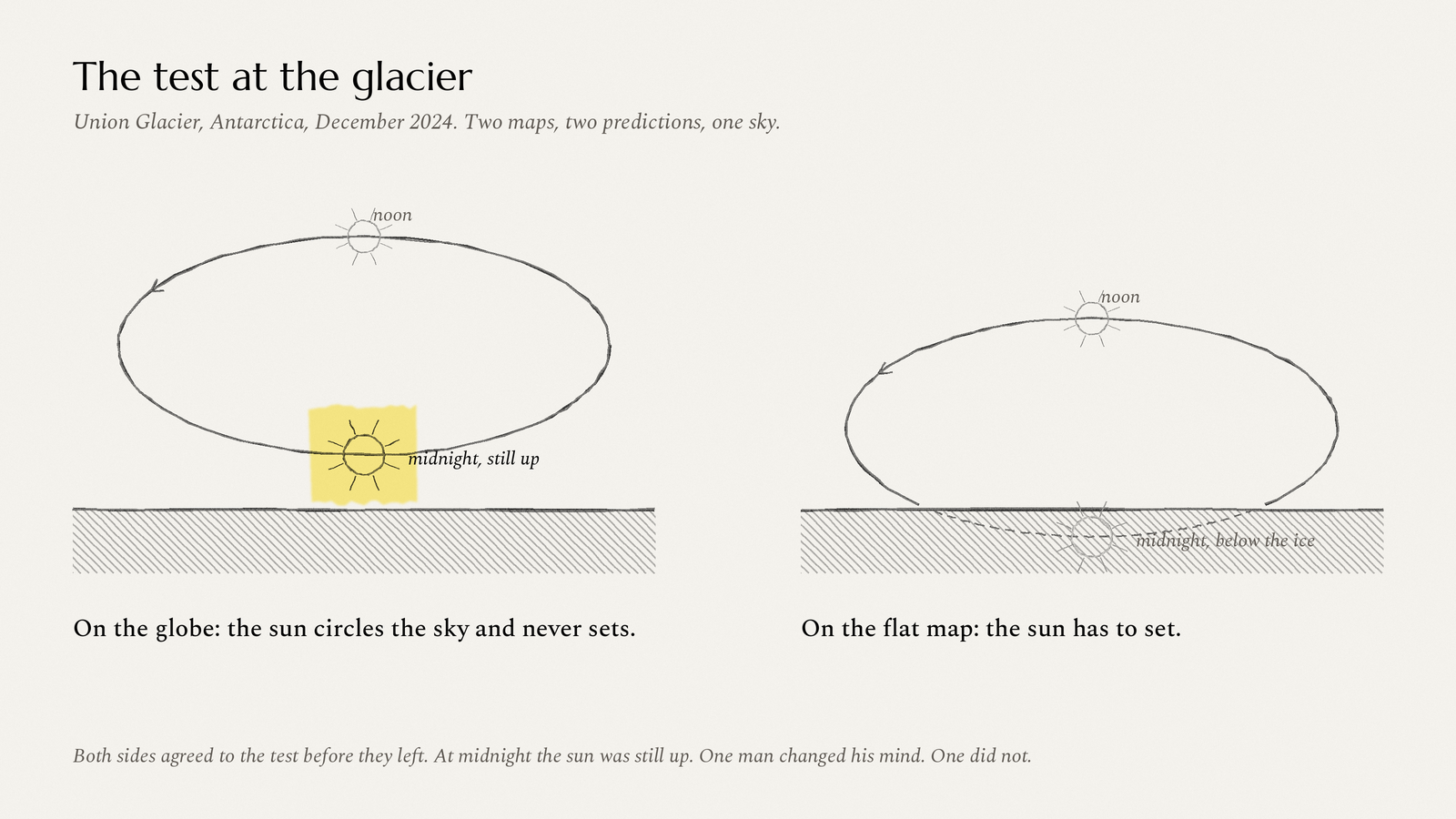
In December 2024 a pastor from outside Denver took a group of flat-earthers to Antarctica to look at the sun. He paid the travel and equipment of four of them himself. [2] By his account, both sides had agreed on the test before they left. On the usual flat-earth map, Antarctica is a wall of ice around the rim of the world, and nowhere in the far south can the sun stay up for twenty-four hours. On a globe, in the southern summer, it does. So they went south, and at midnight the sun was still up, circling the sky.
One of them had spent years making flat-earth videos. He said on camera that sometimes you are wrong in life, and that he had thought there was no twenty-four-hour sun. [3] Within weeks he said he was stepping away from the movement. [3] Another man in the group accepted the sun, kept the belief, and by spring was working on a new model that could hold both. [4]
Decades of photographs from orbit had not done what that trip did for one man. And the trip did nothing for the other. The difference between those two men is what this essay is about.
The clever argument
In a short video published in July 2026, the physicist Brian Cox takes on a flat-earth argument. [5] If the Earth spins once a day and also goes around the sun once a year, then six months from now the side facing the sun at noon should be facing away. Noon should have become midnight. It has not. So the Earth does not move, and the four minutes a day that astronomers add to the day are a patch to save the theory. Cox called the argument clever, and it is. The answer is that the four minutes are not a patch. They are the thing being observed. The Earth takes about twenty-three hours and fifty-six minutes to turn once against the stars, then about four minutes more to bring the sun back overhead, because it has moved a little way along its orbit in the meantime. The flat-earther saw something real and put it in the wrong frame.
Cox says one more thing in the clip, and it matters more than the astronomy. “These people,” he says, “they’re not idiots. What they’re doing is focusing on one thing ... and then being suspicious about the rest.” [5] That is further than the evidence side usually gets. He grants the man his intelligence, and he names the suspicion. Notice where he stops. The suspicion is treated as a habit of mind, a fault in how the man looks at things, and that is where it is left. Nobody asks what the rest is, who supplied it, or why the man stopped taking their word for it. The rest is everything he was asked to believe on someone else’s say-so. That is the question this essay is about, and the four minutes cannot answer it.
What happens next for the person Cox is answering is usually nothing. It is likely as hard for a flat-earther to fathom what Brian Cox is saying as it is for Brian Cox to fathom what the flat-earther believes. They are looking at the same sky through two different instruments.
Cox decides what is true the way a scientist does. Run the test. If anyone who runs it gets the same answer, the claim stands, no matter who made it. A bishop and a clerk look through the same telescope and see the same moon. That is the beauty of the method. It swaps the question of whom to believe for a question anyone can settle. But most people will never run the test. They take it on faith that the people who ran it did it honestly. The method does not get rid of trust. It moves it, from the man making the claim to the people running the test.
The flat-earther decides what is true the older way. He believes what he can see with his own eyes, and what people he trusts have seen with theirs. That is how most people have decided most things for most of history, and it works until the thing in question is too big to see from where you stand. Then it comes down to one question: do you trust the people who say they saw it? He has decided he does not. So Cox’s explanation arrives from the one source he has already ruled out. He is wrong about the sky; the four minutes prove it. But the four minutes cannot reach the real disagreement, which is not about the sky at all. The two men disagree about what counts as a reason to believe something.
The script
For a hundred and fifty years the people with the evidence have answered flat-earthers by supplying more of it. That is understandable, since evidence is what they have, and it is right, since the evidence is true. It has also not ended the movement. In 1870 a flat-earther bet five hundred pounds that six miles of canal would show no curve. He lost in front of an agreed umpire, and spent the next five years accusing the winner of fraud. [6] In the 2018 documentary Behind the Curve, flat-earthers test a gyroscope sensitive enough to feel the Earth turn. It shows fifteen degrees of drift an hour, exactly what a turning Earth should give. The man running it says on camera that they were “not willing to accept that,” and they go looking for another cause of the drift, in the heavens rather than in the Earth. [7] The reading was accepted. The explanation was moved somewhere nobody could check.
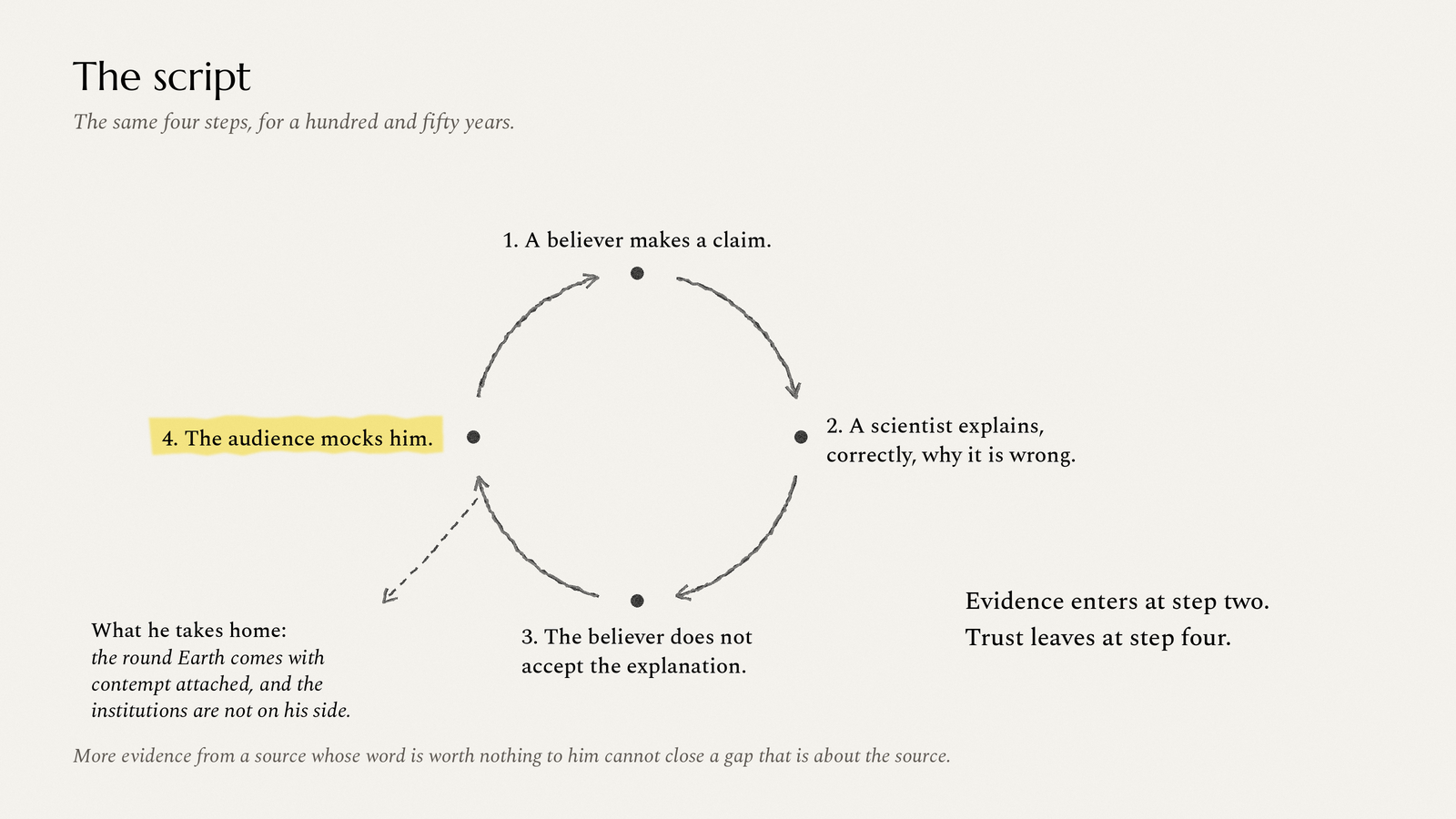
The pattern is so regular it can be written as a script. A believer makes a claim. A scientist explains, correctly, why it is wrong. The believer does not accept the explanation. The scientist, or more often the scientist’s audience, mocks him. The believer goes home having learned two things: that the round Earth comes with contempt attached, and that the people who hold it were never going to take him seriously. Both confirm the one thing he was already sure of. The institutions are not on his side.
This is not a claim that evidence never works. On most questions, for most people, a correction moves them a little toward the fact. [8] The flat-earther who is still a flat-earther is the limiting case. The correction reaches him from a source whose word is worth nothing to him, and more evidence from that source cannot close a gap that is about the source.
Being right is necessary. It is not the same as being believed.
Held on credit
Here is the fact the whole debate keeps walking past. Nobody checks that the Earth is round. A few hundred people have seen it from orbit. Everyone else holds it the way they hold most of what they know: on credit. School said so. The map says so. The pilot, the satellite that finds the phone, every government on Earth. [9] It may be the most institutional fact there is, believed by nearly everyone and checked by nearly no one. That is assumed trust, in its purest form.
The flat-earther has called in that credit, and the record shows he did not start with the Earth. When researchers interviewed thirty people at the first flat-earth conference in 2017, the lead researcher later said that twenty-nine had come to it through YouTube, and most had got there from videos about other things first: the moon landings, the attacks of 2001, a school shooting. [10] The flat earth was the last thing their distrust reached, not the first. That is how credit works. It is not withdrawn one fact at a time. It is withdrawn from the lender, and then everything that lender ever supplied comes due at once.
What replaces it is the oldest rule there is: believe what you can see. The horizon looks flat. Water lies level. A man who keeps that rule, and lets the horizon decide what he looks at, will reason his way to a flat earth honestly, from the only evidence he still accepts. He is a skeptic with the institutions taken out. The religious believer in the movement, and there are many, has not stopped trusting either. He has moved his trust from the agency to the book. The question was never whether a person trusts. It is whom.
Notice how little rides on this. No policy turns on the shape of the Earth, and nobody’s health does. What a believer has at stake is social: a community, a standing in it. Those are stakes in belonging, not in the fact. Take them out and what is left is the mechanism by itself. It does not stay where it costs nothing.
The bill
In 2020 the United States ran a crash program for a vaccine. What follows is an anecdote, not a measurement, and it should be read as one. In September 2020, with the trials still running, one host of The View said she would take the vaccine after the president’s daughter took it, and another asked whether the agency that approves vaccines had been politicized so a vaccine could appear right before the election. [11] Fourteen months later, with a different hand on the same agency and the same vaccine, the same table told an unvaccinated guest that she was putting her personal freedom ahead of other people’s safety, and that the show should not allow such misinformation on its air. [12] The hosts were not lying in either year, and this essay does not say they were. This author reads the contrast as inferred trust, sensitive to whose hand is on the institution. KFF polling also found partisan differences. That September, 85 percent of Democrats and 35 percent of Republicans worried that political pressure would rush FDA approval before a vaccine’s safety and effectiveness had been established. That concern about approval was not itself a refusal to be vaccinated. By October 2021, party identification, including independents who leaned toward a party, was the strongest predictor among the variables KFF modeled of whether an adult reported receiving at least one dose. [13] Those were different questions in different samples. They did not show the same people reversing their trust, or establish that a change of administration caused anyone to do so.
Opinion 1. Unlike the flat earth, this one came with a bill. A study linked 538,159 all-cause deaths during 2018–2021 among voters aged 25 or older in Florida and Ohio to their 2017 Republican or Democratic voter records. The two groups’ excess death rates were similar before vaccine eligibility widened. In the period from spring through the end of 2021, after eligibility opened to all adults, the adjusted excess death rate among Republican voters was 43 percent higher than among Democratic voters. The difference was primarily seen in Ohio. [14] The study had no individual vaccination or trust data and did not establish what caused the gap. The reading is this author’s: trust may be part of the explanation, but these results do not prove it.
The age of AI
The earlier essays argued that trust in AI is checked now, not assumed. [1] The machines that answer questions are the biggest institution of evidence ever built. Ask one why the Earth is round and it gives the Cox answer at once, to anyone, for nothing. By this essay’s argument, that is the problem, not the cure. A model has no name, no money at risk, no test it agreed to beforehand, and no sun to stand under. And because the machines are built to agree, as an earlier essay argued, each side will rent its own expert, and the argument in the language of evidence becomes free, instant and endless. The believer’s rule, believe what you can see, will break where it is weakest, in anything that arrives on a screen, once a video of a midnight sun can be made in an afternoon by someone who has never seen one. For anyone not standing under the sun, which is nearly everyone about nearly everything, what is left is the oldest question: whom do I trust. The age of AI does not make the flat-earther a relic. It makes him a preview.
Opinion 2. The obvious answer is to forbid it. Build the machines so they will not help anyone argue against what science has settled. This author thinks that cure is worse than the disease. Most of what the method can address is not settled, and the line between settled and open is a judgment that has been wrong before. A rule against questioning settled things is a rule against the method, enforced by a company. Worse, it puts the labs in the chair of deciding what is true for everyone who asks, which is the one chair no institution of evidence should want, because it turns a trust problem into a power problem. A machine that refused the flat-earther would not persuade him. It would confirm everything he already thought about the people behind it.
What stands between
The pastor had three things no space agency has: a name, his own money on the line, and a test agreed before anyone knew the result. Then he stood under the same sun. One man changed his mind and one did not, so that is not a recipe. But it is the whole difference between evidence about the fact and evidence about the people, and trust is built on the second. None of it made the pastor right. It made him answerable, and that is what a person needs before he will believe.
Opinion 3. That is what stands between institutions of evidence and institutions of belief. Not a fact; nobody is short of facts. Being right is necessary. It is not the same as being believed. The institutions cannot take everyone to the pole, and they cannot make anyone trust them. What they can do is stop handing the other side its evidence: the explanation offered as if it settled the matter, and the contempt that follows when it does not. Under inferred trust, both get read.
What would an institution have to do to earn your trust back? Share your view in the comments. Subscribe free to On Borrowed Times for more essays on institutions, merit and AI.
References
Earlier essays in this series: “Data Centers Have Exposed Big Tech’s Trust Deficit,” October 2026, https://johnelijah1.substack.com/p/data-centers-have-exposed-big-techs, and “Trust in AI Is Checked Now, Not Assumed,” October 2026, https://johnelijah1.substack.com/p/trust-in-ai-is-checked-now-not-assumed
The Final Experiment, official site (FAQ on the organizer, Union Glacier camp and the proposed test); Will Duffy interviewed in the Denver Post, January 17, 2025, https://www.denverpost.com/2025/01/17/flat-earth-final-experiment-antarctica-will-duffy/ (Duffy paid the travel and equipment of four participants; four flat-earth believers and four globe believers took part).
Jeran Campanella, on camera at Union Glacier, in “It’s Midnight in Antarctica!”, December 2024; his intention to step away from the movement is reported in the Denver Post interview cited in [2].
Austin Whitsitt, “Aether Cosmology and The Final Experiment,” The Way Forward podcast, episode 168, May 28, 2025, https://thewayfwrd.com/podcast/ep-168-aether-cosmology-and-the-final-experiment-with-austin-witsit/
Brian Cox, clip published on YouTube, July 29, 2026, https://youtube.com/shorts/VQcb4-JD0s8. Both remarks quoted in the essay, that the argument is clever and that these people are not idiots, are in the clip. The uploader credits a 2016 National Gallery conversation as the source of the footage; the recording date has not been independently confirmed.
Alfred Russel Wallace, My Life: A Record of Events and Opinions (Chapman and Hall, 1905), vol. II, pp. 364–374, https://darwin-online.org.uk/converted/Ancillary/1905_Wallace_A237/1905_Wallace_A237.2.html; Wallace, “The Hampden-Wallace Libel Case,” 1875, https://people.wku.edu/charles.smith/wallace/S248B.htm; the 1870 wager documents, https://people.wku.edu/charles.smith/wallace/S162-163.htm. The “five years” is Wallace’s own count in the 1875 statement.
Behind the Curve, directed by Daniel J. Clark, 2018; the gyroscope scene at about 49:21 and 49:56.
Thomas Wood and Ethan Porter, “The Elusive Backfire Effect: Mass Attitudes’ Steadfast Factual Adherence,” Political Behavior 41 (2019): 135–163, https://doi.org/10.1007/s11109-018-9443-y (five experiments, more than 10,100 participants, fifty-two issues, no issue on which the correction on average produced a backfire); Asheley R. Landrum, Alex Olshansky and Othello Richards, “Differential Susceptibility to Misleading Flat Earth Arguments on YouTube,” Media Psychology, 2021 (greater science knowledge reduced susceptibility, including among the conspiracy-minded). The conclusion that facts alone do not move a denier and engagement can is also Lee McIntyre’s, in How to Talk to a Science Denier (MIT Press, 2021), from the 2018 Flat Earth International Conference.
The credit analogy for knowledge is William James’s, in Pragmatism, lecture VI, 1907; the point that the ordinary person holds the round Earth on the word of specialists was made by George Orwell in “As I Please,” Tribune, December 27, 1946.
Asheley Landrum, interviewed in The Guardian, “Study blames YouTube for rise in number of Flat Earthers,” February 17, 2019, https://www.theguardian.com/science/2019/feb/17/study-blames-youtube-for-rise-in-number-of-flat-earthers; Alex Olshansky, master’s thesis on flat-earth beliefs, Texas Tech University, 2018 (the interview study).
The View, ABC, September 2020. Joy Behar: “I will take the vaccine after Ivanka takes it,” reported by Mediaite, September 10, 2020, https://www.mediaite.com/tv/ivanka-trump-says-shell-take-coronavirus-vaccine-live-on-the-view-after-joy-behar-challenges-her-to-take-it/; Sunny Hostin, on the FDA having “been politicized” and whether a vaccine would be made available “right before the election,” September 9, 2020, as reported at https://dailycaller.com/2020/09/09/sunny-hostin-invokes-tuskegee-experiments-black-community-shouldnt-trust-trump-vaccine
The View, ABC, November 16, 2021. Sunny Hostin to an unvaccinated guest host: “I don’t understand why you would prioritize your personal freedom over the health and safety of others,” and “I don’t think we should allow this kind of misinformation on our air,” reported by Mediaite, https://www.mediaite.com/tv/the-view-goes-off-the-rails-after-jedediah-bila-defends-vaccine-mandate-opposition-youve-been-at-fox-tv-too-long/
KFF Health Tracking Poll, August 28 to September 3, 2020, “Most Americans Worry Political Pressure Will Lead to Premature Approval of a COVID-19 Vaccine,” September 10, 2020 (62 percent worried overall; 85 percent of Democrats, 35 percent of Republicans); KFF COVID-19 Vaccine Monitor, “The Increasing Importance of Partisanship in Predicting COVID-19 Vaccination Status,” November 16, 2021 (survey of October 14 to 24, 2021; partisanship the strongest predictor of vaccination among the variables modeled).
Jacob Wallace, Paul Goldsmith-Pinkham and Jason L. Schwartz, “Excess Death Rates for Republican and Democratic Registered Voters in Florida and Ohio During the COVID-19 Pandemic,” JAMA Internal Medicine, 2023, https://doi.org/10.1001/jamainternmed.2023.1154 (538,159 deaths, 2018 to 2021; the 43 percent is the relative difference in excess death rates after April 1, 2021). The step from the Antarctic expedition to a lesson for public health was drawn earlier by Garrett Hollembeak, “What Flat Earthers Can Teach Public Health Experts,” Infection Control Today, March 6, 2025.
Facts are sourced. Opinions are marked.