AI Won’t Land in the Middle. Someone Has to Put It There.
The Economist says artificial intelligence will settle somewhere between utopia and disaster. The middle is not a place. It is a set of decisions, and the loudest voices in the debate are not the ones making them.
 John ElijahFreely accessible
Listen
The recording is temporarily unavailable. You can continue reading below.
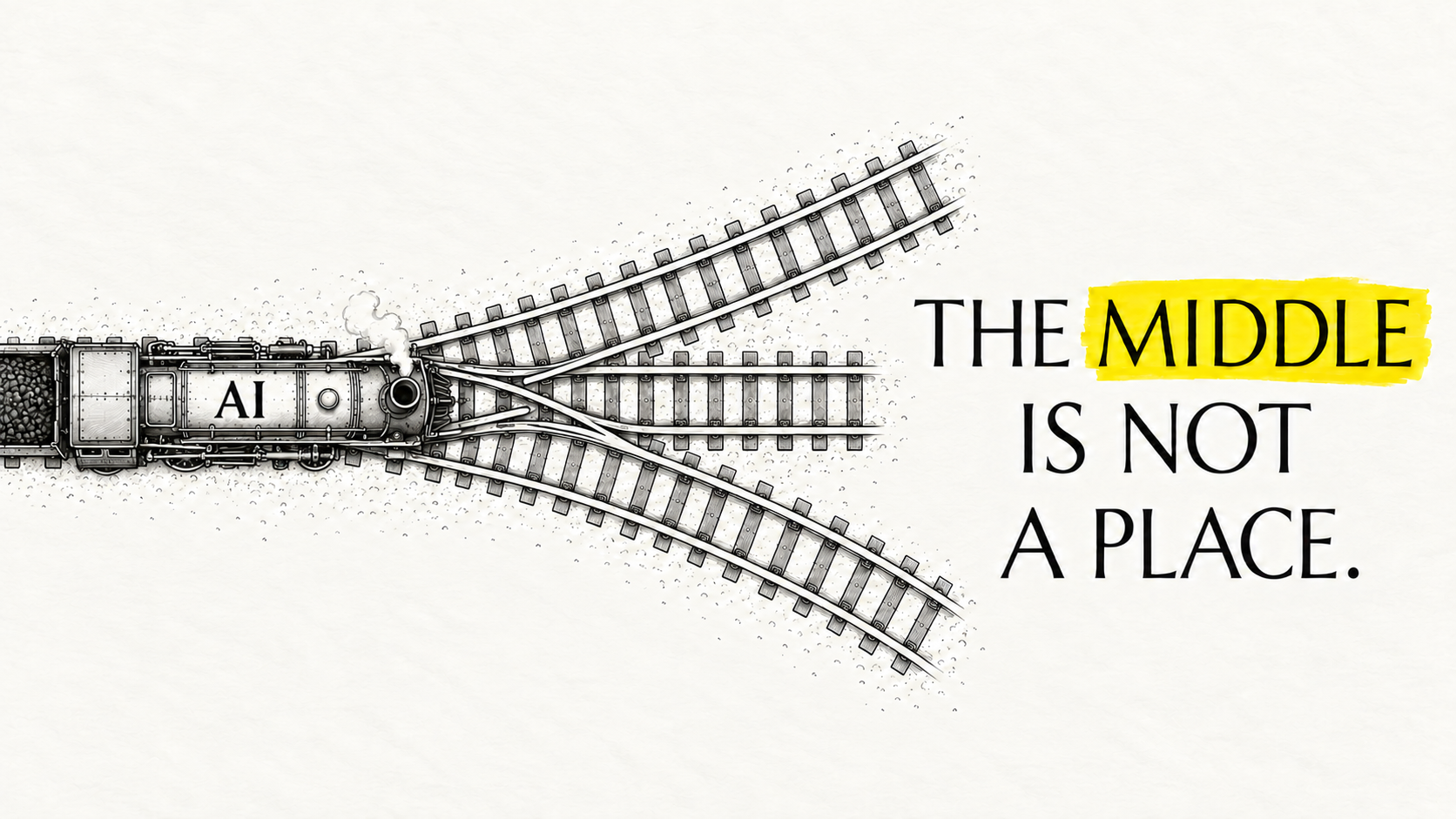
The Economist has a verdict on artificial intelligence. “In all probability,” its new film concludes, “the future will be more of a middle ground” [1]. Not the boom the optimists promise, not the collapse the alarmists fear, but something in between. The three minutes before that sentence are a stack of forecasts. A 5 percent chance of catastrophe by 2100. Nearly 70 percent rating good outcomes likelier than bad. Annual growth that could exceed 20 percent. An AI Chernobyl, paper clips, a lab at MIT, pupils in Nigeria. Then the middle, offered as the sober view.
It is not sober. It is comfortable. The verdict has two problems, and this essay is about both. The first is that “the middle” is not a place. The second is that nothing lands there on its own. The film mentions state intervention and a redesigned economy, briefly and only under its darkest scenario [1]. It does not say who would decide any of that, or how.
Start with the first. “The middle” sounds like one outcome. It is a very large space, and it holds very different arrangements. Electricity landed in the middle. So did the automobile, the airplane, and the prescription drug. Those are four different middles, and the differences are the whole story. Electricity in the United States became a regulated utility: the traditional arrangement gave a company a monopoly in its territory in exchange for an obligation to serve and rates set in public [2]. The automobile became a product anyone could buy, with the costs pushed onto roads, rules, and licenses. The manufacturer’s liability came later: in 1916 for a car negligently built, and in 1968 for a design that made a crash worse than it needed to be [3][4]. Aviation became tightly supervised, because its failures could kill many people at once [5]. The new prescription drug, in the United States, generally cannot be sold until a regulator has reviewed evidence that it is safe and that it does what its maker claims [6].
Each of those middles was a set of answers to the same questions. Who is liable when it goes wrong? What must be disclosed, and to whom? Who is allowed to check? Who pays for the harms the market does not price? The answers were different in each case, and they were written down by people, usually after something went badly. None of the four middles was the arithmetic difference between hope and fear. Each was a design.
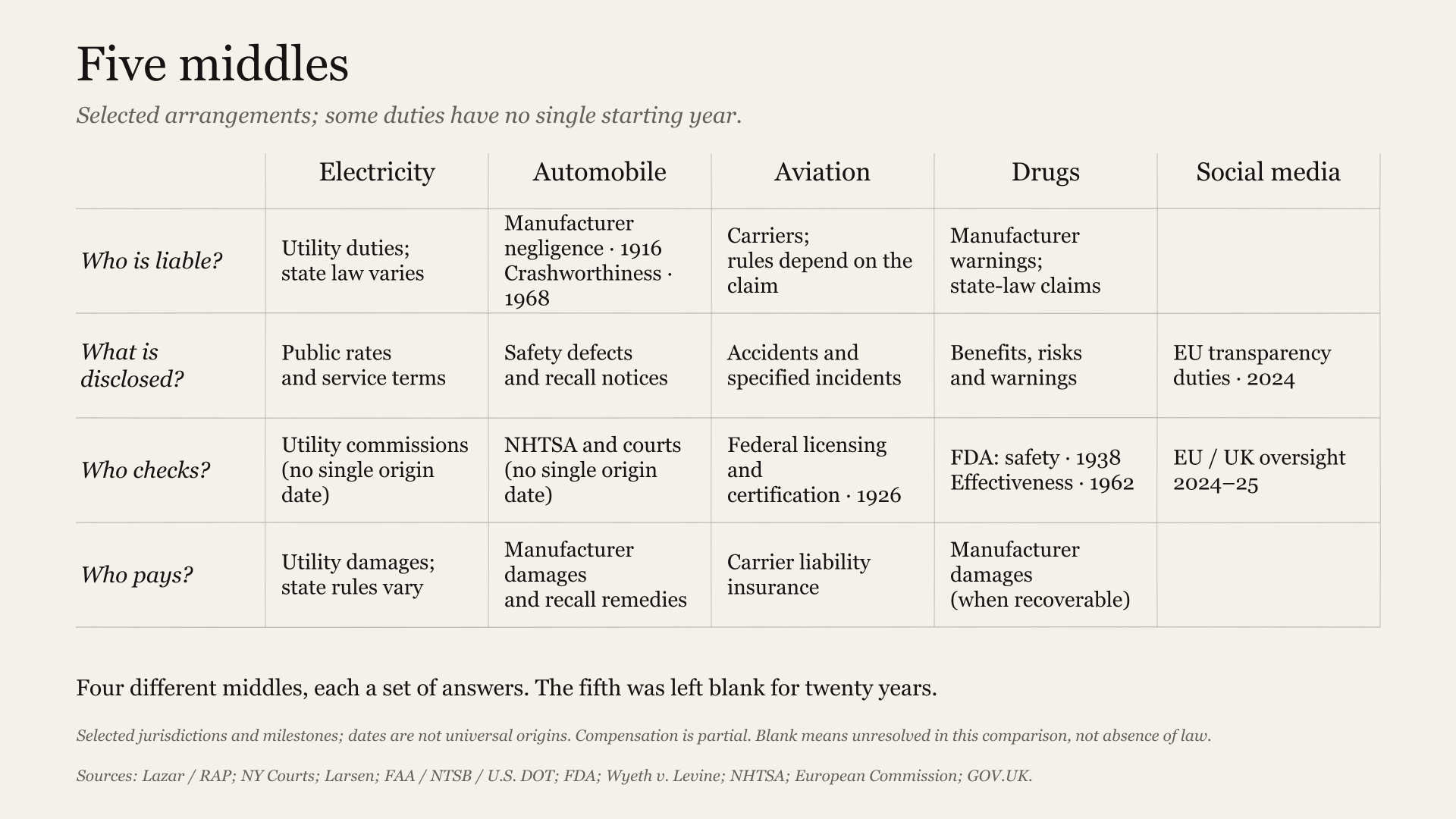
Selected jurisdictions and milestones; dates are not universal origins. Compensation is partial. Blank means unresolved in this comparison, not absence of law.
Sources: Lazar / RAP; NY Courts; Larsen; FAA / NTSB / U.S. DOT; FDA; Wyeth v. Levine; NHTSA; European Commission; GOV.UK.
Social media is the fifth case, and the one that should trouble The Economist’s confidence. By the forecaster’s standard, it too landed in the middle. The world did not end and the world was not saved. But social media grew under rules that left its effects on children inadequately checked [7]. Some of that is changing. State attorneys general have sued Meta over alleged harm to minors, Europe and Britain have written duties into law, and Australia has set a minimum age for social media accounts [8][9][10][11]. But those answers arrived after a generation grew up inside the product, and they are still being argued over. The middle social media reached was what the incentives built while public safeguards lagged, and the repair work came late and expensive. If “somewhere in the middle” includes that, the phrase tells a reader only that the world will probably not end. That is a low bar for a forecast.
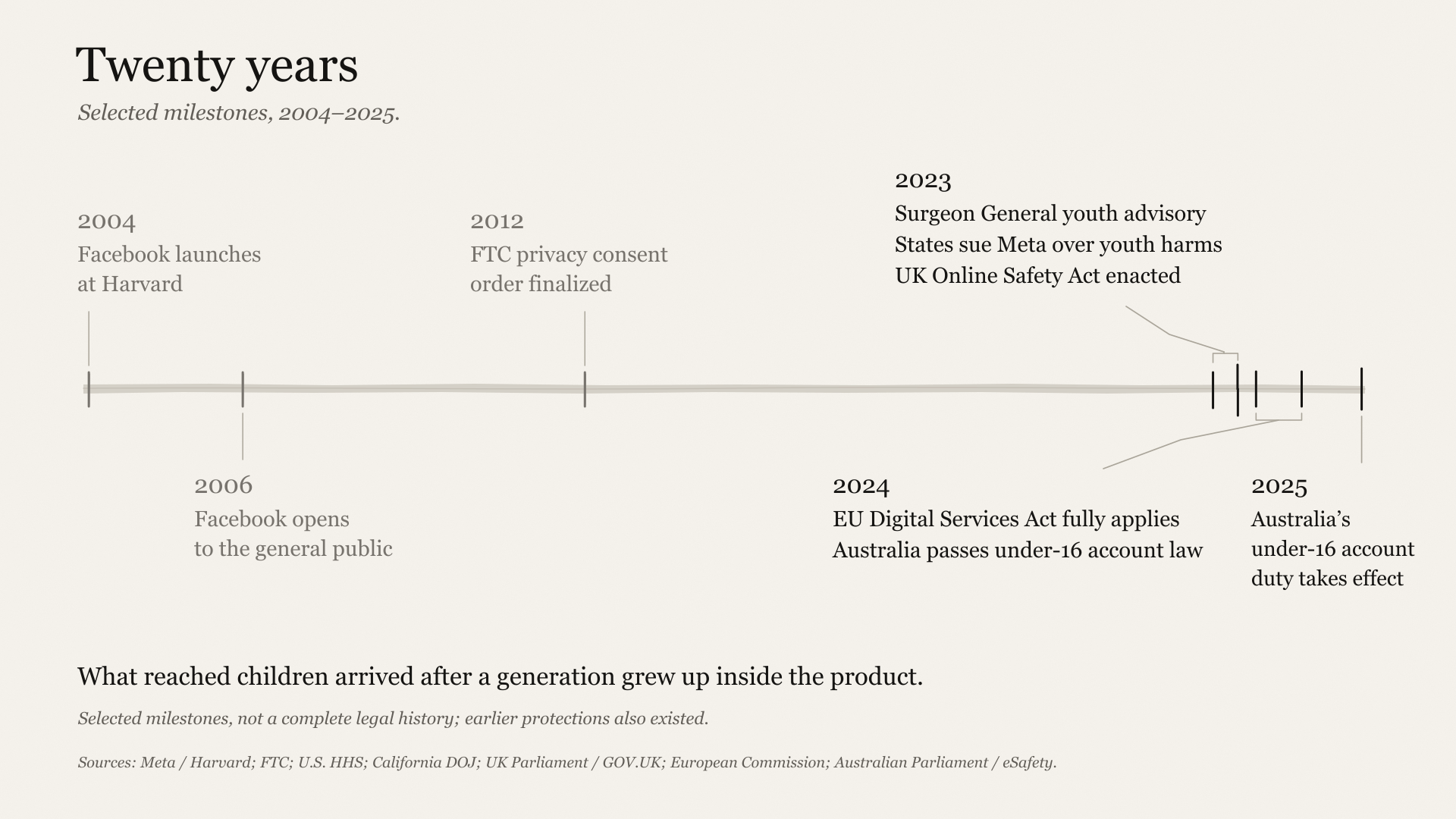
Selected milestones, not a complete legal history; earlier protections also existed.
Sources: Meta / Harvard; FTC; U.S. HHS; California DOJ; UK Parliament / GOV.UK; European Commission; Australian Parliament / eSafety.
So the question is not whether AI will land in the middle. It is which middle, and who decides. That is a harder conversation than the one most people hear, and it is worth being clear about why they do not hear it. The voices with the bullhorns fall into three camps: hope, fear, and the shrug. Each camp has a reason to hold its view, and the reasons are not hidden.
Hope and fear are both broadcast, loudly and often, from the same place: the frontier labs, the companies building the most capable models. The film places these views side by side. It opens by saying “even the tech bros can’t agree.” It then plays one of them calling AI “hugely positive” and another giving “a 25 percent chance that things go really, really badly.” Later, it attributes the bleakest scenario to “Silicon Valley’s warnings that state intervention and perhaps a universal basic income will be necessary” [1]. This is not a contradiction. Both stories serve. Fear says this technology is dangerous enough to need strict control. Rules built on that premise, if they fall on newcomers and on models anyone can download and run, would favor the established labs. Hope says the gains are so large that anything slowing them is a cost the country cannot afford. A lab can hold both views sincerely. It can also notice that each one, in its own way, argues for the lab’s position. This essay does not claim anyone is lying. It claims the interest is visible, and that a reader should keep it in view.
The shrug belongs to the commentators, and it is comfortable for a reason: it cannot be wrong. Nobody will come back in ten years to say the middle failed to arrive.
The harder conversation is happening. Standards bodies, state legislatures, researchers who test these systems for a living, and a few courts are having it now, mostly without bullhorns [12]. What is missing is not the conversation but its volume, and the fact that the people who can check a claim are not the people the public hears most. Auditors who can test a safety claim. Standards that an outside party can measure a system against. Disclosure that someone other than the company can verify. Courts, when the rest fails. In the four older cases, those were the people who built the middle. In the AI debate they are the quiet part. The loud part goes on among parties none of whom can know the answer, about a future that depends on what the quiet part does.
The Economist offers one reason the fear is overdone that deserves its own paragraph: “People like having human interaction, so it’s unlikely that all jobs will disappear” [1]. The preference is real. It is not a guarantee for particular workers. Automation changed banking, travel booking, and retail without eliminating the teller, the travel agent, or the cashier, and without protecting the particular people whose jobs went [13]. Wanting something is not the same as being protected from losing it. A forecast that rests on what people prefer, rather than on what anyone is required to do, rests on very little.
None of this is an argument against AI, and this author has made that point before [14]. AI is here, it is not going away, and a country that throttles it too hard pays for that in security and in its economy. The labs will talk, and they should; they hold most of the information. The problem is not that they speak. It is that they hold crucial information that outsiders cannot yet fully check. Twenty years of social media spent the trust the technology industry used to get for free. Trust in these companies is no longer assumed. It is inferred, from what can be checked, and right now very little can be [15]. The data-center fights showed that deficit in public [16].
So “building the middle” is not a slogan, and it is not a call to slow anything down. It means four plain things. A claim about safety or capability should be testable by someone outside the company that makes it. There should be a standard to test it against that was not written by the company alone. What a system does with a person’s data, and what it is doing to the person, should be disclosed in a form a regulator or a researcher can verify. And when those fail, there should be a court that can hear it. The four older industries each acquired some combination of those safeguards, in different measures and on different timetables. The only question with AI is whether it gets its own early, when it is cheap, or late, when it is expensive and many of the harms are built into how the system works. This author has argued elsewhere that institutions which wait to correct a drift pay far more to reverse it than they would have paid to prevent it [17][18]. There is no reason to think this case is different.
The onus here does not belong on individuals, who cannot see what the systems do, and it does not belong wholly on the labs, who cannot be both the player and the referee. It belongs on the institutions that use AI on people, on the bodies that exist to check them, and on the lawmakers who decide what those bodies are allowed to check. That conversation is quieter than hope, fear, and the shrug, and it will stay quieter, because it is about rules and tests rather than futures. It is the one that decides which middle society gets.
AI will not land in the middle. Someone has to put it there, and the choice of which middle is being made now, by whoever shows up.
References
[1] The Economist, “Will AI cause utopia or disaster?”, video, YouTube, accessed 26 October 2026. https://www.youtube.com/watch?v=QEUTgbVhX_o
[2] Jim Lazar, Electricity Regulation in the US: A Guide, Regulatory Assistance Project, March 2011, section 2.4, “The So-Called Regulatory Compact,” p. 6. https://www.raponline.org/wp-content/uploads/2023/09/rap-lazar-electricityregulationintheus-guide-2011-03.pdf
[3] MacPherson v. Buick Motor Co., 217 N.Y. 382, Court of Appeals of New York, decided 14 March 1916. https://www.nycourts.gov/reporter/archives/macpherson_buick.htm
[4] Larsen v. General Motors Corp., 391 F.2d 495, U.S. Court of Appeals for the Eighth Circuit, decided 11 March 1968. https://openjurist.org/391/f2d/495/larsen-v-general-motors-corporation
[5] Federal Aviation Administration, “A Brief History of the FAA.” https://www.faa.gov/about/history/brief_history
[6] U.S. Food and Drug Administration, “Milestones in U.S. Food and Drug Law,” entries for the Federal Food, Drug, and Cosmetic Act of 1938 and the Kefauver-Harris Amendments of 1962. https://www.fda.gov/about-fda/fda-history/milestones-us-food-and-drug-law
[7] Office of the U.S. Surgeon General, “Social Media and Youth Mental Health,” advisory, 2023. https://www.hhs.gov/surgeongeneral/reports-and-publications/youth-mental-health/social-media/index.html
[8] Office of the New York State Attorney General, “Attorney General James and Multistate Coalition Sue Meta for Harming Youth,” announcement, 24 October 2023. https://ag.ny.gov/press-release/2023/attorney-general-james-and-multistate-coalition-sue-meta-harming-youth
[9] European Commission, “The Digital Services Act package,” applying to all platforms from 17 February 2024. https://digital-strategy.ec.europa.eu/en/policies/digital-services-act-package
[10] United Kingdom, “Online Safety Act: explainer,” the Act having passed into law on 26 October 2023. https://www.gov.uk/government/publications/online-safety-act-explainer/online-safety-act-explainer
[11] Australia, Online Safety Amendment (Social Media Minimum Age) Act 2024, No. 127 of 2024, assented to 10 December 2024. https://www.legislation.gov.au/C2024A00127/asmade/text
[12] UK AI Security Institute, Frontier AI Trends Report, December 2025. https://aisi.gov.uk/frontier-ai-trends-report
[13] U.S. Bureau of Labor Statistics, Occupational Outlook Handbook, entries for tellers, travel agents, and cashiers, 2025 employment and 2025 to 2035 projections. https://www.bls.gov/ooh/office-and-administrative-support/tellers.htm; https://www.bls.gov/ooh/sales/travel-agents.htm; https://www.bls.gov/ooh/sales/cashiers.htm
[14] John Elijah, “What The Economist Gets Wrong About AI and Jobs,” 19 October 2026. https://obtimes.com/essays/what-the-economist-gets-wrong-about/
[15] John Elijah, “Trust in AI Is Checked Now, Not Assumed,” 14 October 2026. https://obtimes.com/essays/trust-in-ai-is-checked-now-not-assumed/
[16] John Elijah, “Data Centers Have Exposed Big Tech’s Trust Deficit,” 13 October 2026. https://obtimes.com/essays/data-centers-have-exposed-big-techs/
[17] John Elijah, “The Durable Organization,” 7 October 2026. https://obtimes.com/essays/the-durable-organization/
[18] Governance, Bureaucracy, and Organization: Stewardship, Drift, and Administrative Capacity, Routledge, 2026. https://www.routledge.com/9781041403296