What The Economist Gets Wrong About AI and Jobs
The jobs come back in the totals. They do not come back to the people who lost them.
 John ElijahFreely accessible
Listen to this essay
12 min · AI narration
The recording is temporarily unavailable. You can continue reading below.
The Economist has changed its mind about AI and jobs this year. In May it ran a leader headed “Prepare for an AI jobs apocalypse” [18]. In September it said the apocalypse was postponed and an AI jobs boom had begun [1]. This month it posted a short video. Americans, the video says, are gloomier about their job prospects than at any time since polling began, AI is the main reason, and the video asks whether they are right to worry. Its answer: “For now, try not to worry. The job apocalypse isn’t here yet” [2]. One line of history holds the whole argument up. “If AI were really to put millions of people out of work, it would be unprecedented,” the video says. “New technologies have never before destroyed jobs faster than they produce them” [2]. It is a comforting sentence. It is also not true.
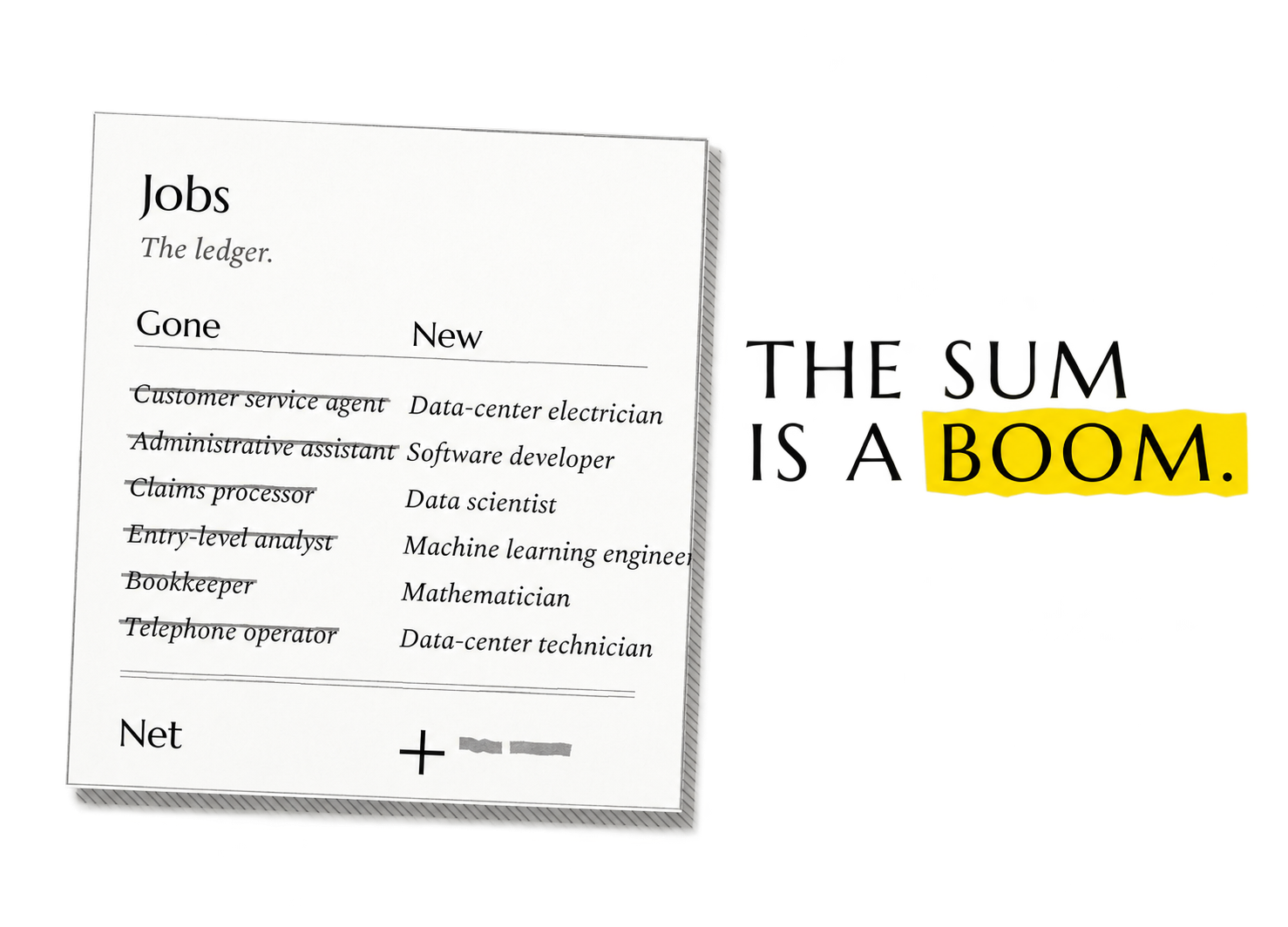
Even where the arithmetic behind the sentence holds, it answers a question nobody asked. The total number of jobs is the one number no person lives in. Technology does not take away totals. It takes particular jobs from particular people in particular places. The jobs it creates go, mostly, to other people, somewhere else, later. The Economist’s own figures show this. It adds up the columns, reports the sum, and stops. The sum is where the argument is safe. The columns are where the people are.
This is not an argument against AI. This author’s view is that AI is a turning point and that there is no going back. It will do a great deal of good and a real amount of harm, and which is larger has not been settled. Nor is this an argument against churn. Jobs end and new jobs start. That is how economies grow, and no serious person wants it stopped. The argument is about the accounting. A technology this large will be trusted only as far as its costs are counted as carefully as its benefits. The Economist is counting the gains and not the losses. It is keeping half the ledger.
Where The Economist is right
The totals do not show a collapse. Unemployment was 4.2 percent in September, and the economy is still adding jobs, slowly [3]. Layoffs blamed on AI are real and rising: about 120,000 announced so far this year, now the most common stated reason for cuts [4]. Employers let go of roughly 1.7 million workers in an ordinary month, so that is still a small number [1]. The Economist’s estimate that AI has created about a million American jobs, against about 200,000 layoffs blamed on AI, may be generous. It is not absurd [1].
The Economist is also right that panics about machines have a poor record. Keynes warned of technological unemployment in 1930. A committee of academics told the White House in 1964 that automation was breaking the link between work and income. Oxford researchers said in 2013 that nearly half of American jobs were at high risk, perhaps within a decade or two [5]. None of it has arrived. Over the long run, the record is one of new work, not no work. About six in ten American jobs in 2018 were kinds of work that did not exist in 1940 [6].
So far, so fair. The apocalypse is not in the data. The Economist says so, and its own words are “postponed” and “for now,” and those two hedges deserve more attention than they get. A postponement is not a cancellation. A law of history that needs “for now” attached to it was never a law. “For now” is not a finding. It is a way out.
Where the line is false
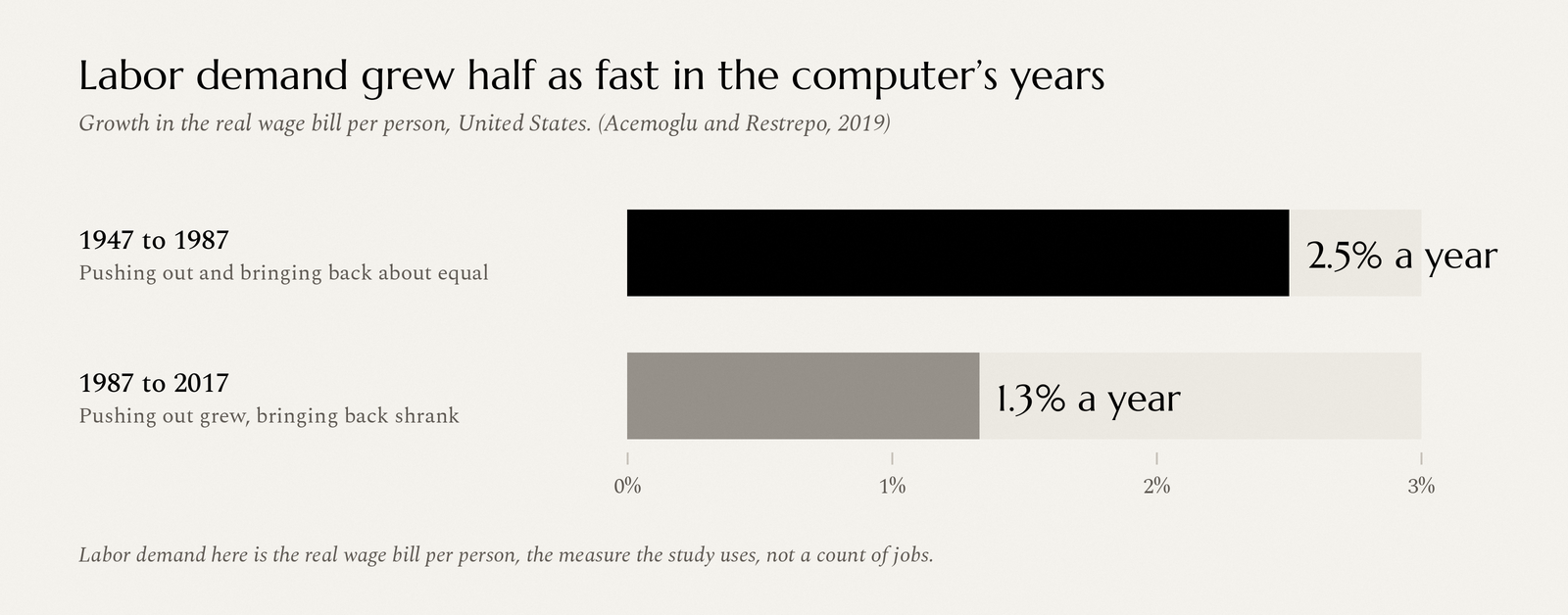
“Never before” is a claim about every technology in every period. It fails on the record The Economist itself relies on. Economists have measured the two forces at work: machines pushing labor out of tasks, and new tasks bringing labor back in. In the United States from 1947 to 1987 the two were roughly balanced. From 1987 to 2017 they were not. The pushing out grew and the bringing back shrank. Labor demand grew at half its earlier pace, and in manufacturing the pushing out alone cut it by nearly a third [7]. That is thirty years, in the largest economy in the world, in which machines removed work faster than they added it. Thirty years is not a rough quarter. It is a working life. The video’s own example is the computer [2]. The thirty years after 1987 are the computer’s years.
Then there is the case The Economist should like best, because the totals came out fine. In the early 1900s, telephone operator was one of the most common jobs for young American women. Between 1920 and 1940, AT&T replaced operators with mechanical switches across more than half the country and ended most of the jobs. The young women who came after found other work, and overall employment did not fall. The women who were operators when the switches arrived had a different outcome. A decade later they were more likely to be in lower-paid work or out of work altogether [8]. The total recovered. The operators did not.
That is the pattern, and it is the pattern inside The Economist’s own September numbers. Since January 2023, customer service employment is down about 10 percent and administrative assistants about 15 percent. Hiring in professional services is running about a tenth below its pre-pandemic average. Meanwhile engineers, developers, and data scientists have added hundreds of thousands of jobs above trend. Installation and maintenance workers at data centers are being offered about 40 percent more than comparable work [1]. The Economist counted those columns, added them up, and called the sum a boom. The sum is a boom. The columns are a transfer from one group of people to another.
Different jobs, different people
This is the point The Economist does not make. David Autor, the MIT economist behind the six-in-ten figure, put it in one sentence: “The real concern is for whom the new work has been created” [9]. Before 1980, new American work appeared mostly in middle-paid production and clerical jobs, the kind an ordinary worker could move into. After 1980 it appeared mostly in high-paid professional work, with low-paid service work second, while the clerical and production jobs in the middle kept being automated away [6]. The clerk whose job was automated was not hired as the software developer. Someone else was, usually younger, usually somewhere else. A net count says how many jobs there are. It does not say who lost one and who got one.
What the displaced lose is known. One study followed men with at least three years on the job who lost it in a mass layoff. On average, counted over the next twenty years, they gave up more than a year of their old earnings when times were good. When times were bad, they gave up nearly three years [10]. A job created in another city, for another person, at another skill level, pays none of that back.
An average is a true number that happens to no one.
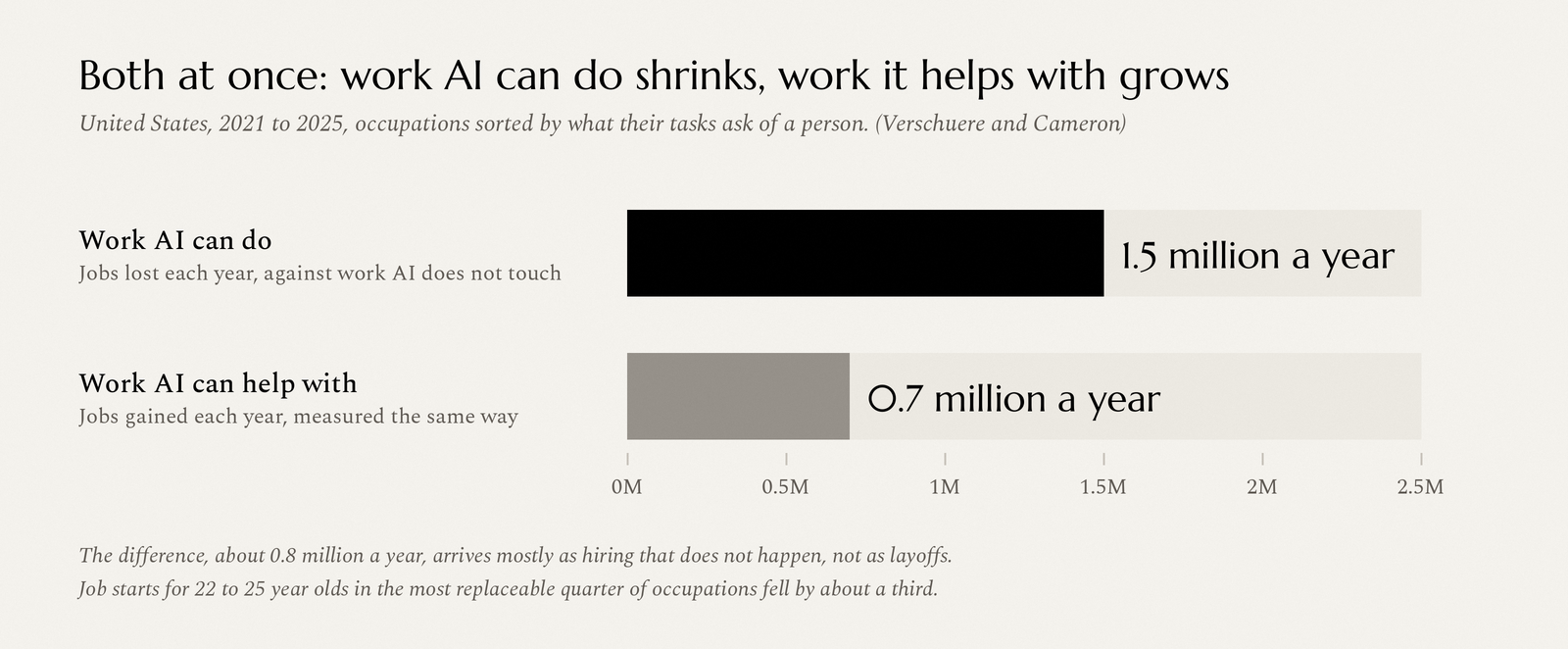
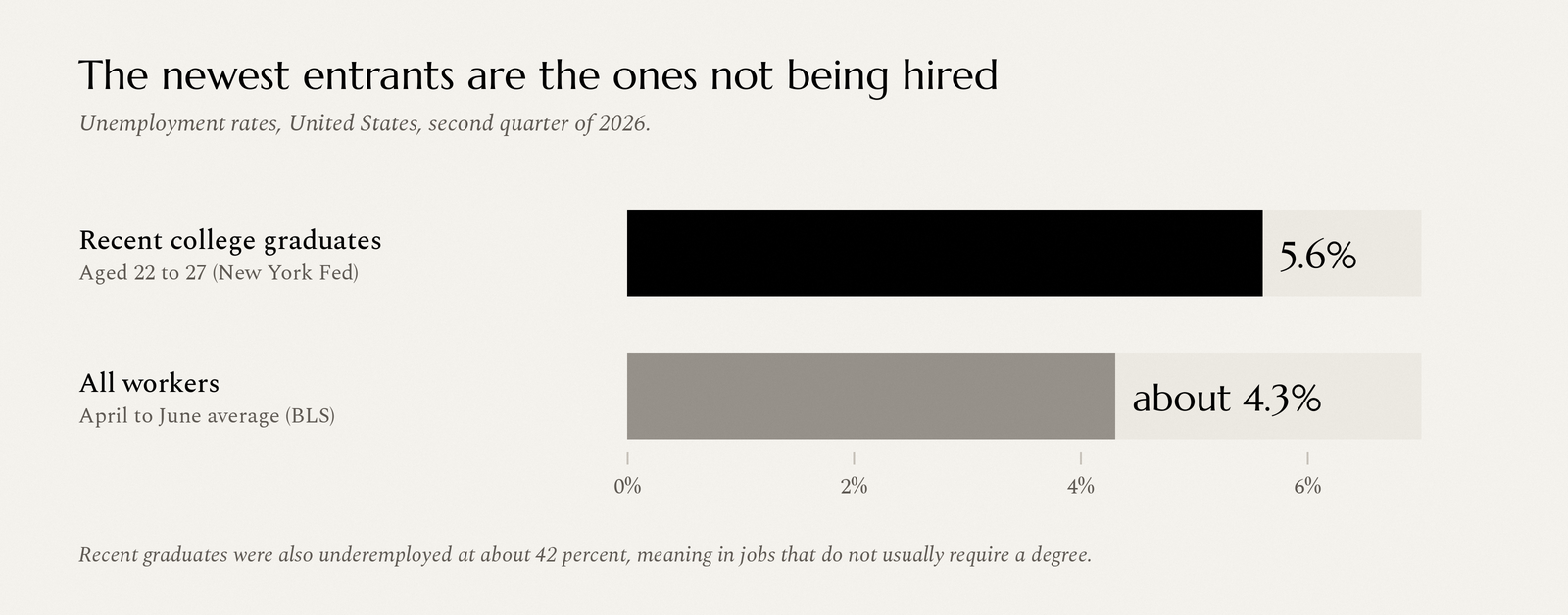
The AI version is already visible to anyone who looks below the average. A study published this month sorted American work into three kinds: what AI can do, what it can help with, and what it cannot touch. Since 2021 the first kind has been shrinking as a share of work and the second growing. The two have moved far enough in opposite directions that the total looks calm. The loss is not arriving as layoffs. It is arriving as hiring that does not happen. Job starts for workers in their early twenties in the most replaceable occupations have fallen by about a third. There is no such drop for the same age group in work AI cannot do [11]. In the second quarter of 2026, recent college graduates were unemployed at 5.6 percent, against about 4.3 percent for all workers in the same months [12][17]. The authors called their study “Hiding in the mean.” The Economist is reporting the mean and calling it the news.
How technology disrupts
The Economist says the fear is overblown because the count is fine. That mistakes what the count measures. A new job replaces a lost one only if it is in the same place, at the same pay, open to the same person, at the same time. Those four conditions are almost never met together. The electrician’s job at the data center is real. It is not the customer service representative’s job, it is not in her town, and she is not an electrician. The loss happens to her in a single quarter. The new job happens to someone else over a decade. Added up across the country and across the years, the two cancel on paper. In the places and the lives where they land, they do not cancel at all.
That is how technology disrupts. Not in totals, but in who, where, when, and at what pay. The question the video’s sentence should raise is the question it never reaches: created for whom, and how long is the gap.
The rate of churn
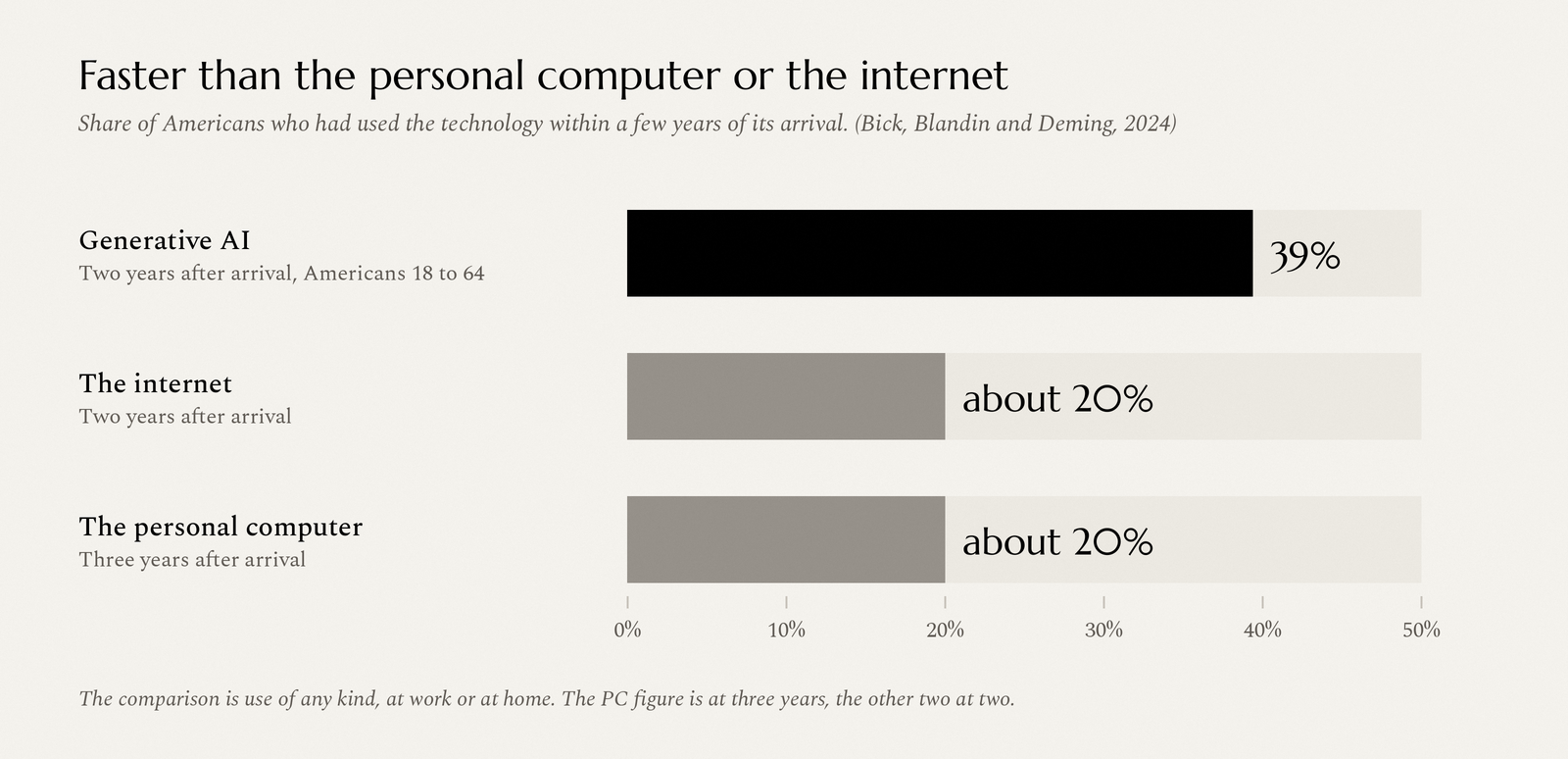
Every past reassurance depended on time. The telephone switches took twenty years to reach half the country, and the operators they displaced were still worse off a decade later. Earlier machines took longer still. People had a working life, or at least a generation, to move. Generative AI is not moving at that speed. Two years after its public debut, about four in ten working-age Americans had used it. That is faster uptake than the personal computer or the internet [13]. The first measurable effects on hiring showed up within three years.
Here the honest statement is a question, not a claim. Nobody knows yet whether the creation of new work has sped up to match. If losses now arrive in quarters and new work still arrives in decades, the totals can hold while the gap widens. The gap is where people live. The old comfort was never that nobody lost. It was that there was time. Whether there is still time is the question to watch, and it is exactly the question a net count hides.
An accounting, not a verdict
The jobs argument has a shape, and The Economist has used it before. In September it called the public backlash against data centers a foolish moral panic, “fuelled by misinformation and misunderstanding” [14]. Some of the water figures in circulation are wrong. Having established that, the piece stopped. It never asked why so many people, across the whole political spectrum, had become angry enough to show up at county hearings. This author gave an answer elsewhere. People used Big Tech’s products for twenty years without trusting the companies, and a data center is the first piece of the AI era they could vote on [15]. Calling a worry a myth does not end it. It tells the worried that nobody is listening.
The same move, made about jobs, will get the same result. People can tell when they are being handed an average. An average is a true number that happens to no one. The customer service representative whose team stopped hiring in 2023 does not need a correspondent to explain that the totals are fine. The totals were never the question. The question is whether anyone is counting. AI has to be trusted if it is to do the good it can do. That takes a fair and open accounting: gains and losses, for whom, where, and how fast. Not a glossed version. Trust does not come from the people who say there is nothing to see. It comes from the people who show the whole count.
The Economist is entitled to its view. It was founded in 1843 to argue for free trade [16], and this author reads its AI coverage as part of that tradition. Being for markets and for new technology is a respectable editorial position. The objection is not to the position. It is to an opinion being dressed up as a fact. “New technologies have never before destroyed jobs faster than they produce them” is not a finding. It is a point of view, delivered in the tone The Economist uses for settled facts, with “for now” added in case the data change. Confidence is the house style. It is not evidence.
The honest version is available, and it is still optimistic. The totals are holding. The losses are falling on the young, the clerical, the customer-facing, and the towns that depend on them. The gains are going to engineers, electricians, and data scientists. History says the totals recover and the displaced mostly do not, and the gap between the two is measured in careers, not quarters. That version lets readers find themselves in the picture. The Economist’s version asks them to take comfort in an average that describes none of them.
The jobs come back in the totals. They do not come back to the people who lost them.
References
The Economist, “The jobs apocalypse is postponed. An AI jobs boom is here,” 4 September 2026. https://www.economist.com/finance-and-economics/2026/09/04/the-jobs-apocalypse-is-postponed-an-ai-jobs-boom-is-here
The Economist, “Are you about to lose your job?” video with Alex Hern, 19 October 2026.
U.S. Bureau of Labor Statistics, “The Employment Situation, September 2026,” released 2 October 2026. https://www.bls.gov/news.release/empsit.nr0.htm
Challenger, Gray & Christmas, “Job Cuts Fall in September; Hiring Plans Up 3% Over 2025,” October 2026. https://www.challengergray.com/blog/job-cuts-fall-in-september-hiring-plans-up-3-over-2025-on-weak-early-seasonal-hiring/
John Maynard Keynes, “Economic Possibilities for our Grandchildren,” 1930; Ad Hoc Committee on the Triple Revolution, memorandum to President Lyndon B. Johnson, 22 March 1964; Carl Benedikt Frey and Michael A. Osborne, “The Future of Employment: How Susceptible Are Jobs to Computerisation?” Oxford Martin School, 2013. https://oms-www.files.svdcdn.com/production/downloads/academic/The_Future_of_Employment.pdf
David Autor, Caroline Chin, Anna Salomons and Bryan Seegmiller, “New Frontiers: The Origins and Content of New Work, 1940 to 2018,” Quarterly Journal of Economics 139, no. 3, 2024. https://www.nber.org/papers/w30389
Daron Acemoglu and Pascual Restrepo, “Automation and New Tasks: How Technology Displaces and Reinstates Labor,” Journal of Economic Perspectives 33, no. 2, 2019. https://www.nber.org/papers/w25684
James Feigenbaum and Daniel P. Gross, “Answering the Call of Automation: How the Labor Market Adjusted to Mechanizing Telephone Operation,” Quarterly Journal of Economics 139, no. 3, 2024. https://www.nber.org/papers/w28061
Peter Dizikes, “Most work is ‘new’ work, U.S. Census data show,” MIT News, 1 April 2024, quoting David Autor. https://news.mit.edu/2024/most-work-is-new-work-us-census-data-shows-0401
Steven J. Davis and Till von Wachter, “Recessions and the Costs of Job Loss,” Brookings Papers on Economic Activity, Fall 2011. https://www.nber.org/papers/w17638
Benjamin Verschuere and Angus Cameron, “Hiding in the mean: AI is adding jobs and removing them at the same time,” VoxEU, Centre for Economic Policy Research, 3 October 2026. https://cepr.org/voxeu/columns/hiding-mean-ai-adding-jobs-and-removing-them-same-time
Federal Reserve Bank of New York, “The Labor Market for Recent College Graduates,” data through the second quarter of 2026. https://www.newyorkfed.org/research/college-labor-market
Alexander Bick, Adam Blandin and David Deming, “The Rapid Adoption of Generative AI,” Federal Reserve Bank of St. Louis, 23 September 2024. https://www.stlouisfed.org/on-the-economy/2024/sep/rapid-adoption-generative-ai
The Economist, “The moral panic over data centres is foolish,” 3 September 2026.
John Elijah, “Data Centers Have Exposed Big Tech’s Trust Deficit,” On Borrowed Time, Substack, 13 October 2026. https://johnelijah1.substack.com/p/data-centers-have-exposed-big-techs
The Economist Group, “About us.” https://www.economistgroup.com/about-us
U.S. Bureau of Labor Statistics, civilian unemployment rate, series LNS14000000, April to June 2026, via FRED, Federal Reserve Bank of St. Louis. https://fred.stlouisfed.org/series/UNRATE
The Economist, “Prepare for an AI jobs apocalypse,” leader, 14 May 2026. https://www.economist.com/leaders/2026/05/14/prepare-for-an-ai-jobs-apocalypse