The Posting Has Outgrown the Job
Every hire fills a hole. The posting has stopped describing it.
 John ElijahFreely accessible
Listen to this essay
11 min · AI narration
The recording is temporarily unavailable. You can continue reading below.
Every hire begins with a hole. Someone left, or the work grew past the people who were doing it. Before anyone writes a word, the hole has a shape. It is the work that is not getting done, and that work has edges.
The last essay argued that companies have never described the person they want more exactly, or known less about whether they got one. This one is about an earlier step. Before a company can check whether it filled the hole, it has to describe the hole. That is the step that has quietly stopped working. The posting is meant to trace the shape of the gap. Past a certain line, it traces something else.
Deep and wide
Gaps come in two shapes.
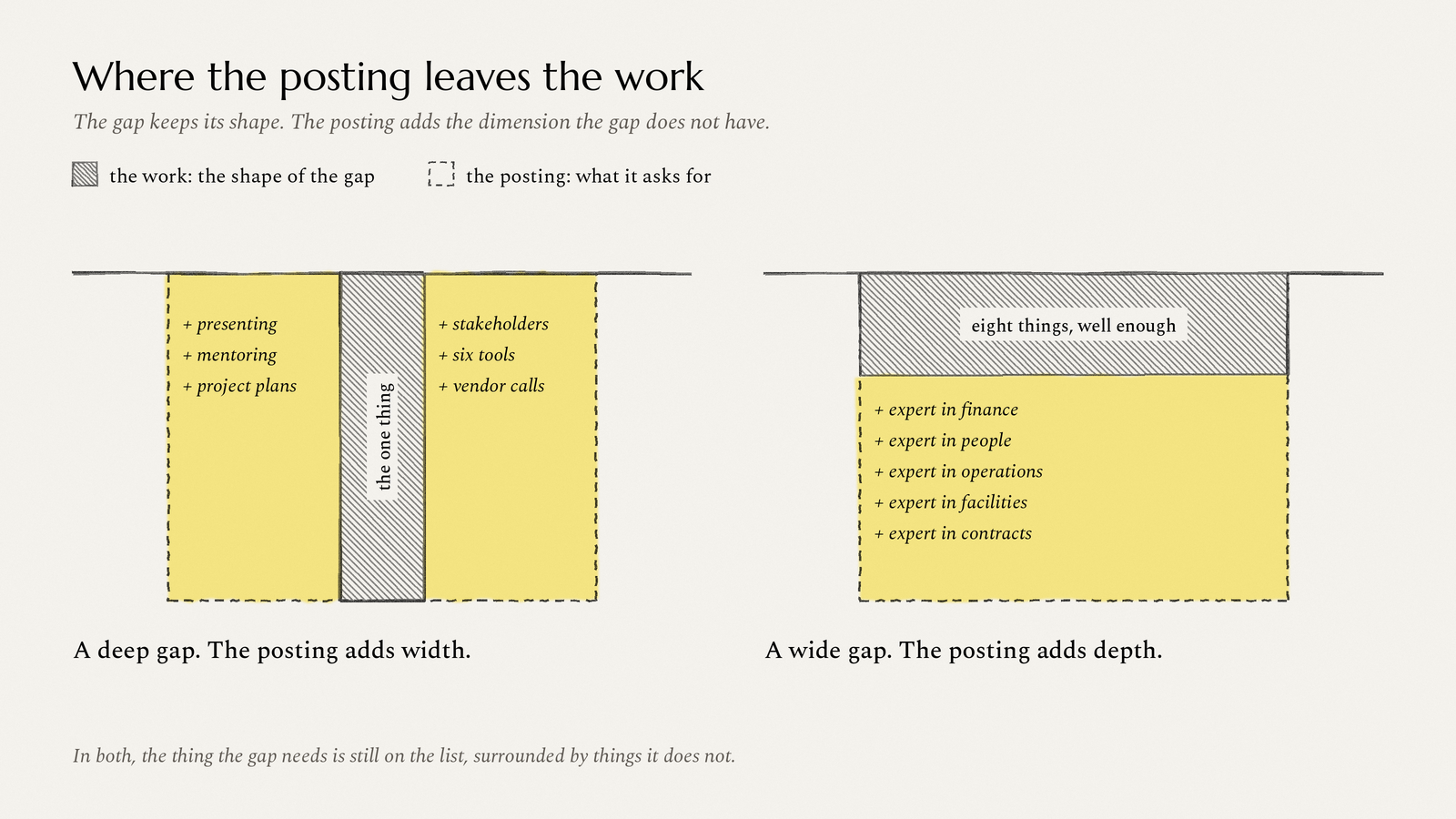
A deep gap is one thing that has to be done well. The person who can read a packet capture and tell you what happened at two in the morning. The person who knows the old billing system because she built half of it. The actuary. The surgeon. The translator who knows the legal register of one language pair. Deep work is bought with hours spent on one thing, and the hours are not refundable. Nobody gets deep in six things, not because talent is scarce but because the week is.
A wide gap is many things that have to be done well enough. The operations lead at a sixty-person company who does vendor contracts on Monday, a hiring plan on Tuesday, and an outage on Wednesday night. The one person in a ten-person firm who is finance, HR and facilities. The first product manager. Wide work is bought with the same hours spread thin, and the skill in it is knowing how thin is safe.
Most jobs lean one way or the other. A few need both, and the people who hold them are the ones everyone names in the first ten minutes of a reorganization. Depth is not better than width. But the gap leans one way before the posting exists, and the posting is supposed to say which.
Two ways to leave the gap behind
Postings drift from the gap in both directions.
The deep gap acquires width. The specialist who needs to do one thing well must also present to executives, run projects, mentor juniors, own vendor relationships, and be fluent in a list of tools long enough that two of them do the same job. The one thing the gap needs is still on the list. It is now line four of twenty.
The wide gap acquires depth. The generalist who needs to do eight things adequately must be an expert in each of them. Eight experts’ worth of depth, in one person, at one salary. The posting is describing a department.
The drift runs both ways partly because of where gaps come from.
A gap left by attrition is person-shaped. Someone did the job for nine years, and the posting traces her whole outline: the thing she was hired for, the three things she grew into, the two things she did because nobody else would, and the one thing she was the last person in the building to know. The list is accurate. It is a biography. Nobody who has not spent nine years in that chair can match it, and the one person who could has just left.
A gap opened by growth is guess-shaped. The work has not been done yet, so nobody knows its edges, and the honest answer to “what does this role need” is “we will find out.” Postings do not say that. They hedge. Everything that might be needed goes in, because leaving something out feels like a decision and putting it in feels like diligence.
Then the committee arrives. Peter Cappelli, who has been saying this about hiring for years, describes the plain version: the manager decides what the job needs, then asks everyone who will work with the new person what they would like to see, and nobody whittles the answers down. They are added up. [1] In practice the adding has more hands than that. A peer adds the tools the team uses. A second peer adds the ones it is about to adopt. Recruiting adds the lines from the last posting with the same title, which inherited them from the one before. Legal adds a paragraph. Nobody is paid to subtract, and nobody is blamed for a requirement that was never needed. The list grows the way a hallway fills with boxes: one at a time, each one somebody’s good reason.
And then there is the market. The one piece of outside evidence this author went looking for holds, and it holds in both directions. When more people are looking for work, companies ask for more from the same title at the same company. [2] The published estimate is that the rise in job seekers during the recession accounts for 18 to 25 percent of the rise in posted requirements between 2007 and 2010. [2] When the market tightened again after 2010, the same researchers watched the requirements come back down. [3] The title had not changed. The list had. The list is partly a thermometer. It measures how many people are standing outside the door.
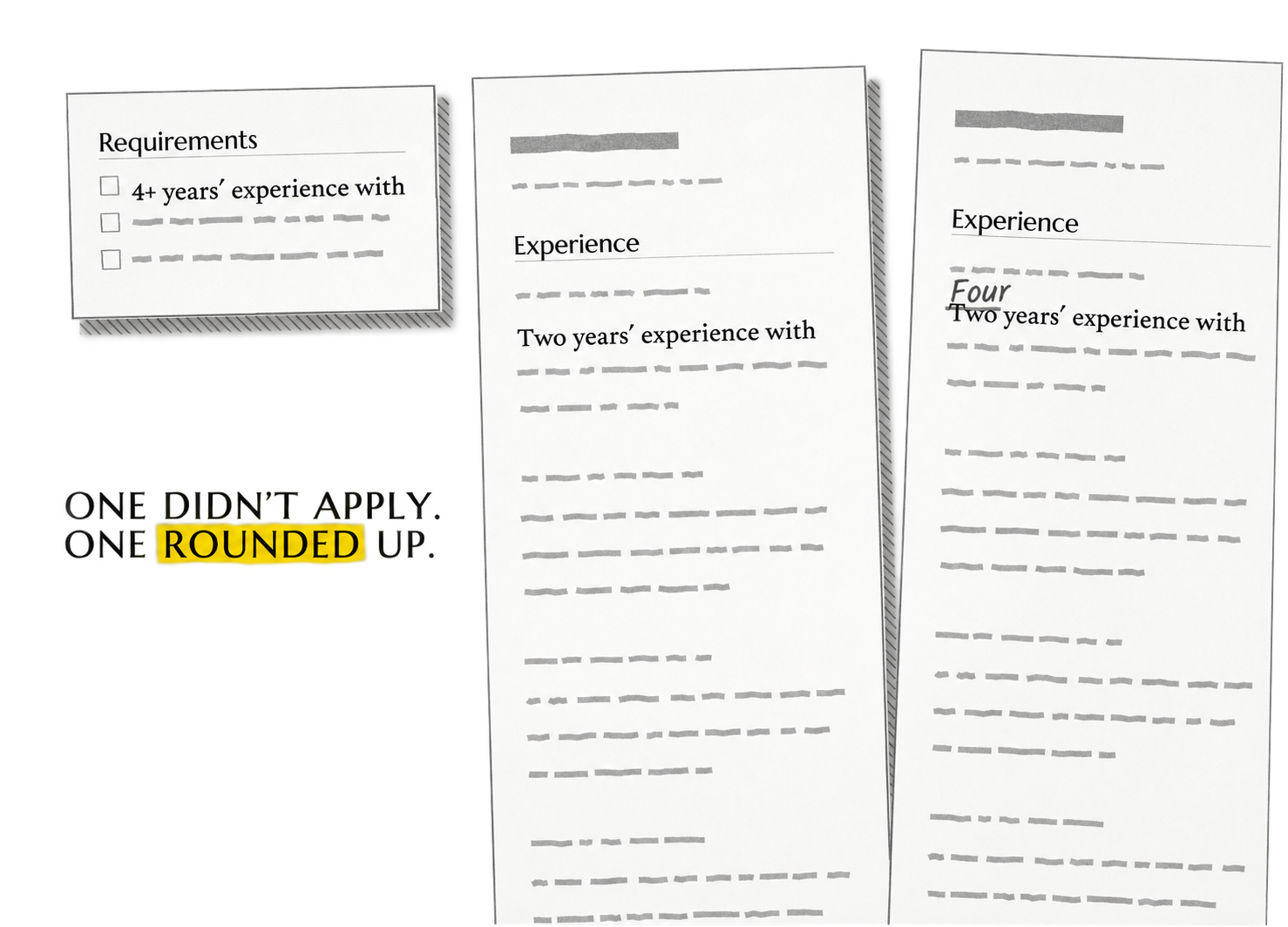
The cleanest specimen of a list leaving the work behind is a few years old now. A programmer saw a posting that required four years’ experience with a software framework. He could not apply. The framework was about a year and a half old. He knew, because he had written it. [4] The same week, a posting at one of the largest technology companies in the world asked for twelve years’ experience with a tool that had existed for six. [4] Nobody could have met those lines, which means they were never descriptions of a gap. They were a habit: a number added to a noun.
What the twentieth line does
Here is the part this author thinks is new, or at least not said plainly enough.
The lines that describe the gap do real work. They separate people who can do the job from people who cannot. Each one carries information, and the company learns something about every candidate who passes it.
Past the shape of the gap, the lines stop carrying information and start selecting for something else. A twenty-item list has a property a five-item list does not: almost nobody meets all of it well. So the list is no longer asking who can do this. It is asking who will say they can.
Candidates read a list like that in one of two ways. The literal reader counts. She can do twelve of the twenty well, three passably, and has never touched the other five. She takes the list at its word and does not apply. The rounding reader also counts, reaches the same twelve, and rounds the rest up. Familiar with becomes experienced in. Two years becomes four. A tool he watched a colleague use becomes a tool he knows.
A requirement the work does not need cannot select for the work. There is nothing in the work for it to select. What it selects for is the willingness to claim it. That is the whole argument in one sentence. Every line past the shape of the gap costs the company a literal reader and keeps a rounding one. And the literal readers are not a random slice of the pool. They are the careful ones, and for a deep gap, care is the job.
A requirement the work does not need cannot select for the work. What it selects for is the willingness to claim it.
Opinion 1. This is why this author calls the returns negative, not merely diminishing. A line that adds nothing and costs nothing would be harmless clutter. A line that adds nothing and costs the careful candidates is a filter working against the company that wrote it.
This author has looked for a study that tests this and has not found one. The absence deserves a sentence of its own. Companies have been lengthening these lists for at least fifteen years, and nobody has measured what the length does to who applies. The last essay said why: the measures that survive are the ones that can be found quickly, move this quarter, and read at a glance. This one fails all three. What can be found is thinner, and here it is.
In a British experiment with more than ten thousand current and prospective job seekers, the point at which people said they would apply came, on the researchers’ estimate, at a little over half the listed requirements, for men and women alike. [5] The familiar claim that women wait until they meet all of them while men go at sixty percent turns out to have no data behind it, and a second study in 2024 found no reliable gender gap either. [5] [6] The list in that experiment had five items. People said they would go at about three. What they do at twenty, nobody has measured, and the claim above should be read with that in mind.
In a 2025 survey of two thousand American job seekers, a quarter admitted lying on a resume, and the two most common lies were years of experience and skills. [7] The survey did not ask what the postings looked like. It says only where people round, and they round in the two currencies a posting is written in: years and skills. And in a study of a million and a half Austrian postings, the ones that listed more skills stayed open a little longer. [8]
Put that together and this author’s claim is this: the people who answer a twenty-item posting sort, with few exceptions, into two groups. Those who can do some of it well, and those who say they can do all of it. The company then interviews a pool it has tilted toward the second group, with a process that, as the last essay argued, cannot check. [9]
What the gap would say
Opinion 2. If the gap could write its own posting, it would be short, and it would have a shape.
A deep gap would ask for the one thing, at depth, and say how depth will be checked: a problem to work, a system to read, an hour with the people who will depend on the answer. It would not ask the specialist to also be a presenter, a project manager and a mentor, because every one of those lines sends away someone who spent the hours on the one thing instead.
A wide gap would ask for range and say so. Eight areas, competence in most, strength in two, and the judgment to know which is which this week. It would not say expert eight times, because that word is a filter for people who will say it back.
Opinion 3. Neither would be hard to write. What is hard is the subtraction. Someone has to strike the peer’s favorite tool, the departed employee’s ninth year, recruiting’s inherited paragraph, and the number that got added to the noun. Nobody is rewarded for that. Nobody is blamed for its absence. So the list grows, the gap keeps its own shape underneath, and the two drift apart a line at a time.
The last essay ended with the one part of hiring nobody designed, the referral, and the odd fact that it keeps producing hires out of all proportion to the applications it brings in. Add one more reason. At its best, the person who refers a candidate knows two shapes: the shape of the gap, because she works next to it, and the shape of the candidate, because she worked next to him. She is not matching a list. She is matching a hole to a person. That is what the posting was for, before it started describing the market, the committee, and the person who left.
References
Peter Cappelli, “Your Approach to Hiring Is All Wrong,” Harvard Business Review, May–June 2019, https://hbr.org/2019/05/your-approach-to-hiring-is-all-wrong. The account paraphrased here is from his Knowledge at Wharton interview, October 4, 2019, https://knowledge.wharton.upenn.edu/podcast/knowledge-at-wharton-podcast/fix-the-hiring-process/
Alicia Sasser Modestino, Daniel Shoag and Joshua Ballance, “Upskilling: Do Employers Demand Greater Skill When Workers Are Plentiful?”, Review of Economics and Statistics 102, no. 4 (2020): 793–805, https://doi.org/10.1162/rest_a_00835
Alicia Sasser Modestino, Daniel Shoag and Joshua Ballance, “Downskilling: Changes in Employer Skill Requirements over the Business Cycle,” Harvard Kennedy School Faculty Research Working Paper RWP16-014, March 2016, https://www.hks.harvard.edu/publications/downskilling-changes-employer-skill-requirements-over-business-cycle
“IBM job ad calls for 12 years’ experience with Kubernetes, which is six years old,” The Register, July 13, 2020, https://www.theregister.com/2020/07/13/ibm_kubernetes_experience_job_ad/, which reproduces Sebastián Ramírez’s post of July 11, 2020 on the FastAPI posting. FastAPI’s first public release, version 0.1.0, is dated December 8, 2018: https://pypi.org/project/fastapi/0.1.0/
Leonie Nicks, Filip Gesiarz, Lourdes Valencia, Tim Hardy and Johannes Lohmann, “Gender Differences in Response to Requirements in Job Adverts,” Behavioural Insights Team with the Government Equalities Office, March 2022, https://www.bi.team/wp-content/uploads/2022/03/Gender-differences-in-response-to-requirements-in-job-adverts-March-2022.pdf
Mona Salwender and Dagmar Stahlberg, “Do Women Only Apply When They Are 100% Qualified, Whereas Men Already Apply When They Are 60% Qualified?”, European Journal of Social Psychology 54, no. 7 (2024): 1545–1557, https://doi.org/10.1002/ejsp.3109
ResumeBuilder.com, “1 in 4 Americans Have Lied on Their Resume, and Many Say It Helped Their Careers,” survey of 2,000 U.S. job applicants conducted by Pollfish, January 2025, https://www.resumebuilder.com/resume-examples/1-4-americans-have-lied-on-their-resume/
Lennart Ziegler, “Skill Demand and Wages: Evidence from Linked Vacancy Data,” IZA Discussion Paper 14511, June 2021, https://docs.iza.org/dp14511.pdf
John Elijah, “The Hiring Blind Spot,” Substack, October 2026, https://johnelijah1.substack.com/p/the-hiring-blind-spot
Facts are sourced. Opinions are marked.