The Hiring Blind Spot
The more exactly a company describes the person it wants, the less it can tell whether it got one. The only part of hiring that still knows was never written down.
 John ElijahFreely accessible
Listen to this essay
15 min · AI narration
The recording is temporarily unavailable. You can continue reading below.
Postings of a certain kind are everywhere now. One, for an analyst at a security company, asks for a single person who can read raw network traffic and brief an executive, write code and run a server, follow a foreign adversary and lead a team, and then stand up at a conference and talk about all of it. Twenty qualifications. Twenty-two named tools, formats, and protocols. Pieces of at least five occupations, by the government’s classification. Two of the skills it demands appear nowhere in the work it describes. None of this is unusual. The average posting now names about 14 skills, and postings in software and project management name more than 20. [1]
Here is the strange part. A year after that job is filled, nobody at that company will be able to say which of the twenty mattered. Not because the question is hard, but because no one will have asked it. In a 2025 survey of about 1,300 senior recruiting professionals, one in four said they were highly confident their organization could measure quality of hire. [2] The other three will know, to the day, how long the position took to fill and what it cost.
Opinion 1. That is the condition of hiring now. The description of the person has become precise, the knowledge of whether the hire worked has disappeared, and the two facts are connected. The precision is the cause of the blindness.
The precision is the cause of the blindness.
The reason is a rule about what organizations measure. A company measures what it can find, what moves this quarter, and what reads at a glance. Governance, Bureaucracy, and Organization makes that argument about administrative systems in general. Everything that passes those tests gets managed. Everything that fails them gets a proxy, and the proxy gets managed instead. A requirement is a field in a database: it can be found, it fills a role this quarter, and it reads in a second. Whether the hire worked is none of those things. It arrives a year later, spread across one manager’s judgment and a few colleagues’ willingness to say so, and it comes as a story rather than a number. So the posting gets more exact every year and the result gets no clearer, and the first is why the second never improves: every item added to the list is one more thing the company would have to check and never will. Peter Cappelli, who has been saying this for years, puts it plainly: firms manage the speed and cost of hiring because those are the numbers they have. [3]
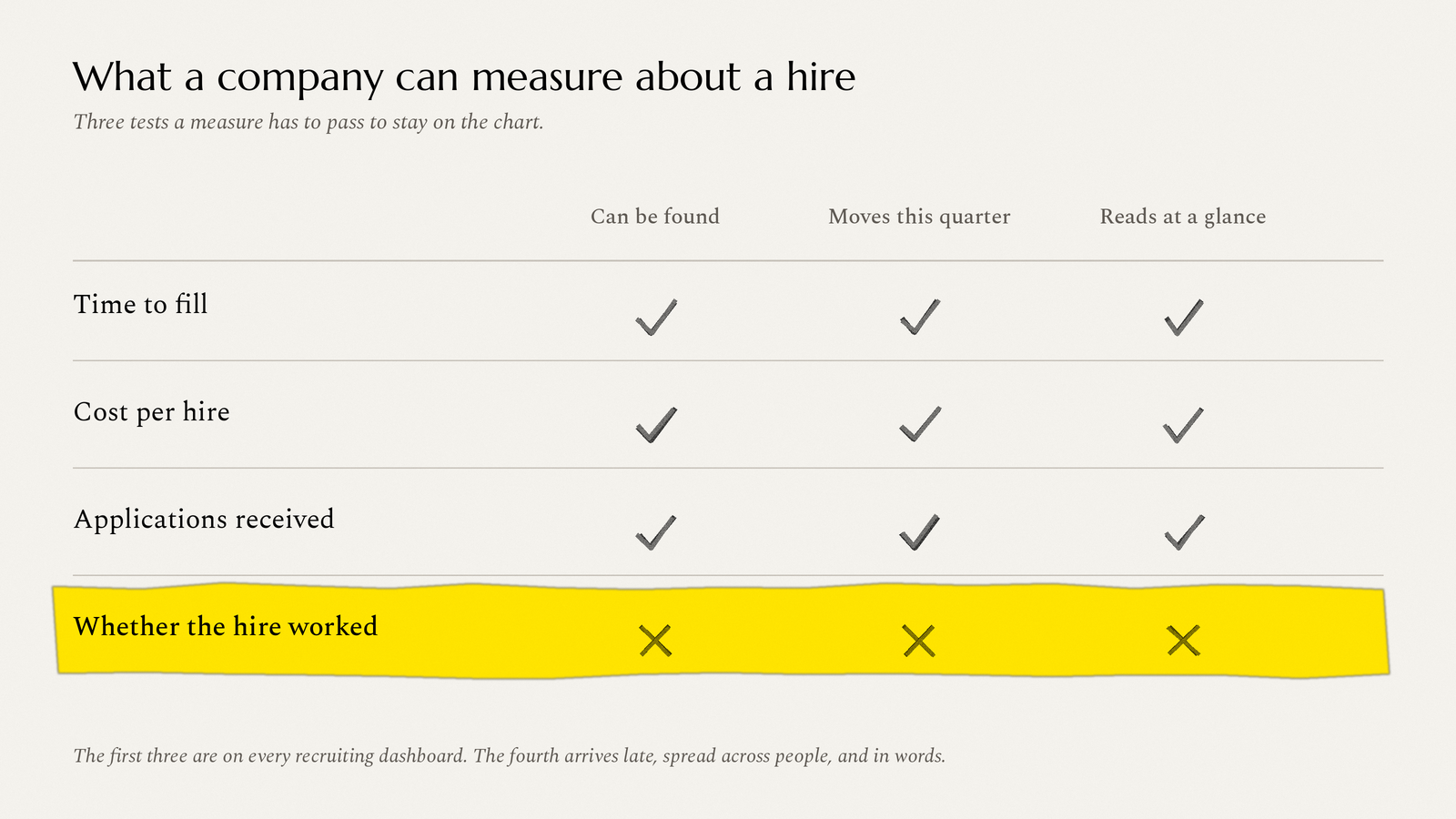
The four designed parts of hiring show the rule at work, in order. The fifth part, the one that still knows whether the hire worked, was never designed at all.
The name
The job title is the most precise thing in the posting and the least informative. It is a field in a database, so it is counted, searched, and compared in seconds. The federal government recognizes 867 detailed occupations, up from 821 in 2000. [4] One company that collects postings starts from millions of raw titles and boils them down to about 75,000 standardized ones. [5] That is 86 names for every occupation. Some of those names are real: one study traced when each title in the Census index first appeared and found that about 60 percent of 2018 employment sits in specialties that did not exist in 1940. [6] Some are not: in one profession with good records, the same nursing role carried a wide range of titles, and the title chosen tracked the pay band. [7] Nobody can say the split, because a title is checked against nothing. It is written once, at the top of the posting, for the search engine, and it is never compared with the work the person went on to do. A name that is never checked is free to multiply, and it has.
The list
Below the name comes the list, and the list is where precision does its damage. Applying for a job became nearly free: a click, a stored resume, now a generated one. At one applicant-tracking company, inbound applications roughly tripled between 2021 and the start of 2024. [8] Employers had to cut the pile somehow, and the cheapest knife is a requirement. Require a degree. Require five years. Name the tool. Add the certification. Each item is reasonable on its own, each shrinks the pile, and none is ever removed, because nothing downstream ever reports that it was useless. After enough rounds the posting describes someone who can do twenty things.
Opinion 2. Some of those twenty are real. About one posting in eight asks for a combination of skills that used to belong to different jobs, those jobs pay 20 to 40 percent more, and the firms that ask for technical and social skill in the same person are the better-paying ones. [9] [10] But a specialized job and a badly scoped one look the same on paper, and the only way to tell them apart, scoring the hire against the list a year later, is not practical at twenty items. So the list is never scored. It cannot be. The company can know the employee is doing well and still not know whether it hired for the right reasons, which is the one thing the list was written to establish.
The evidence that lists describe wishes rather than jobs is not subtle. In 2017, researchers compared 26 million postings with the people already doing the work. For production supervisors, 67 percent of postings asked for a bachelor’s degree. Sixteen percent of working production supervisors had one. [11] Then came the test. Between 2014 and 2023, tens of thousands of roles at large employers dropped the degree requirement, usually with an announcement. In 2024 the same researchers checked the hires. In the roles that dropped it, non-degree hiring rose by 3.5 percentage points; across the economy, by 0.14 percent, less than one hire in 700. [12] The posting changed and the hiring did not, because the posting had never been connected to the decision in the first place. The minority of firms that changed their process rather than their posting raised non-degree hiring by about 18 percent, and those hires stayed longer than their degree-holding colleagues. [12] Where someone looked at the outcome, the outcome moved. Almost no one looked.
The lists move with the market, not with evidence. The share of postings requiring a degree fell from 2019 to early 2024 and has been rising since the market cooled; the share naming years of experience fell overall while in technology the share asking for five or more years rose. [13] [14] A list that lengthens when applicants are plentiful and shortens when they are scarce is measuring the employer’s leverage, which is visible this quarter, not the job, which is not. And the cost of the filter never appears on a report. Employers themselves say that rigid descriptions and automated screening reject people who could do the work. [15] Those people never become employees whose performance could be measured. They vanish from the evidence. The employer has solved a measurable problem, too many applications, by taking on an unmeasured one.
The conversation
The interview should be the correction. It is the one point where a human could set the list aside and ask what the job is and whether this person can do it. The research on which interviews work is old, large, and settled: the structured kind, the same job-related questions for everyone and a scoring guide, predicts performance about as well as anything the field has, and the unstructured conversation predicts it much worse. A 2022 reanalysis lowered every estimate and kept the order; the structured interview came out on top. [16] [17] The field has known for a generation.
Most candidates get the conversation anyway, and the measurement rule explains why. A conversation produces an impression, formed in an hour and held with confidence, and an impression reads at a glance. A structured interview produces a score sheet that has to be designed, which requires first deciding what the job is, which is the work the twenty-item list was written to avoid. In a 2013 set of experiments, people who ran interviews built from deliberately random questions still formed confident judgments, those judgments made their predictions worse, and when offered the choice they preferred a random interview to none. [18] Feeling informed is not being informed, and nothing afterward compares the feeling to the hire. Even a structured interview cannot repair an undefined job. Pointed at twenty requirements, it only evaluates them more consistently. The process gets more disciplined without getting more accurate.
The numbers that fill the hole
What happens after the hire should be where the company finds out. Instead it is where the emptiness becomes visible, because the slot where the outcome belongs is filled with figures that sound like outcomes. A third of new hires leave within 90 days. Nearly half fail within 18 months. A bad hire costs 30 percent of first-year salary, according to the Department of Labor. Every one of those is a proxy wearing a number. The first is a 2018 vendor survey in which 30 percent of respondents said they had, at some point in their careers, left a job within its first 90 days. [19] The second is a 2005 poll of managers in which failure included a poor review. [20] The third has no traceable source at the Department of Labor or anywhere else. [21] The hiring industry’s statistics about its own failures were never measured either. They circulate because they read at a glance and nothing better exists to contradict them.
The government data that do exist point the other way and still cannot answer the question. Median tenure with the current employer was 4.1 years in January 2026, up from 3.9 two years before, and the share of workers with a year or less of tenure fell. [22] About five million people are hired every month and about five million leave, and no public table says how long the leavers had been there. [23] Whether a hire worked is not a number anyone collects, inside companies or outside them.
One signal comes through, and it comes as a story, from the people who left. In every survey that asks, the leading reason for leaving a job early is that the work was not what the person was told: 43 percent of early leavers in 2018, and in 2025, 36 percent of respondents who had left a job within 90 days over the gap between the interview and the role. [19] [24] The remedy is known and old. Telling candidates the unattractive parts of a job before they take it lowers early turnover by a small, repeatable amount across roughly fifty studies. [25] [26] It works by giving both sides the information the twenty-item list did not contain. Some postings never meant to contain it. One hiring platform found that in a typical quarter about a fifth of the jobs on its system were listings with no active effort to fill them, and that seven in ten of its customers had posted at least one. [27] A posting counts as activity whether or not anyone is hired from it. That is the measurement rule at its most literal.
The part nobody designed
Which leaves the referral, and the referral fails every test the rest of hiring passes. It cannot be located; it happens in a conversation before the company sees the applicant. It does not appear on this quarter’s report except as a bonus paid. It cannot be read at a glance, because it is one person’s judgment of another person’s work, delivered late and in words. It is exactly the kind of soft measure that drops off the chart. It is also the only part of hiring with a record of working.
At the applicant-tracking company whose inbound pile tripled, referrals were about one percent of applications and 17 to 18 percent of hires, and referred candidates reached interviews and offers at far higher rates than anyone who came in through the front door. [8] Older benchmarks put referrals at a quarter to a third of hires. [28] So this is not how most people get jobs; four hires in five come some other way. It is the one channel whose results differ in kind. The best study of why used personnel records from nine large firms. In the lower-skill firms, referred employees were about 10 to 11 percent less likely to leave. They were not consistently more productive. [29] A study inside a single firm’s referral system found the same, and so did a study that followed 1,700 applicants to one phone service center: referred candidates advantaged at every stage, from interview to offer to retention, because the employees who referred them had screened and informed them before the company saw a resume. [30] [31]
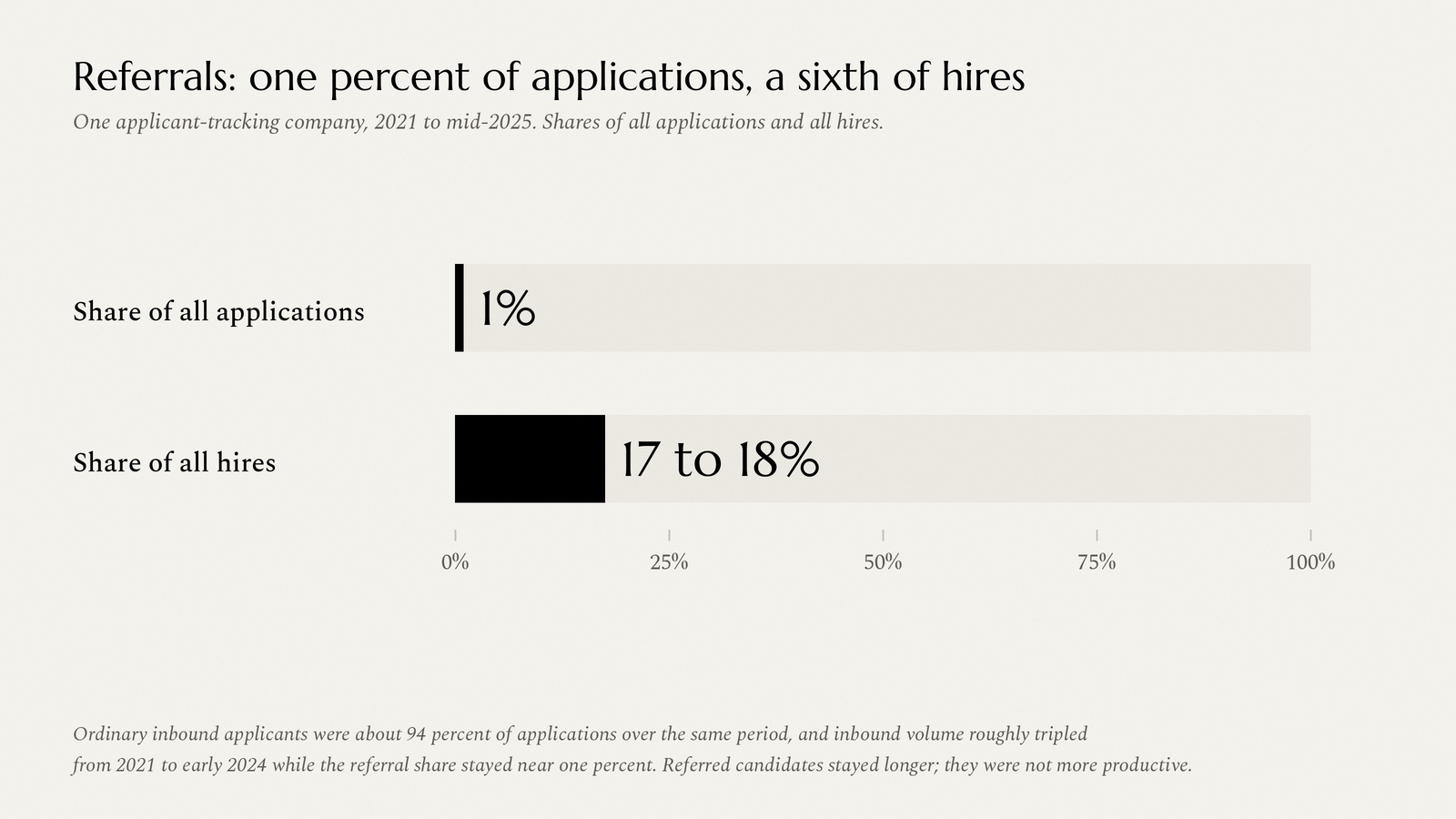
Opinion 3. Better retention without better productivity is what information looks like. The referral does not find a better worker. It finds a better match, because it is the only step at which two things happen that nothing else provides: someone who has seen the candidate’s work vouches for it, and someone who knows the job tells the candidate what it is. Those are the two facts the twenty-item list was supposed to carry and cannot. The volume of the last few years sharpened the contrast without changing it: applications tripled, the referral share stayed flat, and the gap between the two channels in how often an application became a job widened. [8] The formal channel gained volume, which goes on the dashboard. It did not gain information, which does not.
The referral is not clean. Networks reproduce themselves. One firm’s hiring records showed employee networks carrying existing racial disparities into hiring without anyone preferring anyone, and a study of Brazilian employer records found both things at once: referred hires dismissed less often, and the makeup of the networks passing inequality forward. [32] [33] A channel that runs through friends corrects for fit and not for fairness, and neither result shows up on the chart either.
What the hire costs
Opinion 4. Hiring is one instance. The same three tests govern whatever a company knows about itself, and they fail the same way for anything whose result arrives late, spread across people, and in words: whether training took, whether the reorganization held, whether the people who know how the place works are still in it. What passes the tests gets managed. What fails them gets a proxy, and the proxy gets managed instead, until the proxy is the only thing anyone can see. Companies have become very good at filling jobs quickly and cheaply, because that is what they can see, and they have become more exact about the person they want at the same rate, because exactness is cheap to write. Neither of those tells them whether the person they got was the person they needed. A company knows the cost of filling a position to the dollar. It does not know the cost of defining the position badly, and the more precisely it defines it, the less able it is to find out.
Opinion 5. The referral survived all of this because it carries the one vital sign the chart cannot, in the only form that sign comes in: one person’s judgment of another person’s work. Nobody designed it. Nobody could have. It is the part of hiring that still measures the thing the rest of hiring stopped looking at.
References
Indeed Hiring Lab, “How Skill Concentration Sets Tech and Healthcare Sectors Apart,” June 2026. https://www.hiringlab.org/2026/06/03/how-skill-concentration-sets-tech-and-healthcare-sectors-apart/
LinkedIn Talent Solutions, The Future of Recruiting 2025. https://business.linkedin.com/hire/resources/future-of-recruiting
Peter Cappelli, “Your Approach to Hiring Is All Wrong,” Harvard Business Review, May–June 2019. https://hbr.org/2019/05/your-approach-to-hiring-is-all-wrong
Office of Management and Budget, 2018 Standard Occupational Classification, Federal Register notice, July 22, 2016. https://www.bls.gov/soc/2018/frn_july_22_2016.pdf
Lightcast, Titles Taxonomy. https://lightcast.io/taxonomies/titles-taxonomy
David Autor, Caroline Chin, Anna Salomons, and Bryan Seegmiller, “New Frontiers: The Origins and Content of New Work, 1940–2018,” Quarterly Journal of Economics 139, no. 3 (2024). https://economics.mit.edu/sites/default/files/2023-12/New%20Frontiers%20-%20The%20Origins%20and%20Content%20of%20New%20Work%201940-2018.pdf
Alison Leary and co-authors, “Variation in Job Titles within the Nursing Workforce,” Journal of Clinical Nursing, 2017. https://pubmed.ncbi.nlm.nih.gov/28880423/
Ashby, Talent Trends: “Are Referred Candidates More Likely to Get Hired?” 2024–2025. https://www.ashbyhq.com/talent-trends-report/reports/referrals
Burning Glass Technologies, The Hybrid Job Economy, 2019, as summarized at https://www.td.org/content/atd-blog/hybrid-jobs-need-hybrid-skills
David Deming and Lisa Kahn, “Skill Requirements across Firms and Labor Markets: Evidence from Job Postings for Professionals,” Journal of Labor Economics 36, no. S1 (2018). https://econpapers.repec.org/RePEc:ucp:jlabec:doi:10.1086/694106
Joseph Fuller and Manjari Raman, Dismissed by Degrees, Harvard Business School, Accenture, and Grads of Life, 2017. https://www.hbs.edu/ris/Publication%20Files/dismissed-by-degrees_707b3f0e-a772-40b7-8f77-aed4a16016cc.pdf
Joseph Fuller, Christina Langer, and Matt Sigelman, Skills-Based Hiring: The Long Road from Pronouncements to Practice, Burning Glass Institute and Harvard Business School, 2024. https://www.hbs.edu/ris/Publication%20Files/Skills-Based%20Hiring_80b90afa-f6b5-4de9-b7f8-5d8232ce20e2.pdf
Indeed Hiring Lab, “Educational Requirements Are Gradually Disappearing from Job Postings,” February 2024, https://www.hiringlab.org/2024/02/27/educational-requirements-job-postings/; and “Where Do College Degrees Still Matter in a Skills-First Job Market?” January 2026, https://www.hiringlab.org/2026/01/28/where-do-college-degrees-still-matter-in-a-skills-first-job-market/
Indeed Hiring Lab, 2025 US Jobs and Hiring Trends Report, December 2024, https://www.hiringlab.org/2024/12/10/indeed-2025-us-jobs-and-hiring-trends-report/; and “Experience Requirements Have Tightened Amid the Tech Hiring Freeze,” July 2025, https://www.hiringlab.org/2025/07/30/experience-requirements-have-tightened-amid-the-tech-hiring-freeze/
Joseph Fuller, Manjari Raman, and co-authors, Hidden Workers: Untapped Talent, Harvard Business School and Accenture, 2021. https://www.hbs.edu/ris/Publication%20Files/hiddenworkers09032021_Fuller_white_paper_33a2047f-41dd-47b1-9a8d-bd08cf3bfa94.pdf
Frank Schmidt and John Hunter, “The Validity and Utility of Selection Methods in Personnel Psychology,” Psychological Bulletin 124, no. 2 (1998): 262–274.
Paul Sackett, Charlene Zhang, Christopher Berry, and Filip Lievens, “Revisiting Meta-Analytic Estimates of Validity in Personnel Selection,” Journal of Applied Psychology 107, no. 11 (2022): 2040–2068. Summary at https://www.siop.org/tip-article/is-cognitive-ability-the-best-predictor-of-job-performance-new-research-says-its-time-to-think-again/
Jason Dana, Robyn Dawes, and Nathaniel Peterson, “Belief in the Unstructured Interview: The Persistence of an Illusion,” Judgment and Decision Making 8, no. 5 (2013): 512–520. https://ideas.repec.org/a/cup/judgdm/v8y2013i5p512-520_1.html
Jobvite, Job Seeker Nation Survey, 2018. https://web.jobvite.com/rs/328-BQS-080/images/2023-01-2018JobSeekerNationSurvey.pdf
Leadership IQ, Why New Hires Fail, 2005. https://www.leadershipiq.com/blogs/leadershipiq/35353729-why-new-hires-fail-emotional-intelligence-vs-skills
On the untraceable Department of Labor figure, see the source-tracing at https://www.frontlinesourcegroup.com/blog-us-department-of-labor-bad-hire-30-percent-of-first-year-earnings.html
Bureau of Labor Statistics, Employee Tenure in 2026. https://www.bls.gov/news.release/pdf/tenure.pdf
Bureau of Labor Statistics, Job Openings and Labor Turnover Summary, August 2026. https://www.bls.gov/news.release/jolts.nr0.htm
Employ, 2025 Job Seeker Nation Report. https://pages.employinc.com/rs/659-JST-226/images/2025-Job-Seeker-Nation-Report.pdf
Jean Phillips, “Effects of Realistic Job Previews on Multiple Organizational Outcomes: A Meta-Analysis,” Academy of Management Journal 41, no. 6 (1998): 673–690. Summary at https://www.qic-wd.org/umbrella-summary/realistic-job-previews
David Earnest, David Allen, and Ronald Landis, “Mechanisms Linking Realistic Job Previews with Turnover: A Meta-Analytic Path Analysis,” Personnel Psychology 64, no. 4 (2011): 865–897. https://onlinelibrary.wiley.com/doi/10.1111/j.1744-6570.2011.01230.x
Greenhouse, State of Job Hunting, 2024. https://www.greenhouse.com/blog/greenhouse-2024-state-of-job-hunting-report
SilkRoad and CareerXroads source-of-hire benchmarks, as reported at https://www.ere.net/articles/job-boards-referrals-lead-as-hiring-sources-agencies-yield-strong-hire-ratio
Stephen Burks, Bo Cowgill, Mitchell Hoffman, and Michael Housman, “The Value of Hiring through Employee Referrals,” Quarterly Journal of Economics 130, no. 2 (2015): 805–839. Summary at https://wol.iza.org/articles/the-value-of-hiring-through-employee-referrals-in-developed-countries/long
Meta Brown, Elizabeth Setren, and Giorgio Topa, “Do Informal Referrals Lead to Better Matches? Evidence from a Firm’s Employee Referral System,” Journal of Labor Economics 34, no. 1 (2016): 161–209.
Roberto Fernandez, Emilio Castilla, and Paul Moore, “Social Capital at Work: Networks and Employment at a Phone Center,” American Journal of Sociology 105, no. 5 (2000): 1288–1356.
Roberto Fernandez and Isabel Fernandez-Mateo, “Networks, Race, and Hiring,” American Sociological Review 71, no. 1 (2006): 42–71. https://cpi.stanford.edu/_media/pdf/key_issues/social_networks_research.pdf
Conrad Miller and Ian Schmutte, “The Dynamics of Referral Hiring and Racial Inequality: Evidence from Brazil,” 2021. https://irle.berkeley.edu/wp-content/uploads/2021/09/The-Dynamics-of-Referral-Hiring-and-Racial-Inequality-Evidence-from-Brazil-1.pdf
Facts are sourced. Opinions are marked.