Stalin’s Org Chart
Why overlapping divisions serve the leader and cost the business.
 John ElijahFreely accessible
Listen to this essay
15 min · AI narration
The recording is temporarily unavailable. You can continue reading below.
This author lived in Russia from 1999 to 2001. He was there when Boris Yeltsin resigned on New Year's Eve and handed the presidency to a little-known former security officer named Vladimir Putin, and he was there a few months later when Putin was elected in his own right. He had been a student of Russia before that, and Russia has been a central part of his work for the better part of twenty years since. It is familiar territory. So when the historian Sarah Paine described how Stalin organized his security services, the structure was not new to him. [1] What was new was the thought that followed: he had seen the same structure in companies, and nobody there had read Stalin.
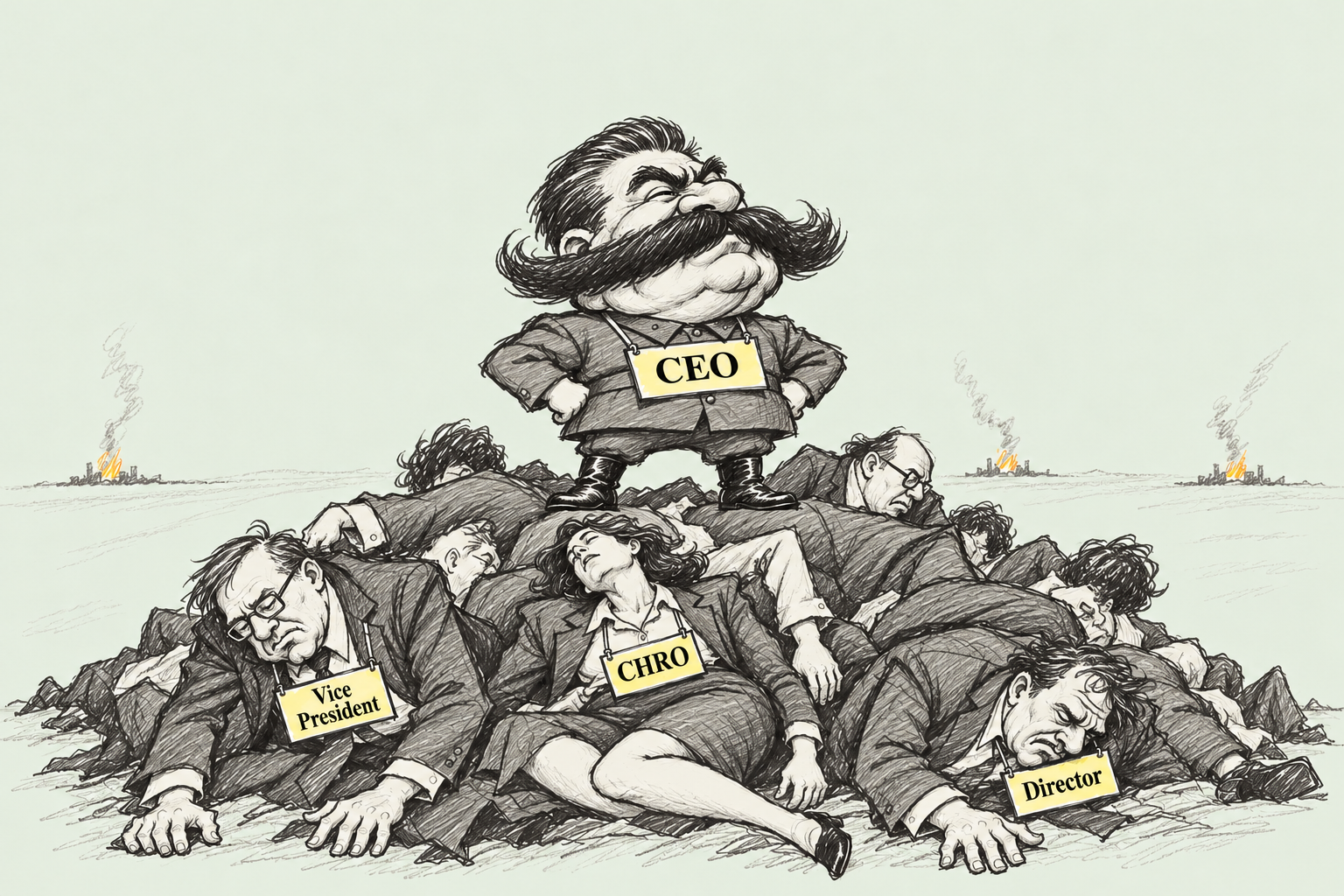
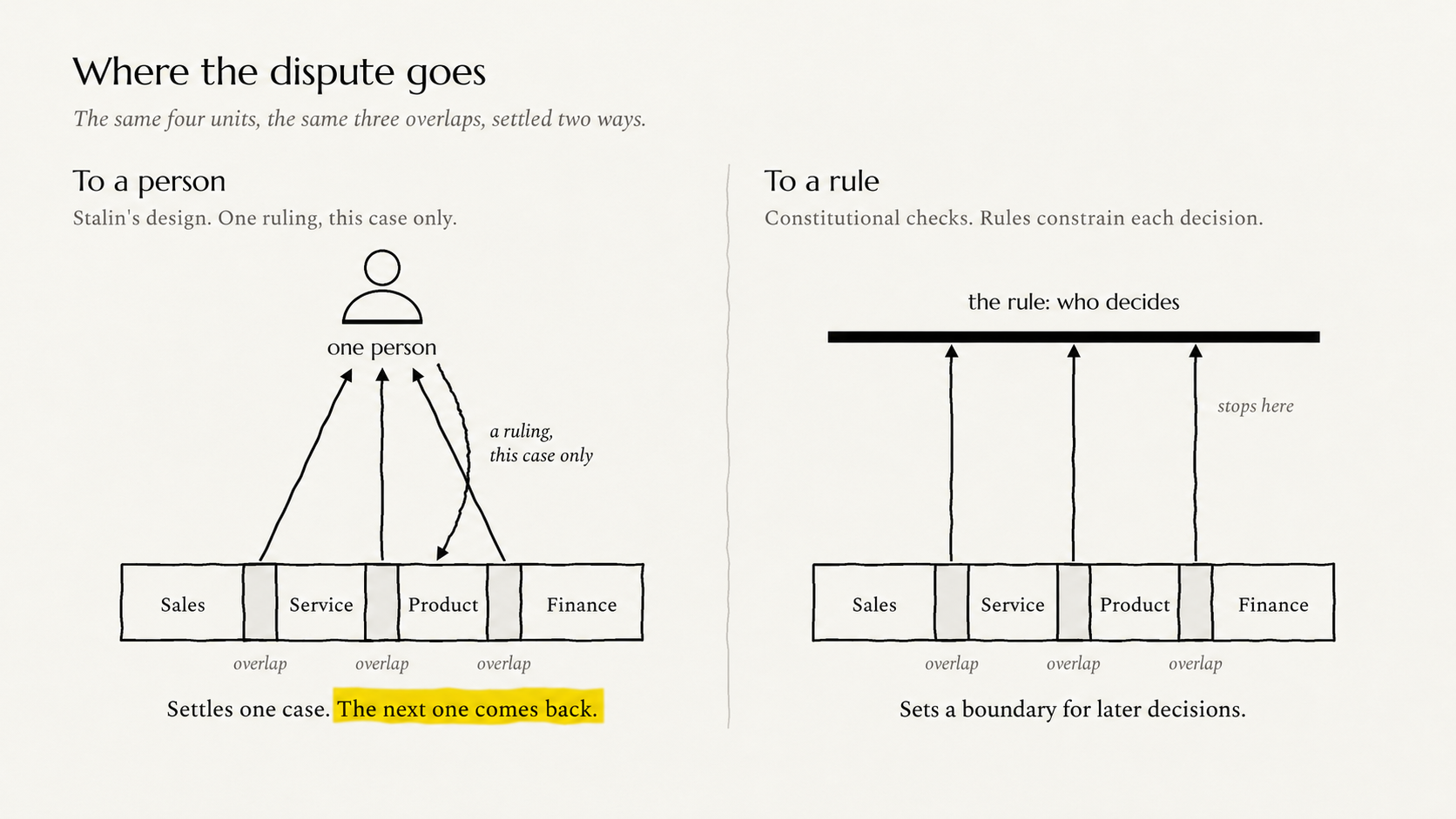
Here is what Stalin did. He never allowed one security service to hold the whole job. The secret police, the military counterintelligence, the party's own control organs, and the personal secretariat all watched the same people, held overlapping authority over the same questions, and watched each other. [2] Where their jurisdictions overlapped, they fought, and the dispute went up, and the top of every chain was Stalin. He settled the ones that mattered to him in person, case by case, and reversed himself freely, so that nobody who won a dispute this year could count on winning it next year. The ones that did not need his hand he left to lieutenants, Yezhov and then Beria, who ruled on his behalf and in his manner; when the terror had run its course, Yezhov carried the blame for it and was shot. [3] Every service needed him. None could act alone. None could combine against him.
The cost was enormous. The services duplicated work, hid information from each other, and spent their energy on rivalry instead of their stated mission. In June 1941, when Germany attacked, the warnings had reached Moscow from several directions. The head of military intelligence could put them together, and did, but he shaped his assessments to fit what Stalin already believed, and Stalin had decided the warnings were a provocation. [4] Nobody below him was willing to say otherwise. The structure that protected him from his lieutenants left him unprotected from his own judgment.
But the cost was worth it to him, and this is the point that matters. The political scientist Milan Svolik counted how dictators were forced from power between 1946 and 2008 and found that, of the removals that could be clearly classified, about two thirds were carried out by people inside the regime, not by revolt or foreign armies. [5] If the main threat to your position is your own lieutenants, then keeping them divided, rivalrous, and dependent on you is not a mistake. It is the correct design. What it loses in efficiency it returns in control. Stalin was not running a security service. He was running a system for staying Stalin.
The structure is neutral
It would be easy to stop there and say that overlapping jurisdiction is a dictator's tool. It is not. James Madison built the American government on overlapping authority on purpose, so that ambition would counteract ambition, [6] and Franklin Roosevelt ran his administration with rival agencies because he wanted decisions to come back to him. [7] The structure is the same. What differs is where the dispute goes. In Madison's design it goes to a rule: a court decides, or a vote decides, or a written procedure decides, and the same framework governs the next dispute. In Stalin's design it goes to a person, who decides this case only, and the next case comes back to him. That difference can be seen from outside. You do not need to know what a leader intended. You need only watch how the fights get settled.
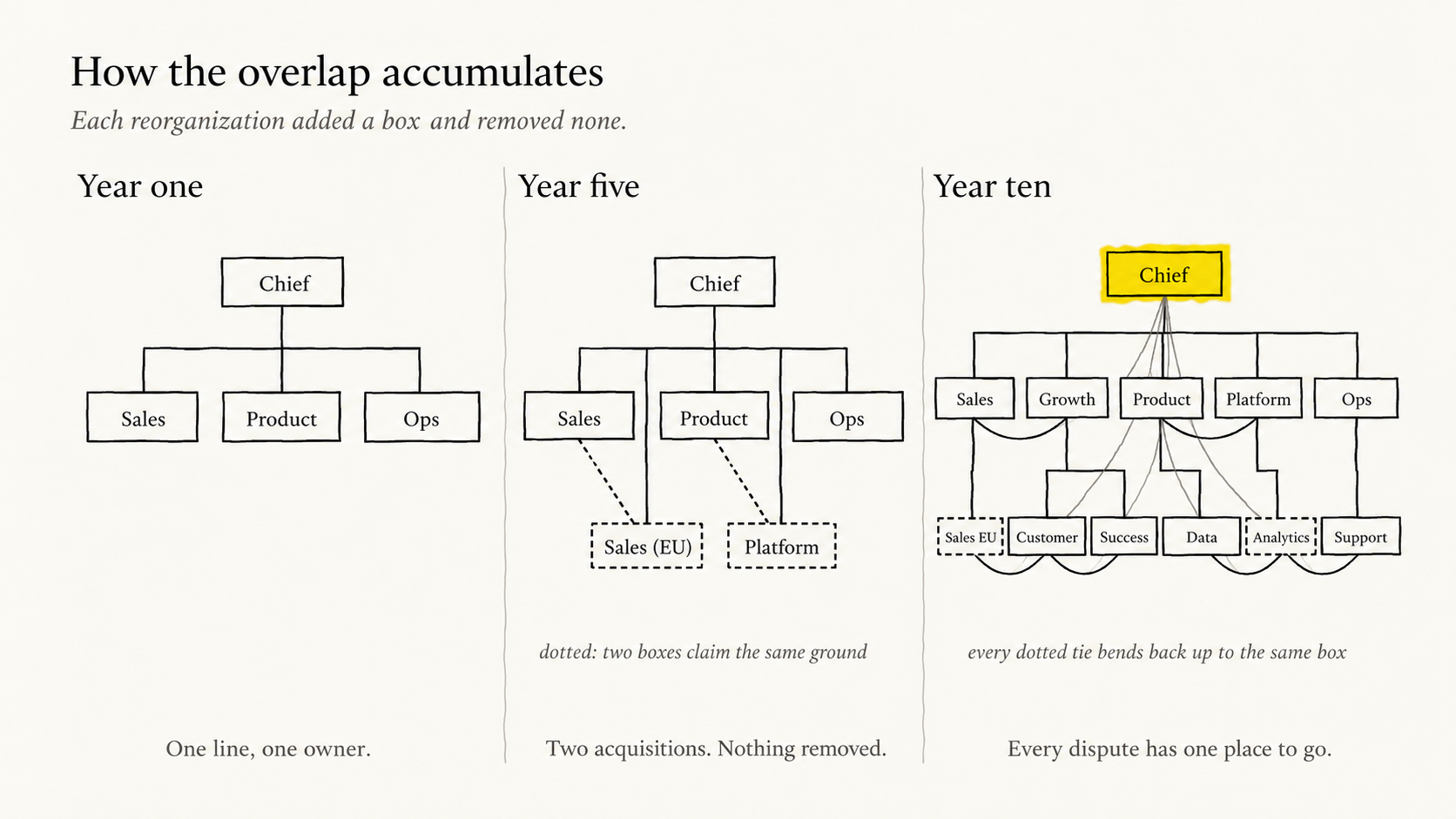
This matters because intention is unknowable and mostly beside the point. A chief executive who divides her company into rival units may be doing it to stay chief executive, or because she read a book about internal competition, or she may not have done it at all: the units may have accumulated over a decade of acquisitions and reorganizations, each adding a box without removing the old one. From inside the company these three cases look identical, and the outcome is what the company pays for.
How organizations get there without deciding to
This author has written before about how the divisions of a company drift. [8] Work is dug like trenches, heads down, and trenches that start parallel rarely stay that way. Some bend toward each other and collide over the same customer, the same budget, the same decision. The earlier essays treated the collision as a cost that nobody chose. This essay adds something: the collision has a beneficiary, and the beneficiary is usually the person everyone expects to fix it.
When two units hold overlapping authority and nobody below the top can resolve it, every dispute escalates, and the person at the top becomes the only integrator. That is a form of power, and a pleasant one, because it feels like being needed. Very few people give up power they stumbled into. So the structure selects for the behavior: a leader who never read Stalin, who would be horrified by the comparison, ends up settling the same fights the same way for the same reason, which is that the fights make him necessary.
He may not even see it. Chief executives rarely settle these disputes in person. They route them through a chief operating officer, a head of human resources, a chief of staff, who become the designated bad guys. That is Stalin's pattern as well: the lieutenant who rules on the leader's behalf is the one-person model with a fuse, removable when she accumulates too much weight, and the blame goes with her. It also gives the leader deniability. A chief executive who never sees the fights can sincerely believe he runs a collaborative company.
And the chief executive is only the clearest case. In a company of any size the same structure repeats wherever someone holds authority over people whose authority overlaps. A vice president settles the fights between two directors. A director settles the fights between two team leads. A team lead settles the fights between two engineers who both think the feature is theirs. Each is the only integrator for the disputes beneath them, each gains the same quiet power from being needed, and each has the same reason to leave things as they are. This makes the problem worse, because most of these fights never rise high enough to be seen. The vice president who settles the same dispute every quarter is doing at her level what the chief executive does at the top, and the chief executive has no idea it is happening. The structure is not centered on one person. It repeats wherever there is a person to center it on.
The symptom: fires
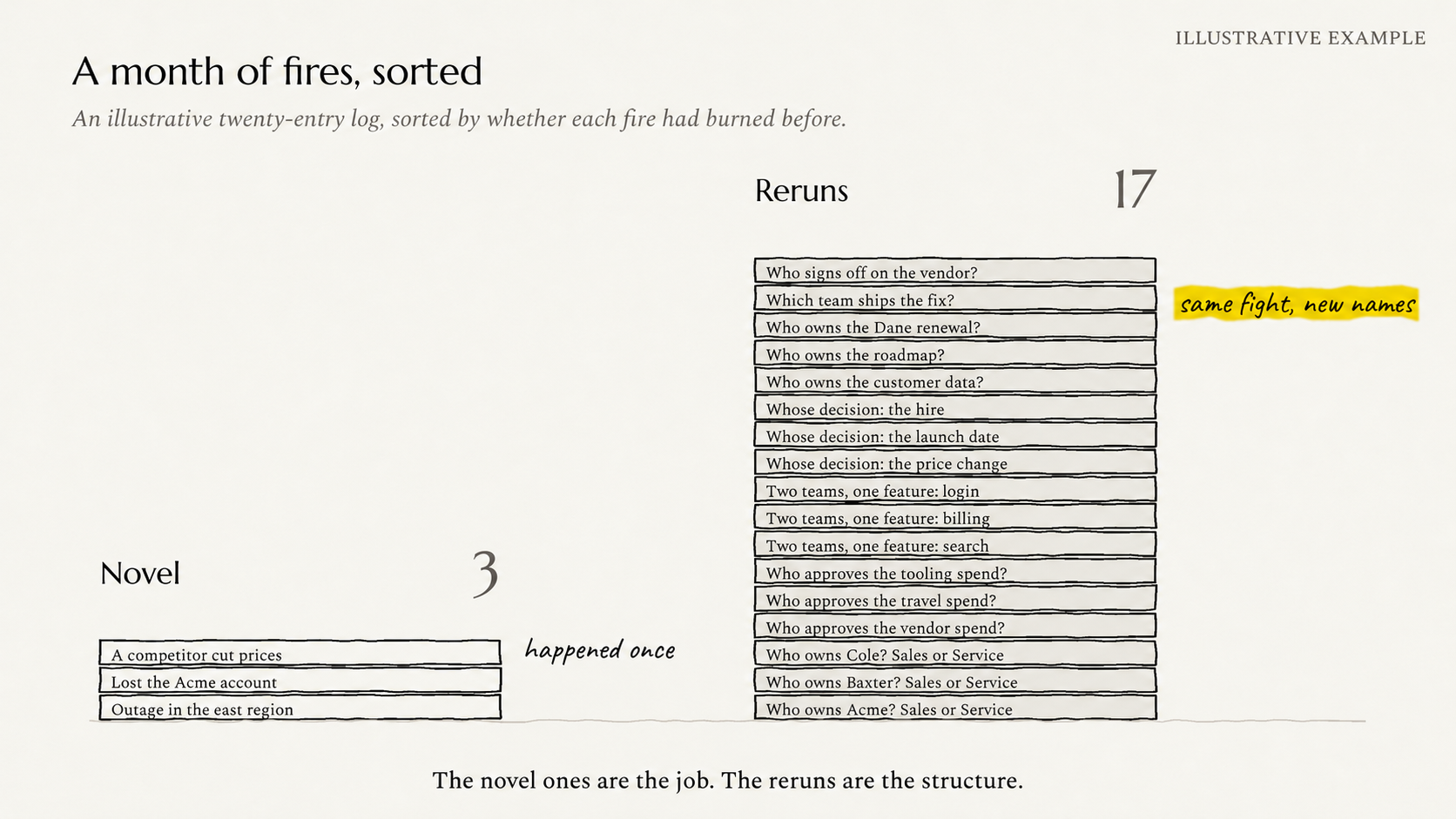
Ask a manager in such a company how things are going and the answer is familiar: we are constantly putting out fires. This author has come to hear that phrase as a diagnostic. A fire is something that needs a leader's personal attention. Some are real: a customer lost, a system down, a competitor's move. Those are novel; they happen once, and the organization learns from them. But most of the fires a leader in a drifted company puts out are the same dispute with new names on it. Two units claim the same customer. Two budgets cover the same work. A decision stalls because nobody is sure who owns it, and it rises until it reaches someone who can rule. If that leader kept a log for a month, she would find most of her fires are reruns.
The fires stop at whatever level holds the authority to settle them, and the ruling settles one case and nothing more, so the next comes up as well. Putting the fires out does not reduce their number. And the person who complains of them is, often without knowing it, the reason they burn. The firefighting is the reward. Being needed is the payoff. The symptom and the incentive are the same thing, which is why it persists at every level at once.
The ambiguity budget
People do not like ambiguity. This author wrote his master's thesis on whether a particular trait helped people deal with it, and the findings were modest, as such findings usually are. [9] But one thing was consistent across every person interviewed: they disliked ambiguity, and their first impulse on meeting it was to resolve it. Sixty years of research on role conflict and role ambiguity, going back to Robert Kahn and his colleagues in 1964, ties ambiguity at work to strain, with the caveat that people differ in how much of it they can carry. [10] It is linked to poorer performance, [11] and to people under strain and planning to leave. [12] This author's reading of that work, and of his own interviews, is that the capacity is real but small. People can carry some ambiguity, not much, and not for long.
Some ambiguity cannot be removed. Markets are uncertain, customers change their minds, technology moves. So think of ambiguity as a budget: each person can tolerate a limited amount, and the organization's capacity is roughly the sum of its people. Market ambiguity is unavoidable and is where the budget should go. Structural ambiguity, who owns the customer, who approves the spend, whose decision this is, is manufactured. Someone drew the lines that way or let them drift that way. And it draws down the same budget. Stalin spent his subordinates' entire budget on fear of him, and the Soviet state paid for it in June 1941. A company with overlapping jurisdictions spends its people's budget on internal fights and arrives at the customer with nothing left.
Why the market punishes what the dictatorship tolerates
Stalin's structure survived for decades because his threat model justified it. His danger was inside. A company in a free market faces the opposite distribution. Its danger is outside, in competitors, in customers who can leave, in shifts in technology that reward the firm able to move as one. A rivalrous structure is tolerable in a stable market, where the units can fight each other and still each sell their product. It fails at exactly the moment the market changes and the units need to cooperate. Sony built digital music players before Apple did, and it owned the hardware, the music, and the electronics expertise to win. Its divisions could not agree on one approach and shipped competing ones, so Apple overtook it with the iPod. [13]
There is one more cost the dictator avoids and the company cannot. Stalin closed the exits. A company cannot, so the structure sorts its workforce. The people who came to work leave, and the people who are good at the fights stay.
The exception
None of this means internal competition is always wrong. There are cases where setting two teams against each other produces something neither would have produced alone, and the test for whether a case is legitimate is the same test that separates Madison from Stalin: who settles the dispute, and does the settlement hold for the next one.
Three conditions mark the legitimate case. First, the rivals are judged by something other than the leader: a metric fixed in advance, a customer, a market result. Procter and Gamble's brand managers competed for shelf space, and the shelf decided. [14] Second, there is a date, and at the date a decision is made to merge, choose, or kill. The competition has an end. Third, the losers are reabsorbed rather than punished, so that losing is a result and not a sentence. Stalin's structure fails all three. The leader judged, there was no end, and losing was fatal. Most drifted companies fail the first two without ever having decided to.
A reader from public administration will object that overlap is good because redundancy improves reliability, an argument that goes back to Martin Landau in 1969. [15] That is true, and it is a different thing. Redundancy means two units can each do the job and either one succeeding is enough. Contested authority means both claim the same decision and someone must rule. The first adds reliability. The second adds fires.
The objection from bureaucracy
A second reader will object that if the remedy for disputes settled by a person is disputes settled by a rule, then the remedy is a rule for everything: a procedure for every collision, nothing decided by judgment and everything by the book. That has a name. It is bureaucracy, and it has costs of its own, which anyone who has worked inside a large institution can list from memory. Some of it is necessary. None of it is free. If this essay is proposing more of it, the reader is right to put it down.
It is not, and the difference is worth stating plainly. There are two kinds of rule. The first says how a dispute between two units will be resolved when it arises. The second says which unit owns the decision, so that the dispute does not arise. The first kind is a procedure, and procedures multiply, because every new collision needs a new one and the old ones never go away. The second kind is a boundary, and boundaries subtract. One clear line about who decides on the customer removes an entire class of dispute and every procedure that would have been written to manage it. Bureaucracy is what happens when an organization keeps the overlap and tries to regulate it: the lines stay blurred, the collisions keep coming, and each one gets its own paragraph in the handbook. An organization that would rather write a procedure than redraw a line is one in which somebody benefits from the line staying where it is.
A third reader will object from the other side, and this author has made her argument himself. Hard lines are how silos get dug. Draw a firm boundary around every unit and you trade the fight for the wall, and the wall has its own bill. That is true, and the answer is that the line and the connection are two different decisions, and the organizations that get this wrong fuse them. The line answers who decides. The connection answers who must be consulted before the decision and who must be told after it. A silo is a hard line with no connection. An overlap is a connection with no line. Neither works. What works is a clear line on the decision and a built channel across it, built because people on either side of a line do not reach across it on their own. Drawing the line does not remove the cost of dividing the work. It moves the cost from the fight to the handoff, and the handoff is cheaper, because it is predictable and nobody wins it.
So the test needs one refinement. When a recurring dispute reaches a leader, the question is not whether to settle it by judgment or by rule. It is whether the line beneath it can be redrawn so that the dispute stops forming, and what channel the work still needs across the new line. If the overlap is real and the work truly belongs to both units, a rule for resolving it is the honest cost of that overlap, written once and kept short. What should never happen is the option most organizations take: keep the overlap, write no rule, build no channel, and let the leader rule on each case forever. That is not judgment. It is Stalin's structure with better manners.
The close
A leader who wants to know whether her organization has drifted into Stalin's structure does not need to examine her motives. She needs to keep a log of her fires for a month and sort them, and to ask the people who report to her to do the same, because most of the fires in a large company burn below the level that can see them. The novel ones are the job. The reruns are the structure. If the reruns dominate, she should ask who benefits from their recurrence, and be prepared for the answer to be herself. Then she should ask whether the line beneath each dispute can be redrawn, and what channel the work needs across the new line. That will make her less necessary. It will also make her organization faster, cheaper to run, and staffed by people who came to work rather than to fight. Stalin could not afford to make himself less necessary. A leader in a free market cannot afford not to.
References
Paine, Sarah C. M. "How Russia Sabotaged China's Rise." Dwarkesh Podcast, October 31, 2025, at about 1:14:31 to 1:16:20. https://www.dwarkesh.com/p/sarah-paine-russo-chinese
Kotkin, Stephen. Stalin: Waiting for Hitler, 1929 to 1941. New York: Penguin Press, 2017.
Jansen, Marc, and Nikita Petrov. Stalin's Loyal Executioner: People's Commissar Nikolai Ezhov, 1895 to 1940. Stanford: Hoover Institution Press, 2002.
Murphy, David E. What Stalin Knew: The Enigma of Barbarossa. New Haven: Yale University Press, 2005. Chapters 15 and 21, on Golikov's assessments and Stalin's reading of the warnings.
Svolik, Milan W. The Politics of Authoritarian Rule. Cambridge: Cambridge University Press, 2012. Chapter 1, figure 1.1: of 316 nonconstitutional removals of authoritarian leaders in office between 1946 and 2008, 303 could be clearly classified, and 205 of those, about 68 percent, were carried out by regime insiders.
Madison, James. The Federalist, No. 51, 1788.
Schlesinger, Arthur M., Jr. The Coming of the New Deal, 1933 to 1935. Boston: Houghton Mifflin, 1958. On Roosevelt's deliberate use of overlapping agencies and rival advisers.
Adamson, Jason. "Trenches, Not Silos: The Bill for Dividing a Company" (September 2026) and "Hold, Collide, Come Apart: The Three Forms the Trenches Take" (October 2026). Available on the author's LinkedIn profile.
Adamson, Jason. The Relationship Between Mindfulness and Ambiguity Tolerance. M.S. thesis, Pepperdine University, 2018. https://digitalcommons.pepperdine.edu/etd/997/
Kahn, Robert L., Donald M. Wolfe, Robert P. Quinn, J. Diedrick Snoek, and Robert A. Rosenthal. Organizational Stress: Studies in Role Conflict and Ambiguity. New York: Wiley, 1964.
Tubre, Travis C., and Judith M. Collins. "Jackson and Schuler (1985) Revisited: A Meta-Analysis of the Relationships Between Role Ambiguity, Role Conflict, and Job Performance." Journal of Management 26, no. 1 (2000): 155 to 169.
Jackson, Susan E., and Randall S. Schuler. "A Meta-Analysis and Conceptual Critique of Research on Role Ambiguity and Role Conflict in Work Settings." Organizational Behavior and Human Decision Processes 36, no. 1 (1985): 16 to 78. On the correlations of role ambiguity with tension and anxiety and with propensity to leave.
Tett, Gillian. The Silo Effect: The Peril of Expertise and the Promise of Breaking Down Barriers. New York: Simon and Schuster, 2015. Chapter on Sony. Sony's first digital Walkman was announced in September 1999; Apple's iPod in October 2001.
Dyer, Davis, Frederick Dalzell, and Rowena Olegario. Rising Tide: Lessons from 165 Years of Brand Building at Procter and Gamble. Boston: Harvard Business School Press, 2004. On the 1931 origin of brand management and competing brands.
Landau, Martin. "Redundancy, Rationality, and the Problem of Duplication and Overlap." Public Administration Review 29, no. 4 (1969): 346 to 358.