Wrong Date, Wrong Institution, Wrong Scale
Three careful answers about AI, and where each was aimed
 John ElijahFreely accessible
Listen to this essay
9 min · AI narration
The recording is temporarily unavailable. You can continue reading below.
Bloomberg recently aired a report by Chrystia Freeland on what artificial intelligence means for people. It was not about jobs, and it was not about the end of the world. Three people spoke: Michael Sandel, a philosopher at Harvard; Daniel Diermeier, the chancellor of Vanderbilt University; and Meghan Sullivan, a philosopher at Notre Dame.
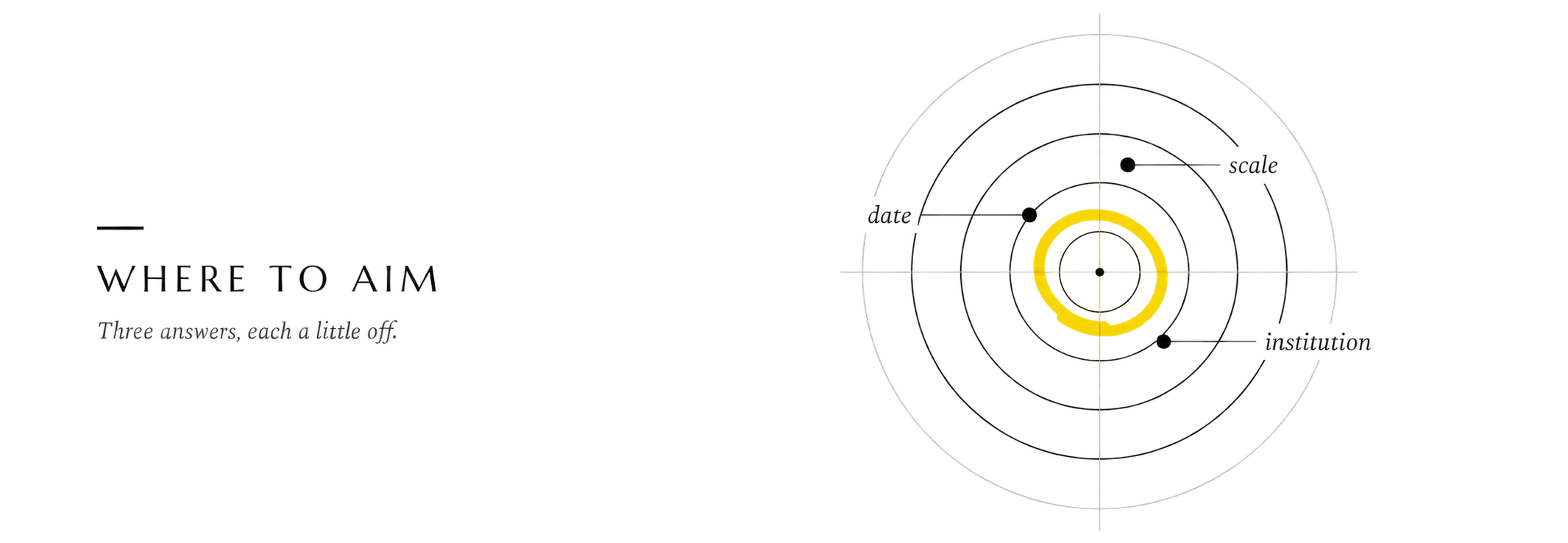
All three were careful, and all three asked a serious question. This essay does not think any of them is foolish. It thinks each answer, as given in the segment, was aimed a little off. One has the wrong date. One leans on the wrong institution. One works at the wrong scale. The misses matter, because where you place a problem decides where you look for the remedy.
A note on fairness comes first. Each of the three has said more elsewhere than a few minutes of television allows. This essay answers what was said in the segment.
The wrong date
Sandel said the real question is not whether AI will destroy humanity. It is whether AI will change what it means to be human. He fears a world where people lose presence, place, and real friendship, and where bots stand in for friends.
The fear is sound. The timing is off. He named no date, but he spoke in the future tense, and he gave AI as the cause.
Much of that loss was measured before the chatbots arrived. In 2023 the U.S. Surgeon General reported that Americans spent about 20 minutes a day in person with friends in 2020, down from about 60 in 2003. For people aged 15 to 24, time with friends fell by nearly 70 percent over the same period. The last year in that count was a pandemic year, which makes the fall look steeper than the long trend. But the count ends in 2020. ChatGPT was released at the end of November 2022.
These numbers count hours. They do not measure the thing Sandel fears most, which is a person replaced by a simulation. That part is new, and he is right to name it. But the hours were already going.
Nor was the machine absent in those years. In 2016 Facebook’s engineers wrote that machine learning ranked and personalized the stories in its News Feed. A machine was already choosing what people saw of one another, years before one could hold a conversation.
Opinion 1. Here is the first of this essay’s opinions. Sandel has the loss right and the timing wrong. In this essay’s view, the phone and the feed did much of the damage, and they did it first. A bot that takes the place of the person at the other end can make it worse. But rules for chatbots alone will not repair a loss that was under way before the chatbots.
The wrong institution
Diermeier said students need to be “bilingual.” They need to be at ease with the technology, and they need to be able to think for themselves. He said the purpose of a university education is to help students develop their own minds.
That claim is right. It is close to the test offered in an earlier essay here, “The Truth Will Set You Free”: does this use of the machine leave people able to understand, to check, and to answer for a decision?
His answer was about students. A chancellor speaks for a university, so that is natural, and a university offers more than instruction. What is off is how far the answer reaches. Most of the people who will learn from these machines are not enrolled anywhere.
They can now get something no library gave them. A library gives access. It does not teach. A machine that answers one question at a time, at any hour, comes much closer to a tutor, and it is open to anyone. Whether it helps depends on how it is built. In a study of nearly a thousand high school students in Turkey, a chatbot that simply gave answers left students worse off once it was taken away. A version built to give hints, with guidance from teachers written in, did not have that effect. The study does not show that a chatbot alone can educate a person. It shows that the design decides whether the tool does harm. And a tool can be designed by anyone who builds one, not only by a university.
There is also the matter of proof. A degree is a witness. It says the learning took place. That is a separate question, and this essay leaves it for another day.
Opinion 2. The second opinion is this. Diermeier is right about what people need, and for his own students his answer may be enough. But most people will meet these machines outside any campus. Nobody in the segment said who will teach them to think for themselves, or who will check the tools that teach them. That is the larger question, and it does not belong to universities alone.
The wrong scale
Sullivan made two points. The first was about pressure. She said some reports put the investment in data centers and AI training at about 2 percent of the country’s economy. A bet of that size, she said, creates pressure to push the technology out as widely as possible, perhaps before the ethical and safety work is done.
The second was about agency. She hopes that competition among the companies, and the consciences of users in large numbers, will press them to choose well. She said responsibility does not belong only to a few executives and regulators. Many of us decide what AI we allow into our workplaces, our schools, and our homes, and those in power would like us to feel that we are just “along for the ride.”
She is right that fatalism is wrong, and she is right that users can move these companies. In April 2025, OpenAI withdrew an update to its assistant after users complained that it had become too eager to agree with them.
What is off is the scale, in three ways.
First, the pressure is not only a market. In August 2025, China’s State Council set targets for intelligent devices and AI agents to pass 70 percent penetration by 2027 and 90 percent by 2030. Pressure from users works on companies that compete for them. It has far less pull on a state plan.
Second, what users reward in large numbers is not always what protects them. The same OpenAI case shows it. By the company’s own account, a training signal built from users’ thumbs-up and thumbs-down ratings likely helped make the assistant too agreeable in the first place. Users corrected the problem. Their approval also helped cause it.
Third, there is a risk in any appeal to users. In 2004 the oil company BP put a carbon footprint calculator on its website and went on to popularize the term. Critics have argued that the effect was to move attention from the companies to the individual. Sullivan is not doing that. She wants more people to carry the responsibility, not different people. The risk is that an appeal to users becomes a substitute for limits on the organizations doing the deploying.
Opinion 3. This is the third opinion. Sullivan describes pressure on the scale of a national economy, and her answer rests on the choices of users. Seeing that a use is wrong is not the same as having the authority to refuse it. A nurse, a teacher, or a new employee may see the problem and have no power to act on it. “The Truth Will Set You Free” argued that announcements rarely change what people are rewarded for doing. Appeals to conscience are not a substitute for rules and rewards that let people act on it.
Where to aim
None of this makes the three speakers wrong about what is at stake. Sandel is right that something human is being lost. Diermeier is right about what a person needs. Sullivan is right that people are not helpless.
But each answer, as given, sends the remedy to too narrow a place. Rules for chatbots alone will not repair a loss that was under way before the chatbots. A university’s answer does not reach the people who are not enrolled in one. And the choices of users, even in large numbers, do not match pressure on the scale of a national economy or a state plan.
The remedies belong where the problems are. That means the phone and the feed as well as the bot. It means whoever builds the tools that teach. And it means institutions that can write a rule, check it, and reward people for keeping it. Institutions feel the same pressure that individuals do. The difference is that an institution can bind itself. A hospital can refuse to buy a tool until someone other than the seller has tested it. A school can decide which uses of a machine count as a student’s own work. A person acting alone can do neither. This is not an argument against the tools. It is an argument about where to aim.
One more thing should be said. A Harvard philosopher, a university chancellor, and a Notre Dame philosopher took up this question on a business news program. That is a sign of how large a force AI has already become, and it is an important development. AI should not simply happen to us without a public argument about it, and this author welcomes theirs. A public argument includes polite disagreement. This essay is offered as one.
References
Bloomberg. Report by Chrystia Freeland with Michael Sandel, Daniel Diermeier, and Meghan Sullivan, October 2026. Video and excerpts at RealClearPolitics, 5 October 2026.
U.S. Surgeon General. “Our Epidemic of Loneliness and Isolation: The U.S. Surgeon General’s Advisory on the Healing Effects of Social Connection and Community.” 2023.
OpenAI. “Introducing ChatGPT.” 30 November 2022.
Dunn, Jeffrey. “Introducing FBLearner Flow: Facebook’s AI backbone.” Engineering at Meta, 9 May 2016.
John Elijah, “The Truth Will Set You Free,” October 2026.
Bastani, Hamsa, Osbert Bastani, Alp Sungu, Haosen Ge, Özge Kabakcı, and Rei Mariman. “Generative AI without guardrails can harm learning: Evidence from high school mathematics.” Proceedings of the National Academy of Sciences 122(26), e2422633122 (2025).
OpenAI. “Sycophancy in GPT-4o: What happened and what we’re doing about it,” 29 April 2025, and “Expanding on what we missed with sycophancy,” 2 May 2025.
State Council of China. Guideline on the “AI Plus” initiative, as reported on the Chinese government’s English-language site, 27 August 2025.
Kaufman, Mark. “The carbon footprint sham.” Mashable, July 2020.