Can Europe’s Social Model Save Itself?
Most of Europe’s pension and care systems have no working way to correct course in time. Some built one and switched it off. One kept it.
 John ElijahFreely accessible
Listen to this essay
34 min · AI narration
The recording is temporarily unavailable. You can continue reading below.
Part one
Across Europe, the systems that pay for pensions, health care, long-term care, and support for people out of work are under strain. Most arguments about them ask whether they are too big, too generous, or too expensive. This essay asks a different question. When conditions change, can these systems still correct course?
This author’s answer is yes, but fewer of them can than most people assume, and the number falls each year they wait.
The reason is not their size. It is that most of them have no working stopping rules. A stopping rule is a feedback loop that connects evidence of drift to corrective action in time. It gives a system a regular way to respond before a problem becomes much harder to fix. Where such rules do exist, they have often been allowed to wither, suspended the moment they began to bite.
In time does not simply mean early. It means two things. First, the correction is still small enough to absorb. People can bear it without the system breaking the promises it exists to keep. Second, there is still enough time between the decision and its effect for people to plan around it. A worker told at 45 that her retirement age will rise by a year can adjust her savings and her plans. A worker told the same thing at 62 cannot. The same change is in time for one and too late for the other.
When a correction is not made in time, its cost does not go away. It builds up. This essay calls that cost stewardship debt: the accumulated cost of corrections a state should have made and did not. Software engineers know a cousin of this idea as technical debt. Stewardship debt differs from the money a state borrows in one important way. Financial debt is counted every quarter. Stewardship debt appears on no balance sheet. It stays invisible until it comes due, and like any debt, it compounds.
Left long enough, stewardship debt produces something worse. This essay calls it correction lock: the point at which an entity can no longer correct course, because any correction large enough to work now sets off the resistance, disruption, or loss of trust that stops it from being carried out. A small business reaches correction lock when it cannot cut costs without losing the people it needs to recover. A state reaches it when it cannot reform its pensions without bringing down its own government. At that point, the fix has become the thing that kills the fix.
The consequences follow in a chain. Without correction in time, stewardship debt piles up. As it piles up, the state moves toward correction lock and loses its practical ability to govern. It can still see the problem, often in great detail. What it loses is the ability to agree on a response and carry it out. Citizens notice. They watch the same problems go unsolved year after year, and their confidence in the state falls. And that lost confidence makes the next correction harder still.
That last step is a feedback loop too, but of the opposite kind. A stopping rule is a correcting loop: drift appears, and the system pulls it back. Distrust is a self-reinforcing loop: each failure makes the next failure more likely. Correction lock is the point where the second loop overpowers the first.
This author calls the change in public confidence the move from assumed competence to inferred competence. When a state works, people assume it knows what it is doing. When it keeps failing to fix what everyone can see, they stop assuming and judge it by results instead. A state judged by its failures has little standing to ask anyone for sacrifice.
France shows the whole chain at work. In the fall of 1995, Prime Minister Alain Juppé set out to cut the budget deficit ahead of the move to the euro, from about 5 percent of the economy to 3 percent. Part of his plan changed pensions for public-sector workers and for the special schemes that covered rail and transport staff. The workers walked out. Trains, subways, and buses stopped for weeks. Polls showed most of the public behind the strikers. On December 15, the government withdrew the pension changes. Other parts of the reform went ahead.
Three decades later, France is having the same argument with far less room to move. Budget fights helped bring down Michel Barnier’s government in December 2024 and François Bayrou’s in September 2025. Public debt reached 119 percent of the economy in the second quarter of 2026. And the scheduled increases in retirement age and contribution years from the 2023 reform have been paused until 2028. France knows its problem. It has known it for thirty years. What it lacks is a way to settle it.
Britain shows the same chain from another direction. France struggles to pass corrections. Britain has passed them and then not carried them out. In 2014, Parliament wrote a cap on the cost of care in old age into law. It was delayed, announced again, delayed again, and cancelled in 2024. It never took effect. Meanwhile, for fifteen years, Britain kept a pension rule that ran in only one direction. It could raise the state pension every year, but it could never slow it. A change was finally announced in 2026, to take effect in 2030.
There are other good ways to look at all of this, and they overlap. Economic analysis looks at costs, revenues, and growth. Political analysis looks at consent, incentives, and institutions. The sociologist Wolfgang Streeck described borrowing as one way governments postponed the conflict between what markets demanded and what democracies had promised. He called it buying time. Demographic analysis looks at a population that is getting older. Each of these lenses is legitimate, and each points to its own kind of solution.
This essay uses the lens of systems. It is not a better lens. It is a different one, and it leads to different solutions. Through it, a social model looks like any other system set on a course, whether a small business, a large company, or a nation. Conditions change. If the rules do not change with them, the system drifts. Drift by itself is not failure. Failure is drift that no feedback loop is set up to catch.
Seen this way, a social model has two lines that matter most. One is what it has promised. The other is what it can pay for. When the lines run parallel, the system holds. When they start diverging, the gap grows a little each year. And as the gap grows, claims from different groups start converging on the same budget, leaving less room to satisfy any of them: young and old, workers and retirees, taxpayers and the people their taxes support.
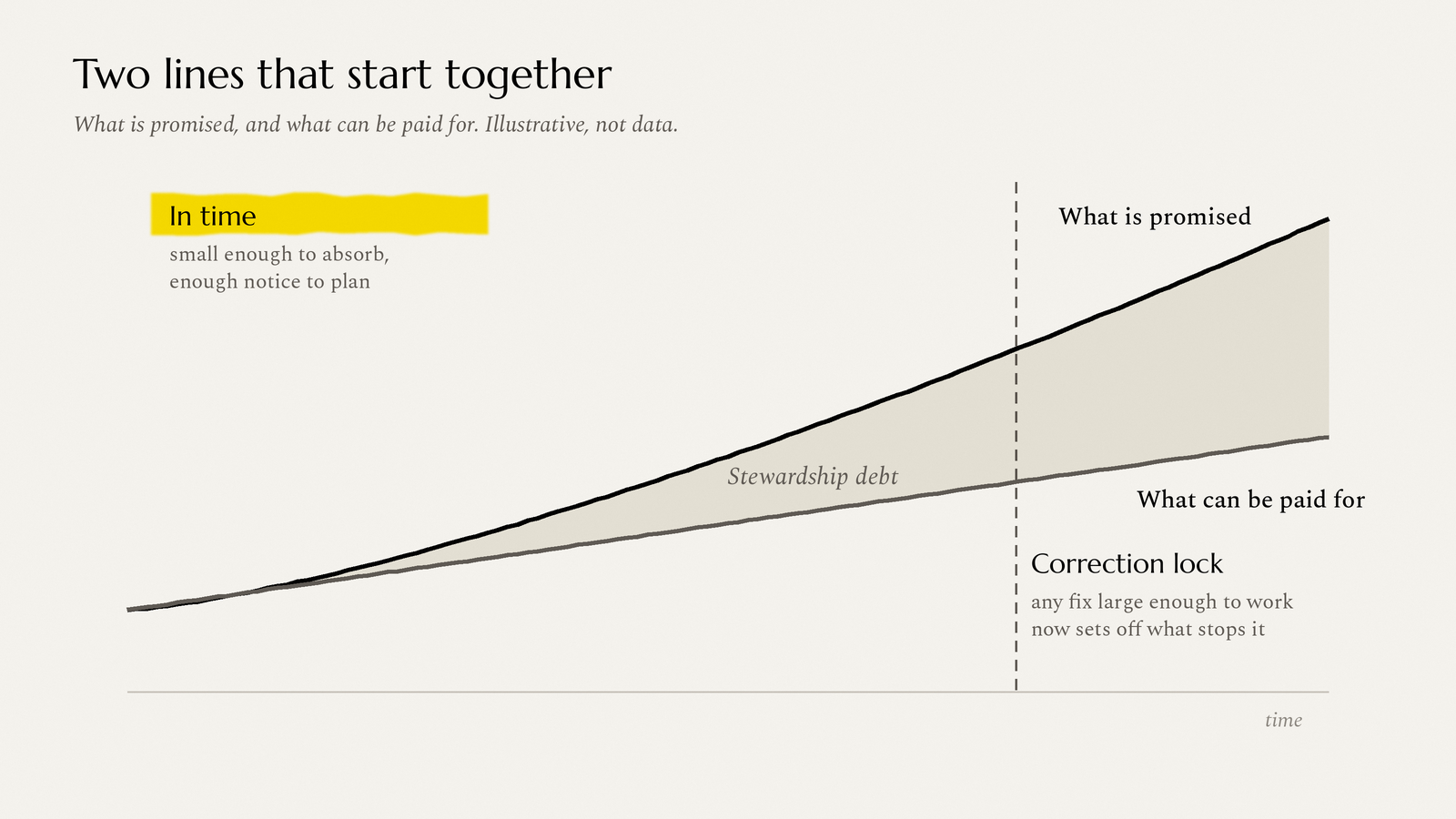
A business that leaves that kind of gap alone eventually pays for it or fails. Failure is painful, but it ends. A state does not get that ending. A country can restructure its debts, but it cannot be wound up like a company. Its citizens still need hospitals, schools, pensions, and police the morning after. So stewardship debt does not disappear. It stays with the people, and it arrives as a choice among hard options: sharp cuts, higher taxes, a debt crisis, or a slow loss of faith in the state itself.
There are a few things this essay does not argue. It does not forecast revolution in France, Britain, or anywhere else. It is not an argument against social protection, or against democracy. It takes no side between parties. Stewardship debt has been built up from more than one direction: by those who resist any change to benefits, and by those who cut taxes without cutting promises.
So can Europe’s social model save itself? The rest of this essay argues that it can, but not through one more large reform. Large reforms are exactly what correction lock defeats. The way out is to close the feedback loop, with rules that act in time, while the changes are still small enough to bear. Sweden did it. Others built such rules and then switched them off. The question is whether the rest will build them, and keep them, before their stewardship debt makes the choice for them.
Part two
The warning was there from the start. In 1942, William Beveridge wrote the report that became the blueprint for Britain’s postwar social model. He saw that the population was aging and that birth rates were low, and he raised the need for later retirement. The people who designed these systems knew that their two lines would someday diverge.
What they built was a large expansion of systems that already existed. Germany had introduced old-age pensions in 1889. After the Second World War, the rich democracies greatly widened pensions, health care, unemployment support, and public services. This author sees that expansion as part of the postwar settlement. Europe had just lived through two world wars, a depression, and movements that promised to tear the old order down. Social protection gave citizens a stake in the order that replaced it.
For a time, the conditions were kind. Economies grew fast, and the working-age population was large. Promises were easy to finance. Then growth slowed, birth rates fell, and people lived longer. Governments changed benefits, contributions, and retirement ages. But the changes did not keep pace with the pressure.
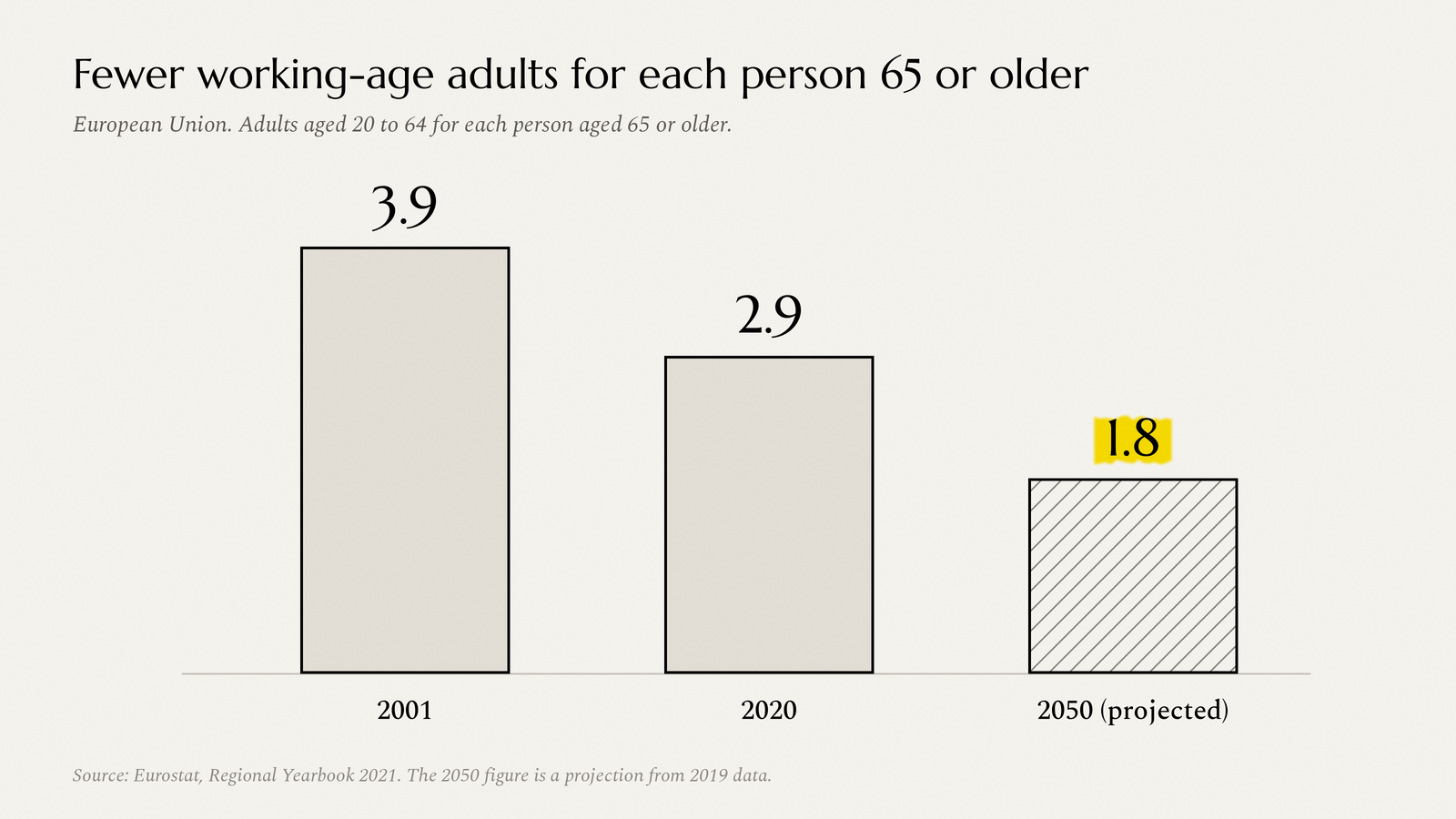
The size of that pressure is not in dispute. Pensions alone absorb about 14 percent of France’s economy, well above the OECD average of about 8 percent. In 2001, the European Union had almost four adults aged 20 to 64 for every person aged 65 or older. By 2020, it had fewer than three. Eurostat projects fewer than two by 2050. None of this is a secret. The projections have been public for decades. The question is what happens after the warning.
In France, the answer has been a long series of fights. After 1995 came a 2003 reform that raised the years of contributions required of public employees. A 2010 law began raising the retirement age from 60 to 62. A 2023 law scheduled a further rise to 64, and the government used Article 49.3 of the constitution to pass it without a final vote in the National Assembly. Now part of that law is on pause.
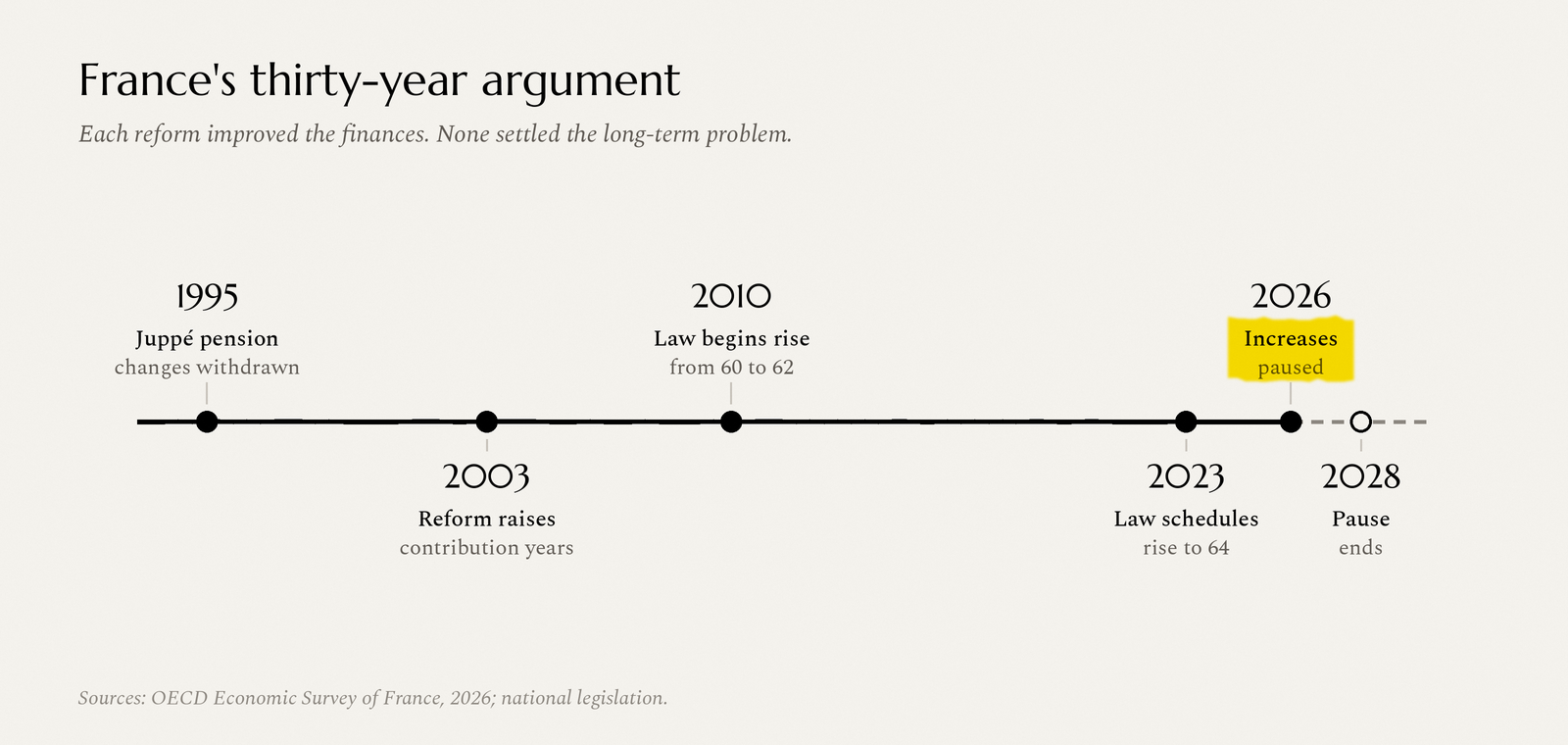
Each of these reforms improved the finances. None settled the long-term problem. The OECD’s 2026 review found that even the 2023 changes, carried out in full, would hold pension spending near 14 percent of the economy through 2045 while still leaving a funding shortfall. It again recommended tying the retirement age to life expectancy.
France does not lack the first half of a feedback loop. It has advisory bodies, regular projections, and scheduled reviews. Its 2003 reform even tied the required years of contributions to life expectancy. What France lacks is the second half: a rule that turns a warning into a decision without a new political war each time. The signal is there. The loop is open. Every correction must be won from scratch, and each delay makes the next one larger, later, and harder to absorb. Each fight adds to the stewardship debt it was meant to pay down.
Britain shows a different way to reach the same place. In 2011, it adopted the triple lock. Each year, the state pension rises by whichever is highest of inflation, average earnings, or 2.5 percent. It is a rule, but for fifteen years it ran in only one direction. It could raise pensions. It could never slow them. By the Institute for Fiscal Studies’ estimate, the triple lock cost about £16 billion more in 2026–27 than linking pensions to earnings would have. In its July 2026 projection, the Office for Budget Responsibility found it accounted for about half of the projected long-term rise in state pension spending. In September 2026, the government announced a change. From April 2030, the pension will still rise by at least inflation or 2.5 percent, but over time it will track average earnings rather than ratchet above them. Measured against this essay’s test, that change is in time: it is modest, it keeps a floor, and it gives years of notice. It took fifteen years to arrive.
Long-term care tells a starker story. In 2011, a commission led by the economist Andrew Dilnot recommended a cap on what people pay for care in old age. Parliament wrote the cap into law in 2014. In 2015, it was delayed to 2020. In 2021, a new cap was announced for 2023. In 2022, it was delayed to 2025. In 2024, it was cancelled. A new commission is due to report in 2027. In fifteen years, no cap has ever taken effect. That is stewardship debt in plain sight: a problem everyone agrees exists, a fix written into law, and more than a decade of postponement that left the cost exactly where it was.
France struggles to pass corrections. Britain has passed them and not carried them out. Other countries went further. They built the kind of rule this essay describes, then switched it off.
By the OECD’s count in 2021, about two-thirds of its members had at least one automatic adjustment somewhere in their pension systems. On paper, that looks like the opposite of this essay’s claim. But look at what happened to those rules once they began to work.
Germany created a sustainability factor in 2004. It slowed pension increases as the number of retirees grew relative to the number of workers paying in. Later, a guaranteed floor on pension levels overrode it. The 2025 pension package extended that suspension through 2031 and kept a guarantee that a standard pension would not fall below 48 percent of average earnings, measured before tax. The factor is due to return in 2032.
Spain passed a sustainability factor in 2013. It was meant to adjust new pensions as life expectancy rose. It never took effect. It was postponed, then replaced in 2021.
Outside Europe, Japan shows the same pattern. It introduced its own adjustment rule in 2004. Because of deflation and earlier benefit freezes, the rule was not applied even once until April 2015, eleven years later.
That is what atrophy looks like. The loop is built, then cut. The rule is written. The rule is praised. Then, when it would actually cost someone something, it is suspended, delayed, or quietly replaced. And pensions are the best case. In this author’s reading, health care and long-term care, the costs that grow fastest as a society ages, are rarely governed by any automatic correction at all. So the record cuts two ways, and both support this essay’s claim. Outside pensions, stopping rules are mostly absent. Inside pensions, they are often switched off.
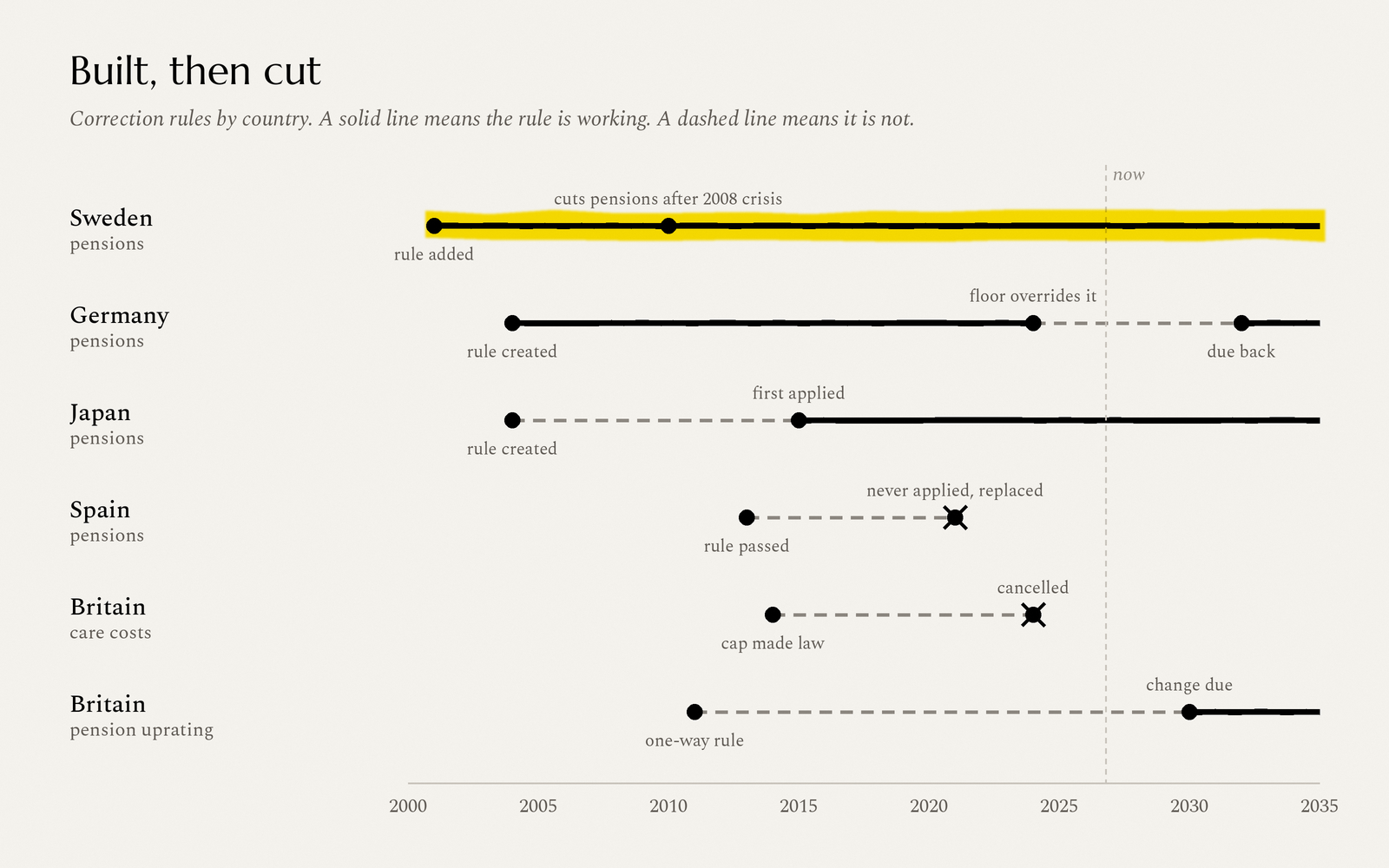
Sweden is the exception that shows what a working rule looks like. In the early 1990s, a severe economic crisis exposed the weaknesses of its old pension system. The government developed proposals in 1992. Parliament agreed on the main principles in 1994, passed most of the legislation in 1998, and added an automatic balancing rule in 2001. The parties behind the reform set up a joint group to oversee it together.
The rule is simple to describe. When the income pension’s measured obligations grow larger than its assets, pensions and pension rights grow more slowly, or even fall. No new vote is needed. The rule works in time because it checks the balance every year and adjusts as soon as the system falls out of balance, while the gap is still small. After the 2008 financial crisis, it did exactly what it was built to do, and pensions fell in several years. It was painful. But the loop held, and nobody cut it.
Sweden did not avoid a crisis. It reformed in the middle of one. What it did was make sure the next correction would not need another crisis to happen. That is the difference between a reform and a stopping rule. A reform pays down stewardship debt once. A stopping rule keeps it from piling up again.
A reform pays down stewardship debt once. A stopping rule keeps it from piling up again.
The cost of postponement reaches beyond the budget. When correction is absent or switched off, stewardship debt builds. Each year, governments have fewer changes they can agree on and carry out. Problems that could once have been handled through ordinary decisions turn into long struggles that bring down prime ministers. That is the road to correction lock. Part three follows it: how a state that can still see its problem loses the ability to act on it, and what happens when young and old start pulling on the same budget.
Part three
Postponement does not just delay a correction. It changes the correction. A change that could have been small and slow becomes large and fast.
Go back to the worker from part one. Suppose a government decides to raise the retirement age by one year and announces it twenty years ahead. That asks very little of anyone. People in their forties adjust their plans. People near retirement are untouched. Now suppose the government waits fifteen years. The gap has grown, so the change must be bigger. The notice is shorter, so the change lands on people who have already made their plans. The same correction that once passed the test of in time now fails it on both counts. It is too large to absorb and too sudden to plan for.
That is how stewardship debt turns into correction lock. The longer a state waits, the more its corrections look like the ones people resist hardest: large, abrupt, and aimed at those closest to the line. That resistance is not a sign that citizens fail to understand the problem. Often they understand it very well. A worker a few years from retirement who is suddenly told to work longer has a sound reason to object. The terms changed late, and that worker is the one paying for the delay. Sustained public opposition and strikes are what late corrections tend to produce.
The second effect falls on the state itself. As stewardship debt grows, the set of changes a government can agree on and carry out gets smaller. Every option now costs someone a great deal. Coalitions that could have shared a small cost split over a large one. In France, governments have fallen over budgets, and the last major pension law could only pass by skipping a final vote in the National Assembly. That is a state that can still see its problem but can no longer act on it through ordinary decisions. Problems a healthy system would handle in a single budget turn into struggles that last for years. Those struggles consume the time and standing a government needs for everything else.
The third effect falls on the public. Citizens watch the cycle. A reform is announced, fought over, delayed, diluted, or reversed. The problem remains. After enough rounds, people draw a conclusion about the state itself. They stop assuming it knows what it is doing. They start judging it by what it delivers. On this issue, what it has delivered is a decades-long argument with no settlement. That is the move from assumed competence to inferred competence.
This is where the self-reinforcing loop takes over. Research by Julian Garritzmann, Erik Neimanns, and Marius Busemeyer, drawing on surveys across eight European countries, found that trust in government makes people more willing to accept reforms that carry costs and risks now in exchange for benefits later. Trust also softens the pull of narrow self-interest. Take trust away, and each person weighs a reform mainly by what it costs them personally. A state that has lost trust is asking people to accept a sacrifice on its word, and its word is exactly what it has spent. So the next correction gets harder. The delay grows, the correction needed grows with it, and the loop turns again.
The fourth effect falls on the young. As the two lines diverge, claims converge on the same budget. Retirees, workers, students, and families all draw from it, and it cannot grow fast enough to meet every claim. The groups do not compete on equal terms. Older citizens vote at higher rates. Their benefits are protected by law, and sometimes by rules such as the triple lock Britain kept for fifteen years. The cost of delay falls hardest on those who arrive last.
France makes the point with its own numbers. Its Pensions Advisory Council reports that French retirees today enjoy a standard of living roughly equal to that of the population as a whole, one of the highest levels among the countries the council tracks. That is a real achievement. But the council also projects that, by 2070, the relative standard of living of retirees will fall to around 90 percent of the population’s. Today’s young workers are paying into a system on terms that will not be offered to them when they retire.
This is not a claim that the old are taking from the young on purpose. It is what happens when correction is postponed. Someone always pays for the delay. The people who pay are the ones who were not in the room when the decision was put off, and many of them were not yet old enough to vote.
That is the full chain. A missing or switched-off feedback loop lets stewardship debt build. Stewardship debt makes each correction larger and later, which sets off the resistance that blocks it. Blocked corrections drain the state’s ability to govern. Citizens watch that failure and stop trusting the state. Lost trust makes the next correction harder still.
At the end of the chain, a state still has every tool on paper. It can still pass laws, raise taxes, and change benefits. What it no longer has is the standing to use them. When that happens, change does not stop coming. It comes from outside the ordinary process. Part four looks at how that has happened before.
Part four
When a state reaches correction lock, change does not stop. It moves. It leaves the ordinary process of budgets, laws, and elections and arrives some other way. History offers several versions of that move, and France has lived through more of them than most countries.
The clearest case is the one this essay has already touched on. In 1786, the French monarchy was nearly bankrupt, largely from the cost of its wars. The finance minister, Charles Alexandre de Calonne, proposed what was in effect a stopping rule: a tax on land that the nobility and the clergy would pay like everyone else. He called an Assembly of Notables in 1787 to approve it. The notables refused. Calonne was dismissed. His successor tried again and was blocked by the courts. In August 1788, the king was forced to summon the Estates-General, which had not met since 1614. Days later, the treasury suspended payments.
Look at that sequence through the chain in part three. The state could see its problem clearly. Its own ministers had written the fix. Each attempt to correct was blocked by those who would pay for it, and each failure made the next attempt larger and more urgent. By the end, the monarchy still had every tool on paper. It had lost the standing to use them. The correction came anyway, from outside the ordinary process. It came with the National Assembly of 1789 and the abolition of the old privileges that August.
It is worth noticing who made that correction. It was not one group. The Third Estate held together lawyers, merchants, urban workers, and peasants, and they were joined by some liberal nobles and clergy. These people agreed on very little except that the old order could not go on. That was enough to bring it down. It was not enough to agree on what came next. Within five years, the revolution had turned on its own leaders, and the Terror settled the scores that the shared enemy had kept in check.
The pattern repeats elsewhere. In Russia in February 1917, a broad and largely spontaneous coalition of workers, soldiers, liberals, and socialists brought down the tsar. In October, the Bolsheviks seized power from the government that February had created. They governed from December 1917 in coalition with the Left Socialist Revolutionaries, who gave them support among the peasants. That coalition broke in March 1918. By July, the Left Socialist Revolutionaries had risen up and been crushed. Allies for the seizure became enemies within months.
Moments like these produce coalitions of convenience. Groups that share some grievances, but not all of them, set their differences aside to defeat a common target. They are often more effective together than they would be apart. The differences do not disappear. They wait. Once the old order falls, the fight over what replaces it begins, and the scores are settled then.
Not every break looks like 1789 or 1917. Some are orderly. France’s Fourth Republic, created after the Second World War, went through more than twenty governments in twelve years. It could see its problems, above all the war in Algeria, but could not hold a government together long enough to resolve them. In 1958, after an army-backed uprising in Algeria, parliament gave Charles de Gaulle the power to write a new constitution. Voters approved it by a large majority. The Fifth Republic was born without a revolution in the streets. But the change still came from outside the ordinary process. The old system did not reform itself. It was replaced.
Some breaks come from creditors. In 2010, Greece could no longer borrow on its own and accepted rescue loans on terms set largely by others. In 2011, as Italy’s borrowing costs soared, Silvio Berlusconi resigned, and a government led by the economist Mario Monti took office to push through changes that ordinary politics had not. In both cases, the decisions that elected governments had put off were made under pressure from markets and lenders. They were not made in time, and they were not made on terms the country chose.
These cases differ in almost every way: monarchy and democracy, violence and peace, the eighteenth century and the twenty-first. What they share is the order of events. A problem was seen. Correction was postponed until it was too large to absorb. Ordinary decisions failed. Then change arrived from outside the process that was supposed to make it. The street, a new constitution, and the bond market are all versions of the same thing. Each is what correction looks like when the feedback loop has been open for too long.
None of this is a forecast. France and Britain are not France in 1788, and nothing in this essay predicts a revolution, a new republic, or a debt crisis. In France today, parties on the far left and far right, who agree on little else, have voted together to bring down governments. That is a coalition of convenience at the level of parliament, not the street. Whether it ever becomes something more is unknowable. It is a reminder that the conditions for such coalitions are present.
The point of this history is simpler. When a system reaches correction lock, it loses the ability to choose how it changes. The correction still happens. But its size, its speed, and who bears its cost are no longer decided by the system itself. They are decided by whoever and whatever is left standing. That is the real price of stewardship debt. It is not only that the bill gets larger. It is that someone else ends up deciding how it gets paid.
Part five turns to the alternative: what it takes to keep that choice in a democracy’s own hands.
Part five
The systems lens leads to a different kind of solution. It does not ask which policy is right: a higher retirement age, higher taxes, lower benefits, or some mix. Those are real choices, and economists and political leaders will keep arguing over them. The systems lens asks something earlier. Whatever a country decides, does it have a feedback loop that will correct that decision in time when conditions change? A good policy without such a loop will drift. A modest policy with one can be kept on course.
Some readers will draw a different conclusion from this argument. If democracies cannot correct themselves, perhaps the answer is a government that does not need consent. In 2009, the columnist Thomas Friedman suggested that a one-party state, led by capable people, could have great advantages over democratic gridlock. The record supports a far more modest claim. A one-party state can start large projects quickly. It is not better at correcting drift. China kept its one-child policy for thirty-five years after the warnings began, and left retirement ages set in the 1950s in place for about seventy years. It held its zero-COVID policy for nearly three years, then dropped it almost overnight. And as part four showed, France’s own monarchy had near-absolute power before 1789 and still could not make the privileged pay. Alexis de Tocqueville observed that the most dangerous moment for a bad government is usually when it begins to reform. The economist Amartya Sen found that no major famine has struck a functioning democracy with a free press.
The reason is the feedback loop. Rule without consent breaks it at the start, by silencing the warnings that show drift early: a free press, open data, and voters who complain. It can act, but it often cannot see. Democracies break the loop at the other end. They can see, but they struggle to act. The answer is not to give up seeing. It is to close the loop.
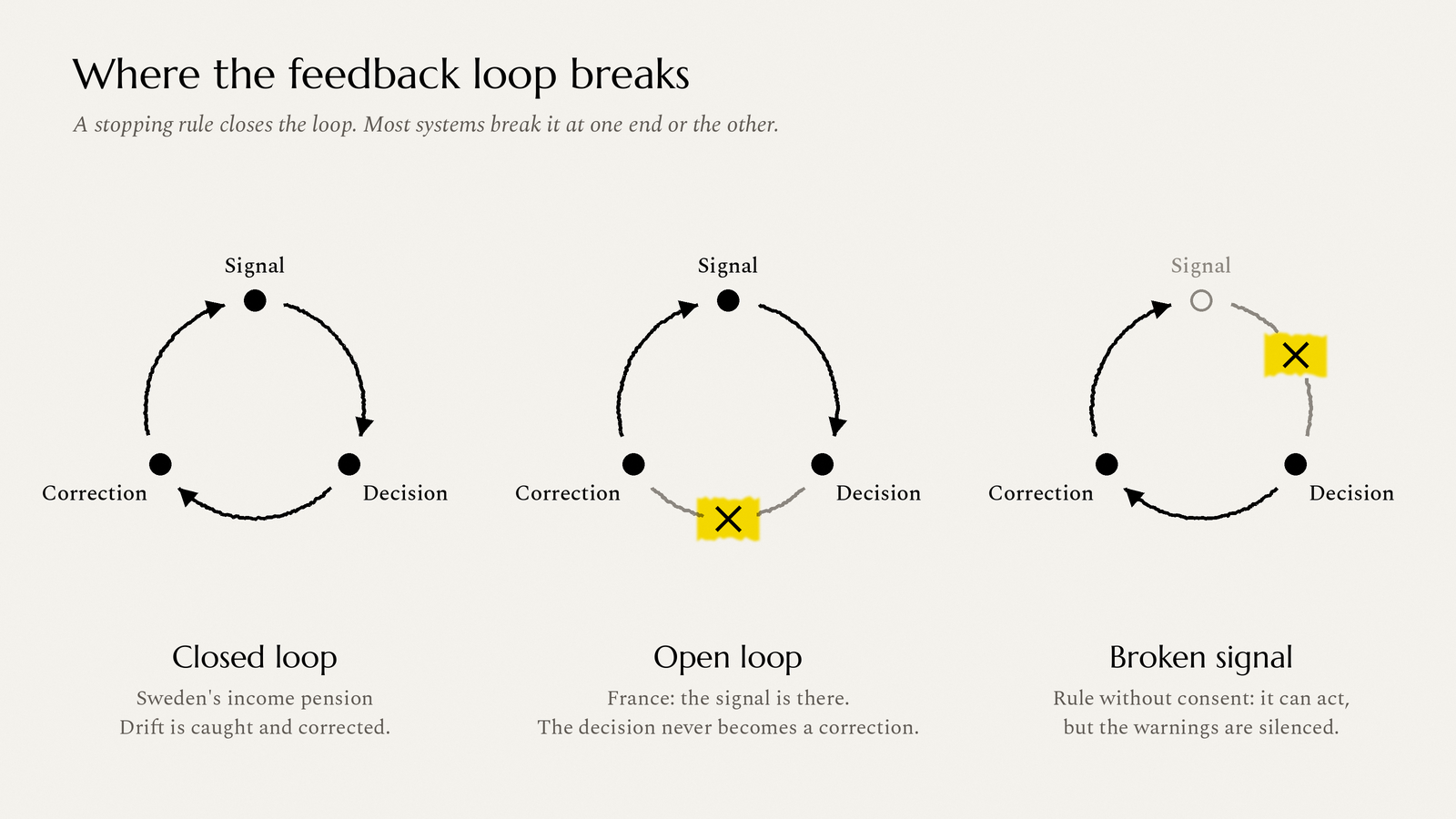
What does a closed loop look like? Sweden’s pension rule is one example, but the parts are general. They apply to a pension system, a health service, a city budget, or a small business.
First, a signal agreed in advance. The system names, ahead of time, what it will watch and what level counts as drift. In Sweden, it is the balance between the pension system’s obligations and its assets. Elsewhere it might be life expectancy, the ratio of workers to retirees, or the cost of care per person. The point is that the trigger is chosen before anyone knows whom it will hit. That is when agreement is easiest.
Second, a response that happens by default. This is the part most systems leave out, and it is the part that matters most. In France, a warning leads to a debate. In Sweden, a warning leads to an adjustment, unless someone acts to stop it. That reverses the burden. Doing nothing no longer means drifting. It means correcting. A government that wants to suspend the rule must do so openly, and must explain who will pay instead.
Third, corrections small enough to absorb. A loop that acts a little every year keeps each change in time. Denmark and the Netherlands both tie their retirement ages to life expectancy, so the age rises gradually, with years of notice, as people live longer. No single step is large enough to bring down a government.
Fourth, a floor. A rule that only balances an account can still leave people with too little to live on. Sweden pairs its balancing rule with a guaranteed minimum pension, paid from taxes, for those with low lifetime earnings. A loop that protects the system’s finances while abandoning the people it exists to serve will not keep public support for long.
Fifth, a review of the rule itself. Conditions change, and a rule set in 2001 may not suit 2040. A working loop includes a regular, scheduled point where the rule can be revised, in the open, by the same broad agreement that created it.
There is a fair objection to all of this. A rule does not remove politics. It contains choices about who bears costs, and an elected government can always change it. Germany’s sustainability factor shows exactly that. And perhaps the deeper problem is not the missing rule but the disagreement that kept it from being built in the first place.
The answer is that no rule can remove disagreement, and none should try. Disagreement is part of self-government. What a loop changes is the default. Without one, every correction must be won from scratch, against those who will pay for it, at the moment the cost is clearest. With one, correction happens unless someone stops it, and stopping it has to be done in the open. That does not guarantee good outcomes. Germany chose to suspend its rule, and that was a legitimate choice. But it was a visible one, with a date for the rule’s return. Rejecting a correction still leaves the problem in place. A loop makes sure that fact cannot be quietly forgotten.
Sweden also answers the question of how such rules get built. Its parties did not agree on everything. They agreed, during a crisis, on a process. That is the lesson for any country that wants a loop: the time to build one is before the next correction is due, while no one yet knows whose turn it will be.
Pensions are where this has been tried most. They are not where it is needed most. Health care and long-term care are growing faster as populations age, and, in this author’s reading, they are rarely governed by any automatic correction at all. Britain’s fifteen-year argument over a care cap is what a missing loop looks like in that field. The same principles apply there: an agreed signal, a default response, small steps, a floor, and a review.
Leadership matters too, though less than people expect. Most campaigns promise large changes, and large changes are exactly what correction lock defeats. A candidate who runs on maintenance offers something less exciting: small, tolerable adjustments made every year to keep the lines parallel. It is not a promise that wins applause. But voters can reward it, and the countries that have kept their loops closed have usually had leaders willing to make it. Institutions matter more than any one leader, because a good loop keeps working after the leader who built it has gone.
This principle does not belong to one party. It does not say whether a country should spend more or less, or tax more or less. A country with a large social model and a closed loop is in better shape than a country with a small one and an open loop. What the principle asks of every side is the same: decide what you are promising, decide how you will know when the promise is drifting, and decide in advance what will happen when it does.
So, can Europe’s social model save itself? It can. Sweden shows that a democracy can build a loop, keep it running through a crisis, and accept the pain it brings without tearing the loop out. Germany, Spain, and others have shown that the loops can be built and then cut. France and Britain show what happens when the signal is clear and the loop stays open: stewardship debt builds, governments fall, trust drains away, and the choices narrow.
The question is not whether Europe can afford its promises. That depends on choices each country must make for itself. The question is whether it will build the means to keep those promises in line with reality, and keep them running, before correction lock makes the choice for it. Every year of delay makes that harder. None of it is out of reach yet.
References
On the 1995 strikes: Swarthmore Global Nonviolent Action Database, French public sectors strike against the Juppé Plan, 1995.
On French public debt: INSEE, Informations Rapides, public debt at the end of the second quarter of 2026, 29 September 2026.
On the 2023 reform, its pause, and the OECD assessment: OECD Economic Survey of France, 2026.
On borrowing as buying time: Wolfgang Streeck, Buying Time: The Delayed Crisis of Democratic Capitalism, Verso, 2014.
On the triple lock and its reform: Institute for Fiscal Studies, New Triple Lock Much Improved, Not Perfect, and Not Enough to Fund Universal Social Care, 29 September 2026; Office for Budget Responsibility, Fiscal Risks and Sustainability, July 2026; Department for Work and Pensions, State Pension Uprating Analysis 2026.
On the care cap: Commission on Funding of Care and Support (Dilnot Commission), Fairer Care Funding, 2011; Care Act 2014.
On Beveridge: William Beveridge, Social Insurance and Allied Services, HMSO, 1942.
On pension spending: OECD, Pensions at a Glance.
On the EU old-age dependency ratio: Eurostat, Regional Yearbook 2021.
On automatic adjustment rules: OECD, Pensions at a Glance 2021, chapter on automatic adjustment mechanisms.
On Germany: Rentenpaket 2025.
On Spain: BBVA Research, A Decade of Pension Reforms and Counter-Reforms, 2021.
On Japan: Japan Center for Economic Research, The Macroeconomic Slide Mechanism of the Japanese Pension System.
On Sweden: Swedish Pensions Agency, Summary on the Swedish Pension System; WSI Study No. 28e, Politics and Organized Interests in Swedish Pension Policy, 2021.
On trust and support for reform: Julian L. Garritzmann, Erik Neimanns, and Marius R. Busemeyer, “Public Opinion towards Welfare State Reform: The Role of Political Trust and Government Satisfaction,” European Journal of Political Research 62, no. 1 (2023): 197–220.
On the standard of living of French retirees: Conseil d’orientation des retraites, Dossier en bref, February 2026; Rapport annuel, June 2026.
On the fiscal crisis of the French monarchy: William Doyle, The Oxford History of the French Revolution, 3rd ed., Oxford University Press, 2018.
On the Russian Revolution and the Left Socialist Revolutionaries: Orlando Figes, A People’s Tragedy: The Russian Revolution, 1891–1924, Jonathan Cape, 1996.
On the end of the Fourth Republic: Julian Jackson, A Certain Idea of France: The Life of Charles de Gaulle, Allen Lane, 2018.
On the European debt crisis: Adam Tooze, Crashed: How a Decade of Financial Crises Changed the World, Allen Lane, 2018.
On China-envy: Thomas L. Friedman, “Our One-Party Democracy,” New York Times, September 8, 2009.
On Tocqueville: Alexis de Tocqueville, The Old Regime and the Revolution, 1856.
On famines and democracy: Amartya Sen, Development as Freedom, Knopf, 1999.
On China’s retirement ages: National People’s Congress Standing Committee decision on raising the statutory retirement age, September 2024.
On retirement ages tied to life expectancy: OECD, Pensions at a Glance 2023.
John Elijah is a pen name. The writer behind it has spent more than twenty years inside large institutions, public and private, and holds a graduate degree in organization development. He writes on institutions, merit, and machines.