Companies Don’t Have a Culture. They Have Habits.
Why the word should go, and what you get in exchange.
 John ElijahFreely accessible
Listen
The recording is temporarily unavailable. You can continue reading below.
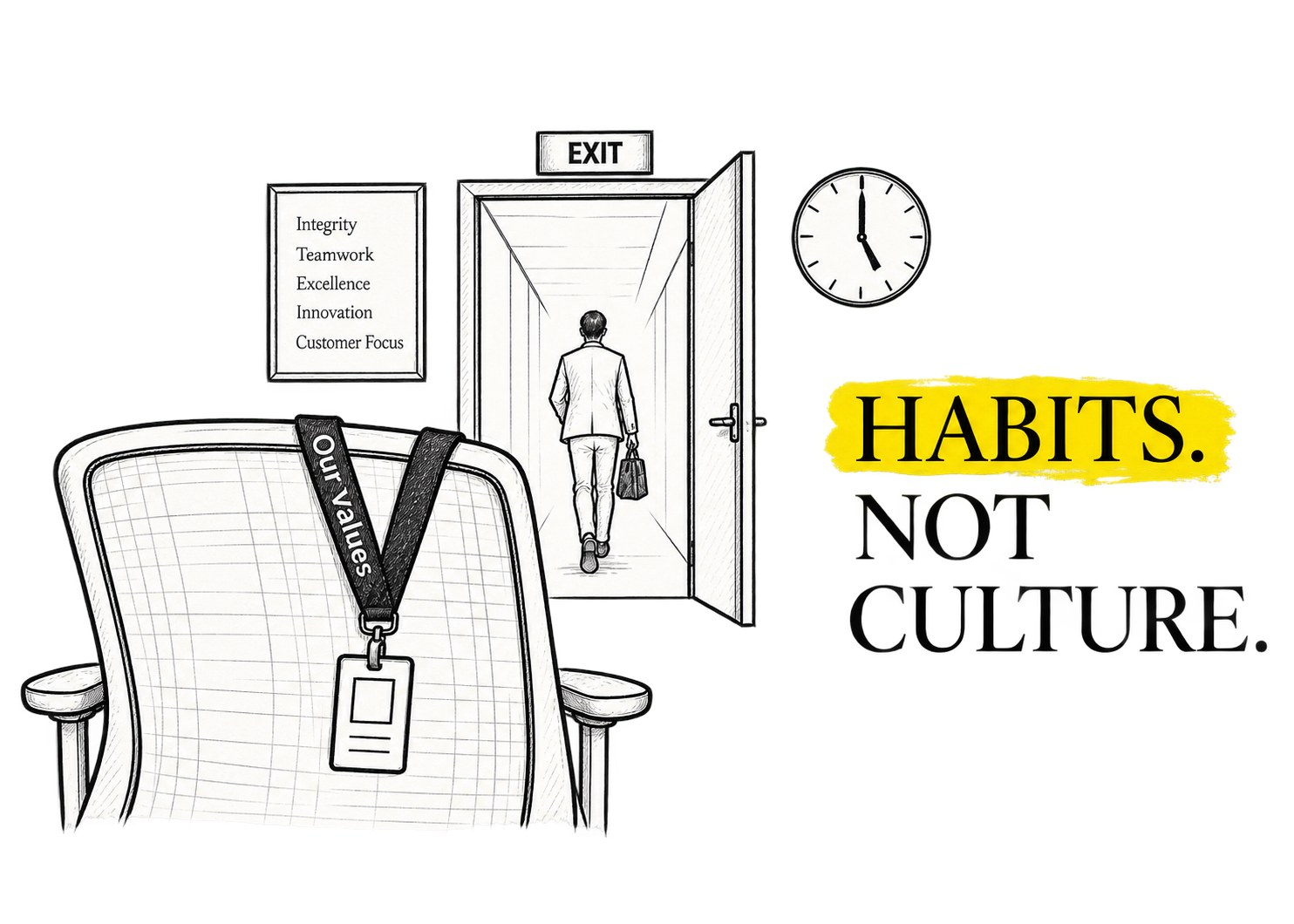
Companies do not have a culture. They have a set of rules, written and unwritten, that people follow at work and set down when they leave, and the habits those rules produce. Calling that a culture is not a quibble about words. A word is a quibble when swapping it changes nothing you would do. This swap changes what a leader tries to fix, whom she holds responsible, how long she waits, what the company sells, what hiring screens for, what gets measured, and what the company is entitled to ask of the people who work there. The word makes each of those choices before anyone notices a choice was made. This essay says what a culture is, what a workplace has instead, and what the difference decides.
This author does not make the claim lightly. Culture is among the most used words in management, thoughtful people have spent careers on it, and a great deal of money rides on it. There is a business built on the word: consultancies with culture practices, vendors that sell engagement surveys, programs that certify a company as a great place to work and sell the badge, and a circuit of books and speakers. An undefined goal lets a provider keep selling effort without an agreed finish, and an industry whose product is the repair of something that cannot be found has a reason to keep that something undefined. That is not a charge of bad faith. It is a description of an incentive, and incentives are what this essay is about.
What A Culture Is
This essay uses culture to mean behavior rooted in enduring shared values and beliefs. That is the core anthropologists have placed at the center of the word for a century and a half,[1] and holding the word to that core is this essay’s choice. The values and beliefs are the point. They sit in a rough order, so that when two of them conflict a person knows, without being told, which one wins. They are acquired early, at home, at school, in the street, in every part of life at once, and they are handed down to the next generation. They are carried inside the person. They outlast their causes: people keep eating what their great-grandparents ate because the land was poor, long after the land stopped mattering. And they have gravity. They pull on everyone inside them whether they like it or not, and no committee can remake them by decree.
Those are deep things, and they are what people bring to work. An adult arrives at a company already formed. Her sense of what is right and what is shameful, what is owed to family and what is owed to strangers, how close to stand and how loud to speak, was settled long before the job offer. The company did not make it and cannot unmake it by decree.
What A Workplace Has
What the workplace adds is a set of expectations about behavior. Some are written: the approval chain, the expense policy, the dress code. Others are not: who speaks first in a meeting, how long to wait before escalating, what happens to the person who brings bad news, whether the meeting starts on time. These are boundaries, not beliefs. People fit themselves inside them the way a traveler fits a second language, and the fit has a name: code-switching.[2] The term began in the study of language, and it has a heavier use, for people who move between a majority’s setting and their own, and that switching carries costs this essay does not make light of.[3] The plain sense is enough here. Everyone switches some. A person talks and acts one way at work and another way at home, and the switch can be deliberate, because the point of it is to fit in and keep the job.
The switch is also reversible, and compliance alone does not establish shared belief. Much of the work behavior comes off at the end of the day, and it is set down for good at the next job, where a different set of rules is waiting and the person learns them in weeks. Something travels: a way of writing, a habit of preparation, a standard she keeps. The values travel whole. The rules do not, and the behavior changes with them. However much time people spend at work, and however much the work matters to them, a rule followed to fit in does not weigh on a person the way a belief does. One says what to do between nine and five. The other says who she is.
Two economists described the practices in 1982 and called them routines: the firm’s habits, held partly in the skills and memories of its people and partly in the arrangements around them, carried out by people who often do not know why, and persisting past the reason they began.[4]
What The Industry Teaches
The word entered management late. Anthropologists had used it for a century when a 1979 journal article proposed studying organizations the same way,[5] and within three years it was everywhere, carried by a wave of books trying to explain why Japanese firms were winning and what the best American ones had in common.[6] The definition that stuck in practice is the one every manager has heard: the way we do things around here. It was used by a consultant in 1966 and became the working definition in a 1982 book.[7] Read it again. It is a definition of habits.
The definition that stuck in the classroom is more careful. The field’s most cited text defines organizational culture as a pattern of shared basic assumptions that a group learned as it solved its problems of surviving in its market and holding together inside, assumptions that worked well enough to be taught to newcomers as the correct way to perceive, think, and feel about those problems.[8] This author was trained on it and has used it. Notice the scope. The assumptions are about the group’s problems, the work problems, and they are judged by whether they worked. That is a description of how a group learned to get its work done, which is to say a description of a rule set, taught to newcomers as the way things are done here. It is a good theory of a byculture. The same text sorts the thing into three levels: the artifacts you can see, the values the company says it holds, and the assumptions underneath, which are taken for granted and rarely spoken. By the model’s account, visible conduct and stated values do not reveal all the underlying assumptions. The assumptions have to be inferred, and inferring them is a service that can be sold. That is where the industry lives.
The tools follow the texts. A widely taught instrument sorts organizations into four types, clan, adhocracy, market, and hierarchy, by asking members how the place is run: how tightly it is controlled, whether it looks inward or out, what gets rewarded.[9] Those are questions about arrangements. The engagement surveys the vendors sell ask how people experience those arrangements. Whatever the instruments ask, what they return is a profile of how the place is run and how people take it, and nothing in the toolkit changes what a person believes is right. In a 1990 study of twenty organizational units, measured the way national culture is measured, the differences were larger in perceived practices than in values.[10] The word was borrowed because the mechanism rhymed, something learned, shared, and passed on to newcomers, and it was kept because it sold. What it names is real. It is just not a culture.
Why Not Call It A Small Culture
The usual way to keep the word is to shrink it. Call it a mini-culture, a micro-culture, a company culture with the understanding that it is a small one. A size prefix keeps the noun. It says the workplace has a culture, only a smaller one, and the noun is what is wrong. The prefix does not survive the careers page either. Nobody recruits for a mini-culture. The small word is dropped, and the big one is sold, with three things it has not earned. Its depth: culture says the values are shared, when what is shared at work is compliance with a rule set, and the values underneath are as varied as the people who hold them. Its clock: a culture moves over generations, and the word carries that patience with it, when rules move in a quarter. And its promise: culture implies belonging, when the arrangement is a contractual relationship, not a guarantee of permanent belonging. A company that calls itself a family and then announces layoffs finds out the same morning how much of the family was held by the payroll.
A Better Description
This essay calls what a company has a byculture, and the prefix does the opposite of the one in mini-culture. Mini and micro say a smaller instance. By says beside, and not. A bystander is not a small stander; he is near the event and not in it. A byproduct is not a small product; it is made alongside the main thing and is not the main thing. A byculture is both: a set of shared habits that sits beside culture, close enough to be mistaken for it, and produced as a byproduct of systems, incentives, and the example set by whoever is in charge. It is a better description than a small culture, because it says what the diminutive hides: this is next to culture, and it is not culture.
A byculture is uneven, because each division’s systems and bosses produce their own. This author has written before about how the divisions of a company dig separate trenches and drift apart, and each trench has its own habits.[11] It is also where this essay meets his earlier work on drift.[12] Drift and byculture are the same pattern seen from two sides: a pattern held mostly by structure, a rule, a budget line, a reporting line, an incentive, which is why changing the holder changes the behavior, sometimes quickly. A culture is held mostly by identity, and it survives a change of setting because most of what holds it is inside the person.
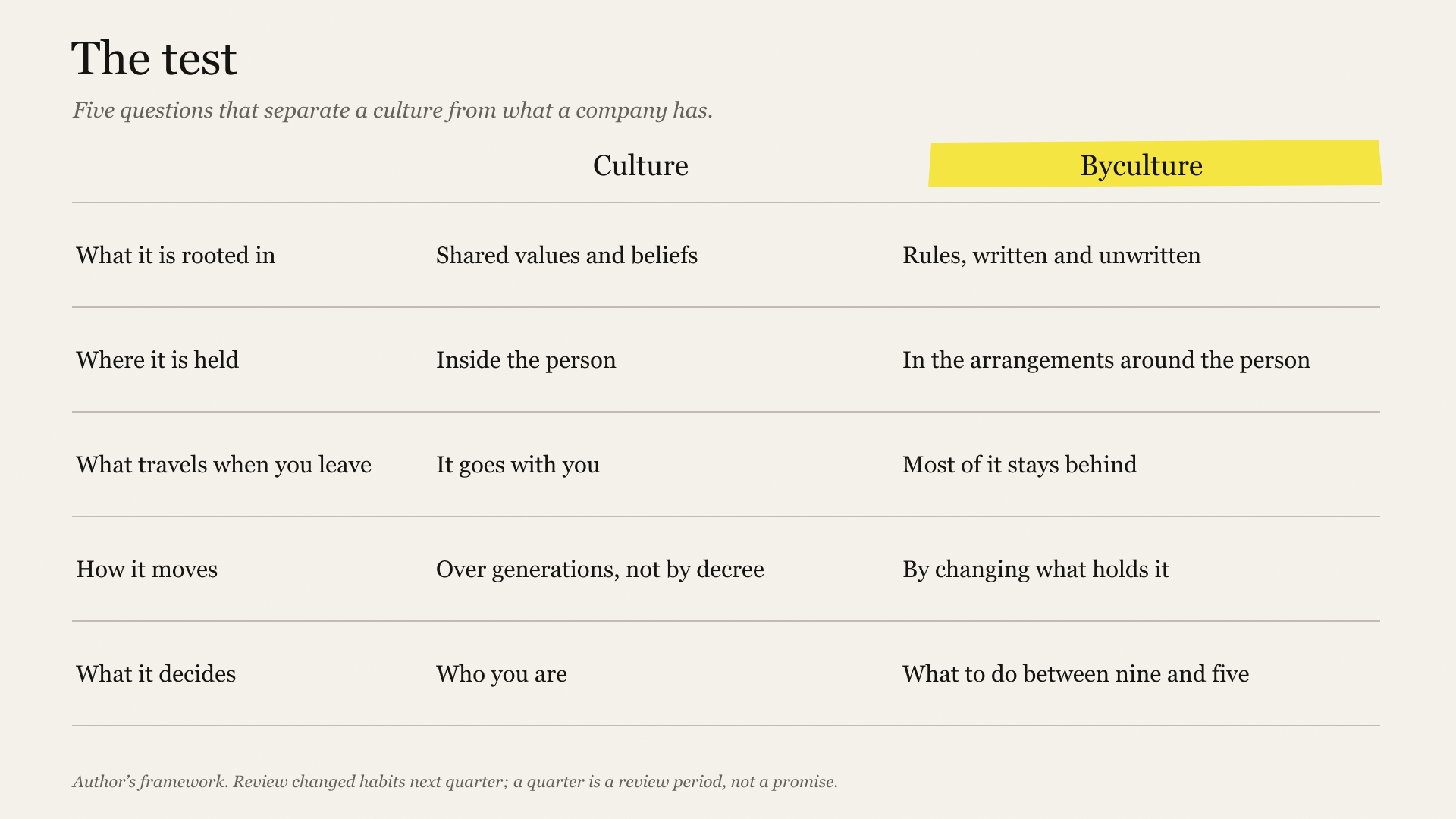
Author’s framework; the term culture uses the definition in this essay.
What The Word Decides
The word is not harmless. It hides problems, because a problem filed under culture has no owner and no fix date. It overclaims, because it promises a kind of belonging and a depth of shared conviction that an employer cannot deliver by decree and did not buy. It misdirects the repair, because it points at values when the thing that produced the behavior was a rule. And it is amorphous. It is hard to say what a company’s culture is in a sentence that another person could check, and easy to say what its habits are. A term nobody can pin down can never be shown to be wrong and never be shown to be fixed, and that is what keeps it in use. It feels important. Dropping it feels like dropping something that matters. So it carries on, and carries the wrong decisions with it. Seven of them, in practice.
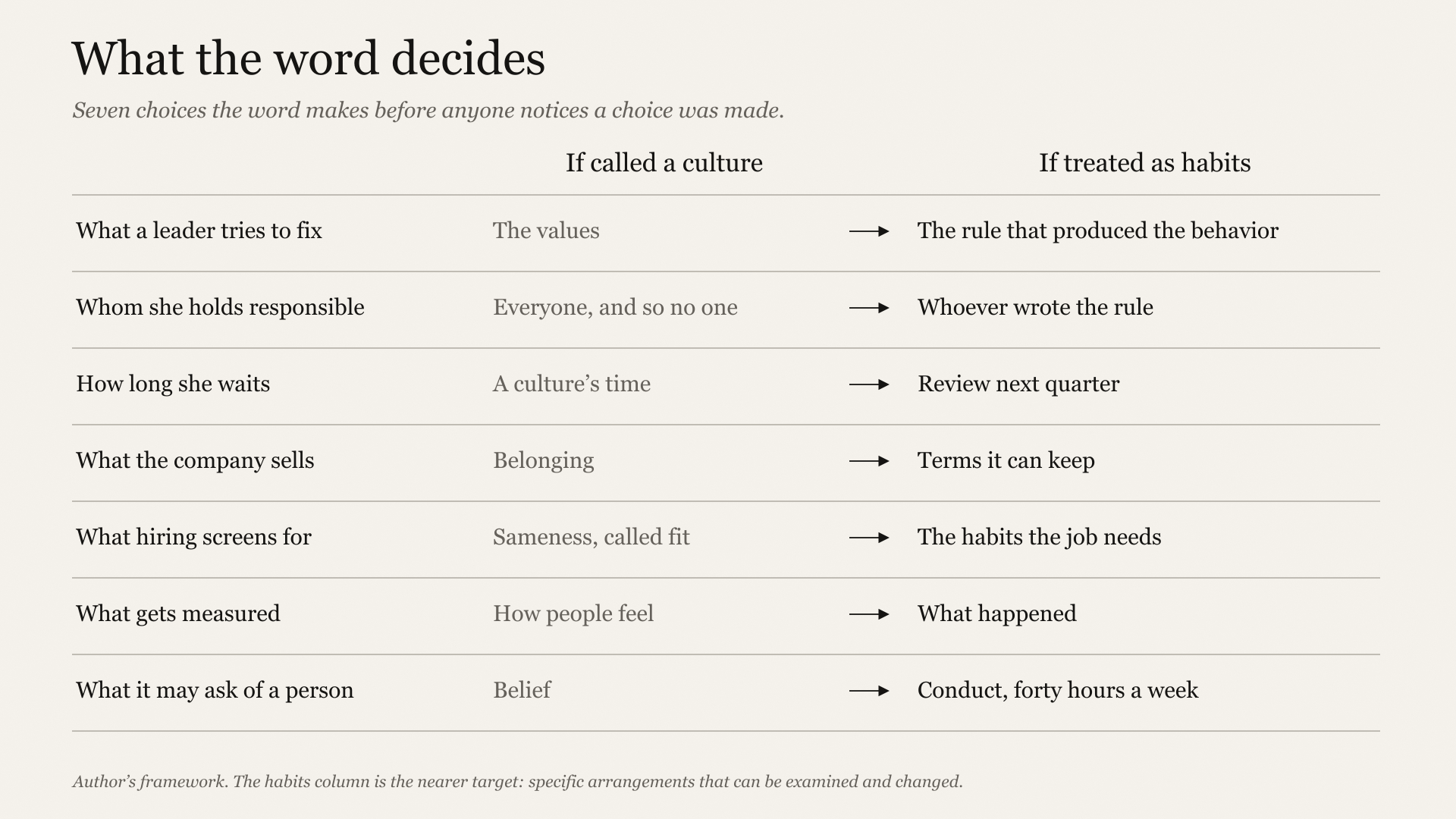
Author’s framework. A quarter is a review period, not a promise.
What a leader tries to fix. If the problem is culture, the object of repair is values, and values do not move by decree. In a survey of more than 1,300 North American executives, nine in ten said improving their culture would raise the value of their firm, and more than eight in ten of respondents said their own culture needed improving.[13] That is a wide gap between the value executives see in culture and the state they want it to reach. The usual explanation is that culture is hard to change. This essay’s objection is to treating culture as the object of repair at all. A program that puts values on the wall and runs workshops while leaving the arrangements that hold behavior untouched has left the practical work undone, and the habits go on as before. A leader’s edict rarely changes behavior because it does not change the incentives underneath it; this author has made that argument elsewhere.[12] The same is true of posters.
Whom she holds responsible. Culture is an alibi when it ends the explanation, because a culture belongs to everyone and so to no one. When Wells Fargo was caught opening accounts its customers had never asked for, the board’s report blamed the bank’s sales culture, and then kept going. It named the executives it held responsible, the sales goals, the pressure to meet them, and the firing of people who did not, and the bank eliminated the product sales goals.[14] The second half is the part that matters. A sales goal is a number in a plan. Someone set it, and someone deleted it. An explanation that stops at culture never gets there.
How long she waits. A leader who thinks he is managing a culture gives it a culture’s time, and waits a year for what a changed rule could have shown him by the next quarter.
What the company sells. A stated culture is a product, sold to recruits, to investors, and to the company itself, which likes the story. The slogan that culture eats strategy for breakfast is on a thousand slide decks because it flatters: it says that what we are matters more than what we do. The evidence for the product is thin. A 2015 study compared the values that large American companies advertised on their websites with how those companies performed. The advertised values had no detectable relationship with profitability or market value, though firms that advertised integrity did score higher on customer satisfaction. What went with better performance was something employees reported about their own managers: that top management was ethical and kept its word.[15] This author reads that as a habit, managers keeping promises, rather than a culture, and what keeps managers keeping promises is a question the study does not answer. The likeliest answer is what the company does to managers who break them.
What hiring screens for. An employer can fairly ask whether a candidate will work the way the job requires. That is a question about habits, and it can be written down. Culture fit rarely is, and a criterion nobody has defined lets resemblance stand in for competence. A study of hiring at elite law, banking, and consulting firms found interviewers favoring candidates who shared their own backgrounds and pastimes, and calling it fit.[16] In plain terms, fit often means how little a candidate would have to switch, and this author has written about what that does to who gets hired and who gets missed.[17]
What gets measured. If the thing is a culture, the natural question is how people feel about it. If the thing is a set of habits, the natural question is what happened. The difference is in the questions, not the instrument. Did the meeting start on time. How many days did the decision wait. Who spoke. Did the manager do what she said she would. Ask about specific conduct, check it against observation wherever possible, and treat reports of fear or distrust as a sign of where to look. Conduct can be asked about again next quarter and compared.
What the company may ask of a person. This is the one that goes past management. A rule you break is a compliance problem. A value you do not share is a character flaw. The word culture turns the first into the second. That is how not a culture fit became an acceptable way to say not like us, and how a company comes to expect belief where it has only earned compliance. The contract bought forty hours of conduct. It did not buy the person’s values, and a company that calls its rule set a culture is claiming what it did not pay for.
The Exceptions
Some organizations do reach values and beliefs in adults. The Marine Corps, the Jesuits, a few firms, usually old ones, whose alumni are recognizable decades later. They do it the same way: hard selection at the door, a long and deliberate period of being remade, rituals, a private language. They do not ask people to switch codes. They change the code. The Marine Corps says a Marine is a Marine for life, whatever the length of service,[18] and that is the point: it is the depth of the immersion, not the years on the payroll, that does the forming. It is expensive and slow, and one close study of a technology company that set out to build a culture on purpose found the people inside paying for it, in long hours and in the distance between the self they showed at work and the one they kept.[19] Most companies will not pay that price, and most should not. What they should stop doing is claiming the result without paying for it.
A rule you break is a compliance problem. A value you do not share is a character flaw. The word culture turns the first into the second.
What You Get For Letting Go
Give up the word, and in exchange you get something nearer to hand. Renaming changes nothing by itself. The gain comes from what the better description makes you do next.
You can point at a habit. Ask a manager in any division to list the ten habits that actually run his floor: how work gets assigned, how a disagreement gets settled, what happens to the person who brings bad news, who has to be in the room before anything moves. Then ask three people who work for him to write the same list without seeing his, and compare. The lists will say more than the values page does, and where they disagree is the first place to look.
You can find what holds it. For most habits it is some mix of four things: an incentive, a rule, a reporting line, or the example set by the boss, and more than one may be holding the same habit. Change one, write down what better would look like, and look again next quarter. If the habit has moved, ask whether the change explains it. If it has not, check the other holders, check whether the change was actually made, and check the diagnosis. A quarter is a review period, not a promise. A working habit gives a manager a nearer target: specific arrangements whose effects can be examined and changed. And because the byculture is uneven, one division’s habits can be worked on without waiting for the whole company to agree.
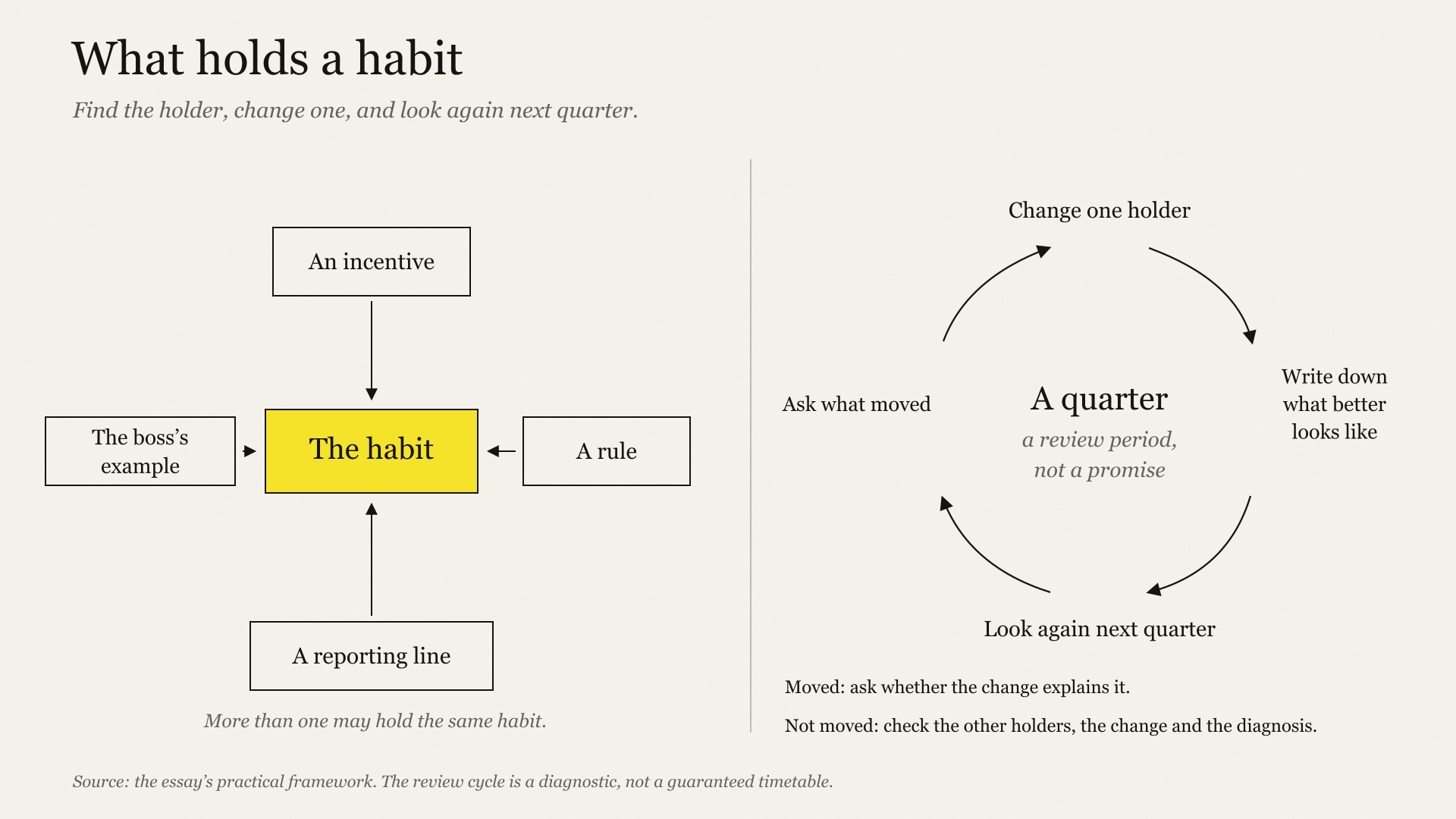
Author’s practical framework; more than one holder may sustain the same habit.
That is the reason to let the word go. Not because a culture is a bad thing to want, but because wanting one has kept leaders staring at something they cannot reach while the thing they can reach sits in front of them, plainly visible and quietly running the place.
What To Do
Stop selling the culture. Take the word off the careers page and out of the investor deck, and describe the habits instead. Recruits would rather know those anyway.
Write the list. Ten habits per division, from the people who live them, not from the leadership team.
Name what holds each one. If nobody can say what holds a habit, that is the first thing to find out.
Measure the habits. Ask about specific conduct, check it against what can be observed, and use reports of distrust to decide where to look.
When a habit stops serving the work, change what holds it, decide what better looks like, and check next quarter.
And accept the ceiling. A company can be a good place to work. It can have good habits, kept honestly. It does not need a culture to be that, and claiming one promises more than good habits establish.
References
[1] Kroeber, A. L., and Clyde Kluckhohn. Culture: A Critical Review of Concepts and Definitions. Papers of the Peabody Museum of American Archaeology and Ethnology 47, no. 1. Cambridge, MA: Harvard University, 1952. Their synthesis of 164 definitions: culture consists of patterns of and for behavior, acquired and transmitted, whose essential core is traditional ideas and especially their attached values. See also Tylor, Edward B. Primitive Culture. London: John Murray, 1871, chapter 1. Source
[2] Blom, Jan-Petter, and John J. Gumperz. “Social Meaning in Linguistic Structure: Code-Switching in Norway.” In Directions in Sociolinguistics, edited by John J. Gumperz and Dell Hymes, 407 to 434. New York: Holt, Rinehart and Winston, 1972. The term’s origin in sociolinguistics; the essay uses it in its extended sense of adjusting behavior to a setting. Source
[3] McCluney, Courtney L., Kathrina Robotham, Serenity Lee, Richard Smith, and Myles Durkee. “The Costs of Code-Switching.” Harvard Business Review, November 15, 2019. On the heavier use of the term and its costs for Black employees in majority-white workplaces. Source
[4] Nelson, Richard R., and Sidney G. Winter. An Evolutionary Theory of Economic Change. Cambridge, MA: Belknap Press of Harvard University Press, 1982. Chapter 5, especially pages 104 to 106, on routines as organizational memory held in the skills and memories of members and in the organization’s arrangements. Source
[5] Pettigrew, Andrew M. “On Studying Organizational Cultures.” Administrative Science Quarterly 24, no. 4 (1979): 570 to 581. Source
[6] Ouchi, William G. Theory Z: How American Business Can Meet the Japanese Challenge. Reading, MA: Addison-Wesley, 1981; Peters, Thomas J., and Robert H. Waterman Jr. In Search of Excellence: Lessons from America’s Best-Run Companies. New York: Harper and Row, 1982; Deal, Terrence E., and Allan A. Kennedy. Corporate Cultures: The Rites and Rituals of Corporate Life. Reading, MA: Addison-Wesley, 1982. Source
[7] Bower, Marvin. The Will to Manage: Corporate Success through Programmed Management. New York: McGraw-Hill, 1966, where the phrase “the way we do things around here” appears; adopted as the working definition in Deal and Kennedy, Corporate Cultures (1982), above. Source
[8] Schein, Edgar H. Organizational Culture and Leadership. San Francisco: Jossey-Bass, 1985; 4th ed., 2010. The definition paraphrased in the text is the fourth edition’s (page 18: a pattern of shared basic assumptions learned by a group as it solved its problems of external adaptation and internal integration, which has worked well enough to be considered valid and therefore to be taught to new members as the correct way to perceive, think, and feel in relation to those problems); the three levels, artifacts, espoused beliefs and values, and basic underlying assumptions, are chapter 2. Source
[9] Cameron, Kim S., and Robert E. Quinn. Diagnosing and Changing Organizational Culture: Based on the Competing Values Framework. 3rd ed. San Francisco: Jossey-Bass, 2011. The Organizational Culture Assessment Instrument and its four types: clan, adhocracy, market, and hierarchy. Source
[10] Hofstede, Geert, Bram Neuijen, Denise Daval Ohayv, and Geert Sanders. “Measuring Organizational Cultures: A Qualitative and Quantitative Study across Twenty Cases.” Administrative Science Quarterly 35, no. 2 (1990): 286 to 316. Twenty units of ten organizations in Denmark and the Netherlands; between-unit differences were significant on all items and larger on perceived practices than on values. Source
[11] “Trenches, Not Silos: The Bill for Dividing a Company.” Monderman, September 2026. https://www.monderman.com/trenches-not-silos.html
[12] “Hold, Collide, Come Apart: The Three Forms the Trenches Take.” Monderman, October 2026. https://www.monderman.com/hold-collide-come-apart.html; Governance, Bureaucracy and Organization: Stewardship, Drift, and Administrative Capacity. Routledge, 2027. https://www.routledge.com/Governance-Bureaucracy-and-Organization-Stewardship-Drift-and-Administrative-Capacity/Adamson/p/book/9781041403296. On drift and on why edicts rarely change the incentives beneath behavior.
[13] Graham, John R., Jillian Grennan, Campbell R. Harvey, and Shivaram Rajgopal. “Corporate Culture: Evidence from the Field.” Journal of Financial Economics 146, no. 2 (2022): 552 to 593. Survey of 1,348 North American executives: 92 percent said improving culture would increase firm value; 84 percent of respondents said their firm’s culture needed improving. Source
[14] Independent Directors of the Board of Wells Fargo & Company. Sales Practices Investigation Report. April 10, 2017. On the Community Bank’s sales goals, the pressure to meet them, the termination of employees who did not, the executives held responsible, and the elimination of product sales goals. https://www.sec.gov/Archives/edgar/data/72971/000119312517118654/d375947ddefa14a.htm
[15] Guiso, Luigi, Paola Sapienza, and Luigi Zingales. “The Value of Corporate Culture.” Journal of Financial Economics 117, no. 1 (2015): 60 to 76. Advertised values showed no detectable relationship with profitability or market value, with the exception that firms advertising integrity scored higher on customer satisfaction; employees’ perception that top management is ethical and keeps its word (from Great Place to Work survey data) was associated with better performance. Source
[16] Rivera, Lauren A. “Hiring as Cultural Matching: The Case of Elite Professional Service Firms.” American Sociological Review 77, no. 6 (2012): 999 to 1022. Source
[17] Elijah, John. “The Hiring Blind Spot” (October 2026). On Borrowed Times. https://obtimes.com/essays/the-hiring-blind-spot/
[18] United States Marine Corps. “Once a Marine, Always a Marine.” marines.com. “Being a Marine doesn’t end when the uniform comes off.” https://www.marines.com/life-as-a-marine/life-in-the-marine-corps/once-a-marine-always-a-marine.html
[19] Kunda, Gideon. Engineering Culture: Control and Commitment in a High-Tech Corporation. Philadelphia: Temple University Press, 1992. A study of one company; cited only for what its engineering of culture cost the people inside. Source